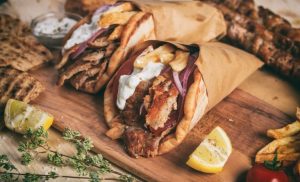
It’s what burgers are to America, tacos to Mexico, bao buns to China, and falafel in the Middle East—for Greece, it’s the humble but tasty souvlaki.
For hundreds of millions of people from around the world who have visited the east Mediterranean country over the past decades, one thing that is almost sure to come to mind when they recall their “food experiences” is the souvlaki. This “meat on the stick” is packed into a type of pita bread along with other ingredients—usually tomatoes, onions, the tangy yoghurt-and-garlic based tzatziki sauce, and sometimes fries.
According to Dorothea Lentis, a biologist and clinical health researcher who lectures in Athens, souvlaki and its derivative, the more internationally known gyro, is the most common and beloved street food in the country.
“We love souvlaki. Practically everyone in Greece has tasted souvlaki. Basically, it is pieces of marinated meat cooked on a skewer. The number one meat used for souvlaki is pork. This is the traditional choice. However, we have chicken, lamb and beef options as well, with pork and chicken still the most common. Souvlaki is usually served hot straight off the skewer, wrapped in a warm pita bread with salad and sauces, and often with tzatziki.”
Tzatziki, a ‘superfood’ in a sauce
“Tzatziki is our very own superfood, and we are very proud of it,” Lentis adds. Something of a tongue-twister, this prime condiment found in souvlaki is a strained Greek-style yoghurt mixed with cucumber, garlic and a touch of olive oil.
Asked about the difference between a souvlaki and a gyro, given that they look practically the same, Lentis noted that “the two look very similar, but at the same time they are very different.
“Souvlaki contains marinated pieces of pork, chicken, beef or lamb, and these are grilled on a skewer. At the other end of the spectrum, gyros are made from layers of sliced meat. This can be pork or it can be chicken, and it is cooked on a vertical rotisserie, so it’s a bit different. Typically, a gyro is also served in a warm pita, along of course, with tomato, red onions, French fries and tzatziki sauce.”
Another close “relative”, for the “uninitiated at least”, is the hugely popular döner, which originated in the Ottoman empire and is now the pre-eminent Turkish street food. It was actually in Germany that it evolved into the doner kebab.
“This is a dish of Turkish origin, and here we’re also talking about minced meat, pressed together again in a vertical rotisserie and cooked. So, while gyros contain small slices of meat, döner contains minced meat. They use different types of meat, too. We should mention that doner kebab originated in the 1970s in West Berlin, where it was brought by Turkish immigrants.”
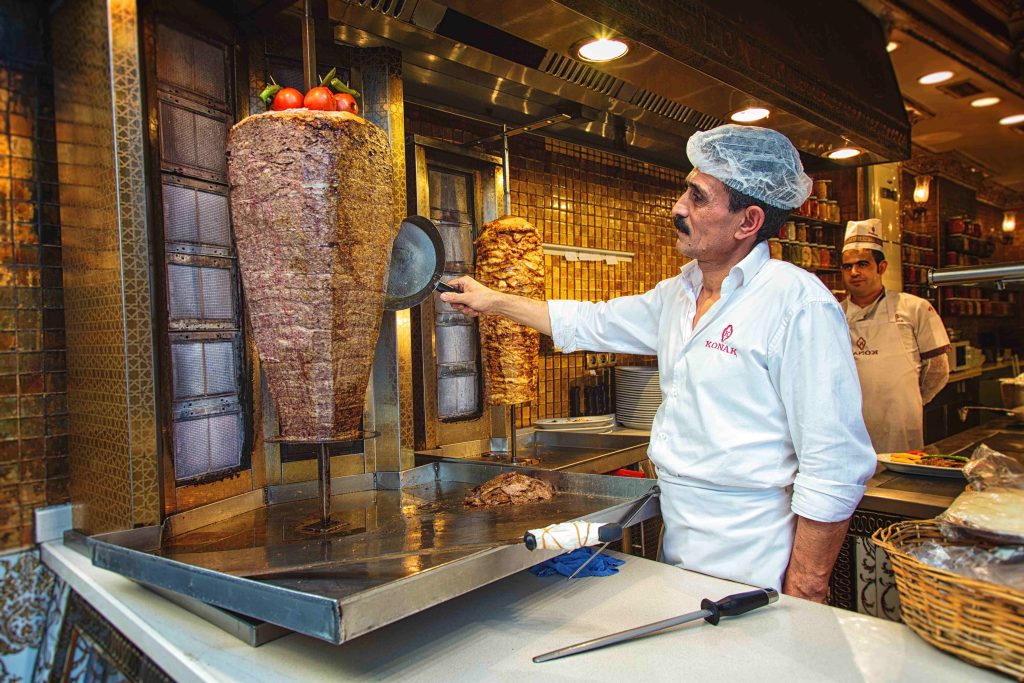
Although they look similar, doner and gyros are very different. Doner kebab originated in Turkey and is minced meat shaped into a vertical inverted cone and served in a Turkish flatbread.
In comparing these familiar Greek and Turkish street foods based on skewered meats, sliced, whole or minced, Lentis clarifies:
“So, in practice, gyros and doner, although they look similar, are very different. One difference has to do with the origin, as we said. Doner kebab originated in Turkey and is minced meat shaped into a vertical inverted cone and served in a Turkish flatbread. The Greek version, which is the gyro, is made of thin slices of meat, again shaped into a vertical inverted cone, cooked next to a heat source, and served in pita bread.”
In the Grecian version then, gyros consist of sliced meats, while souvlaki is small square pieces of meat roasted while skewered.
The differences between souvlaki and gyros, on the one hand, and their distant “cousin” the doner, on the other, also extend to their taste and ingredients, as she notes.
“The doner contains special seasoning mixes that are of Turkish origin, so you sense a lot of cumin, garlic powder, coriander, smoked paprika and pepper. Whereas in our gyros, we use a Mediterranean mix of spices: oregano and rosemary. In both cases, we can have strained yogurt or a yogurt sauce. In the Turkish doner, it is a yogurt and garlic sauce, while in our gyros, we use tzatziki, our superfood.”
Not as inexpensive as in previous eras
Beyond the scrumptious ingredients that make souvlaki as filling as it is delicious, one unfortunate development for food lovers is the rising cost of Greece’s premier street food. The uptick in inflation worldwide in the post-Covid period hasn’t bypassed Greece. In fact, the country has been hit with cost-of-living hikes above the EU average, with meat prices amongst the most affected. The result has seen the price of the humble souvlaki nearing a modest entrée level in some locations around the country, and to “sit down” dinner rates on a handful of highly popular islands.
According to a report in the Athens newspaper “To Vima” last August, the price of a single souvlaki has climbed from 2.50 euros on Crete “back in the day”, to as much as 6.50 euros today in some parts of Heraklion, the biggest city on the island.
In the greater Athens-Piraeus agglomeration on the mainland, where roughly half of the country’s five million residents live, a souvlaki now costs anywhere from 3.70 euros to 5.20 euros. As such, if a four-member family decides to order two souvlaki apiece, the bill can range from 30 to 40 euros—excluding side orders and beverages.
On iconic and “Instagram-friendly” Santorini Island, reports over the summer had a sole souvlaki costing between two and five euros at a food stall, but soaring to up to seven euros for the same wrap at a sit-down dining establishment.
This past summer, a tiny but very busy take-out souvlaki shop on the “boutique” Cyclades isle of Upper Koufonisi sold its basic but filling fare for 4.50 euros.
Street food ‘royalty’ in NYC
While definitely lacking the name recognition enjoyed by the doner kebab in much of Europe, or the more established gyro in North America, souvlaki is making inroads abroad as the Greek street food par excellence.
In the greater New York City area, for instance, one family-owned multiple food truck business is proudly known as “King Souvlaki”.
According to co-founder Giorgos Tsabas, this type of Greek street food is very popular in the Big Apple.
“Since it started in the 1960s, everybody, especially on the East Coast of the United States, has tried and tasted souvlaki,” he says.
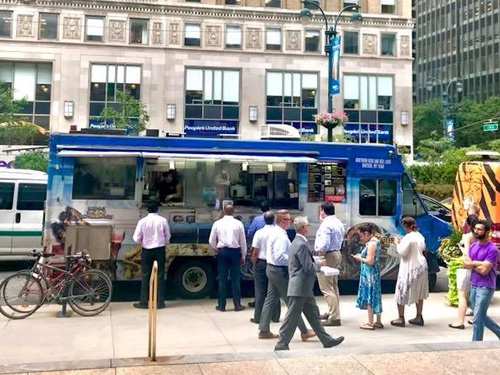
Credit: King souvlaki
Asked about the customers lining up in front of the “King Souvlaki” food trucks, Anthony Tsabas, Giorgos’ son, says the demographics are simple when it comes to who buys souvlaki.
“I’d say pretty much whoever’s hungry. As my father says, it’s already established. And New York is really crowded. So, it’s easy to make a name for yourself if your product has good quality. We have all ages. We have people who used to buy a souvlaki on their way home in high school, and now come back to the same locations with their daughters and sons… it’s always been known as a Greek street food.”
Asked about the price of a souvlaki in already “pricey” NYC, Giorgos Tsabas answers that it’s between 11 and 14 US dollars, before quickly adding, to soften any “shock” to native Greek ears:
“Don’t forget that salaries here aren’t the same as in Greece!”
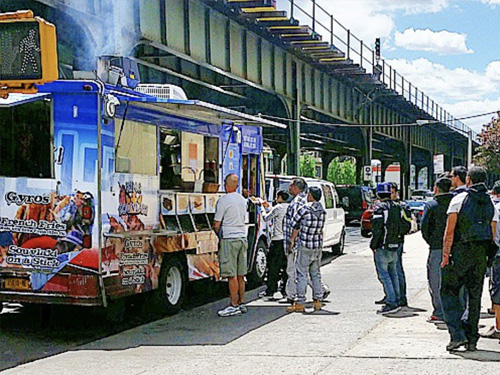
Credit: King souvlaki