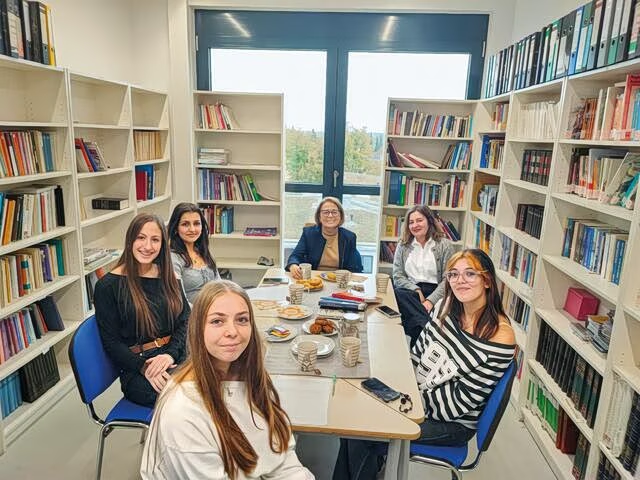
A life written with memories, migration, and quiet strength. Within just a few square meters of a house in Munich, Germany, among paintings created by her own hand, moments of an entire lifetime are preserved. Photographs from presentations, schools, and events, with faces that have grown and left their mark. These moments, as she says, are painted, safeguarded, precious. She welcomed us in the way only people shaped by memory know how: with mountain tea steaming on the table, with freshly baked pumpkin pie, with that silent care that needs no words. Her home was not merely a space; it was a refuge of stories.
Eleni Tsakmaki was born in Zagliveri, near Thessaloniki. While still a small child, she lost her father in 1942, and her mother, a widow with five children, took her and her siblings to Katerini. At just four and a half years old, she was given to foster parents—refugees from Smyrna—uneducated people who spoke only Turkish. Thus, she learned their language as well. They did not offer her formal education; they did, however, offer warmth and love. They loved her as best they could.
“Returning was always the conversation at home. The first generation of migrants did not come to settle; they came to leave.”
She was still a small child when they took her, holding a cloth doll. A doll that became the symbol of her entire childhood and the title of her first autobiographical book. Years later, another woman made her an identical one. She keeps it to this day, like her own child. Her teacher at school encouraged her to continue to secondary education, but her father’s decision was different. She had to learn a trade—to become a seamstress. At fifteen she was engaged, and at seventeen she was married to a relative of the family. Soon she had two children, in a Greece that was difficult, with little work and few prospects.
They did not know a single word of German
The great decision came almost out of necessity. Germany. Factories, machines, an unknown future. The Germans were only looking for workers, not children. And so they took on the first great burden of their lives: separation. One child stayed in Thessaloniki and the other in Ptolemaida, with two grandmothers whom the children hardly knew, since her foster mother had passed away. A silent pain—one that never fades. They departed from Thessaloniki by train, without knowing a single word of German.
“Germany seemed like paradise to us,” she says. “We would work, save money, and return. Returning was always the conversation at home. The first generation of migrants did not come to settle; they came to leave.”
In Munich, they experienced their first shock: wooden benches at the old station, interpreters, paperwork, unfamiliar voices. From there to Stuttgart, to a small factory filled with machines. The work was hard and endless. Often two jobs, just to save something, to send money back home, to build a house and return to their children. After a year and a half, she managed to return to Greece on leave. The journey through Yugoslavia was an ordeal—broken-down cars, dirt roads, sleeping by the roadside, fear. And when she arrived, her son did not recognize her. Her daughter cried, clung to her dress, and begged her not to leave. Yet she had to return to her job.
“Rightly, she has been called the ‘voice of migration,’ the voice of Greeks abroad—of hope, but also of longing for the homeland.”
After four and a half years, she brought her children to join her, shortly before the birth of their third child. Life continued, full of work and struggle, but also small bright moments. Amid shifts and years, her table always remained open—with tea, with pies, with stories told in low voices.
From factories to writing
At the age of fifty-four, she began to write—not out of ambition, but out of a need to express herself and heal her soul. A river of memories, experiences, traumas, and hopes overwhelmed her, flooded her, and had to be released. Everything she carried—war, poverty, separations, migration—demanded to be told.
Thus her books were born, autobiographical and testimonial in nature, centered around The Cloth Doll, The Decision That Was Never Made, and The Trees That Never Took Root. Through interviews, photographs, and documents, she recorded the life of the first generation of Greek migrants, as well as the stories of prisoners of war who lived in Germany.
She did not omit even the memories of her two mothers—both refugees who arrived in 1922, one from Pontus and the other from Smyrna—as a tribute, since one gave birth to her and the other raised her. Her work became historical material, memory recorded, with a devoted readership among Greeks of the diaspora and Germans alike. Many awards followed. She was rightly called the “voice of migration,” the voice of Greeks abroad—of hope, but also of nostalgia for the homeland.
Alongside writing, Eleni Tsakmaki found in theater another way to breathe. Her plays were written to be spoken—to come alive and dramatize the fate of a generation, with its comic and tragic moments. Her most prominent play, Comical-Tragic Scenes from the Life of Migrants, centers on the marriage between a Greek man and a German woman and the reactions of their parents. It is no coincidence that she herself experienced something similar, as her son married a German woman, whom Mrs. Eleni embraced warmly as both a mother and a grandmother to the grandchildren who came—uniting two countries, two cultures, two hearts, and her two great loves: the country that gave her birth and the one that hosted her and offered her a better life.
“The temporary ones” who stayed forever
These five works were performed for years in Greek communities across various cities in Germany, in schools and cultural events of the diaspora—places where audiences did not seek spectacle but recognition. Her stories were their lives.
The play was also presented at the Rethymno Festival, where it received first prize—a recognition that came as both confirmation and vindication, not only for her but for all those who saw their lives illuminated through her texts. She herself does not speak of successes. She speaks of the people she met along the way, her invaluable experiences, and the pain of exile. From these she drew inspiration, and these she recorded. Where to begin remembering—the rehearsals that ended late, the laughter and tears behind the curtain, the feeling that, if only for a moment, Greece could fit onto a stage, with audiences who would not stop applauding.
“She reminds us that Greece is never lost. It simply changes place. And memory builds within us an indestructible homeland, one that lives in the lives of people like Eleni Tsakmaki.”
The theater, like her writing, was an act of memory and resistance. At the same time, her exhibition MIGRED – 60 Years and We Are Still Here has been presented several times in Germany and remained for months in the display cases of the Munich Museum. What drove her to create this exhibition, as she says, was her deep desire to pass on to future generations the experiences and struggles her generation endured along the long and difficult road of migration.
Eleni Tsakmaki became the voice of those who never wrote their own history—those who arrived as temporary and stayed forever; those who never truly took root, yet kept their homeland alive within them. And so, in a room filled with paintings, with the scent of mountain tea she brought from Greece still lingering, her story lives on—in photographs, in presentations, in signatures, in the children who left and those who returned. She reminds us that Greece is never lost; it simply changes place. And memory builds within us an indestructible homeland, one that lives in the lives of people like Eleni Tsakmaki. A life that must not be forgotten.