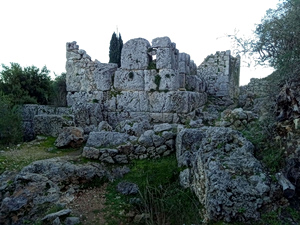
The journey to Thessaloniki seems to prepare, without one quite knowing it yet, the atmosphere for the encounter. When I arrive at the apartment where Vassilis Sperantzas has lived for the past several years, my eyes instinctively turn towards the balcony. From there, the Thermaic Gulf stretches all the way to the horizon.
I think it could have been a source of inspiration for the famous balconies with female figures that appear so frequently in his work—the “mothers of the birds,” as Lakis Papastathis so aptly called them.
Stepping through the door, I find paintings from different decades alongside bronze and plaster sculptures, painted wooden pieces, lithographs and works that seem still to be engaged in an ongoing dialogue with their creator. There is no strict chronological order, nor any sense of display. Anastasia, his gentle companion of many decades, welcomes me with a glass of cool ginger beer in her hands.
We talk about my journey, the heat of the city, the transport links between Athens and Thessaloniki, and the train, which, following the Tempi disaster, has awkwardly found its way back into our conversations.
As we talk, I notice that both of them possess that simplicity which makes a visitor feel that he is not intruding into the private space of a legendary painter, but entering an everyday life that has simply taken “a break” for some pleasant company and a meaningful encounter before continuing along its normal course.
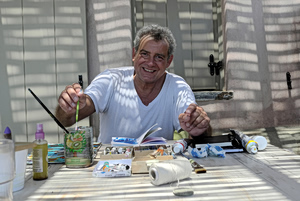
Even before the recording begins, he repeatedly rises from his armchair. He approaches a painting, points to a lithograph, recalls a story, returns to a sculpture. It is as if every work serves as the starting point for a memory he had not intended to share, but which emerges spontaneously the moment he looks at it. “Where do you paint now?” I ask him. “Here, on this little table,” he replies with disarming simplicity, pointing to a desk covered with the tools.
As he speaks, it quickly becomes clear that his recollections are not nostalgic in the conventional sense of the word. They return again and again to the people and places that shaped him: the Athens of his childhood, the small neighborhoods where he walked at dusk; Paris, where he arrived at the age of eighteen; the house in Kallithea which he shared with Alekos Fassianos and Nikos Stefanou. And to the years of the dictatorship, which kept him away from Greece for longer than he had ever imagined. “Painting was never a profession for me. It was the way I created my own world and lived inside it,” he tells me. Perhaps, in the end, this sentence offers the best key to understanding not only the work, but also the life of Vassilis Sperantzas, an artist who is both distinguished and deeply modest.
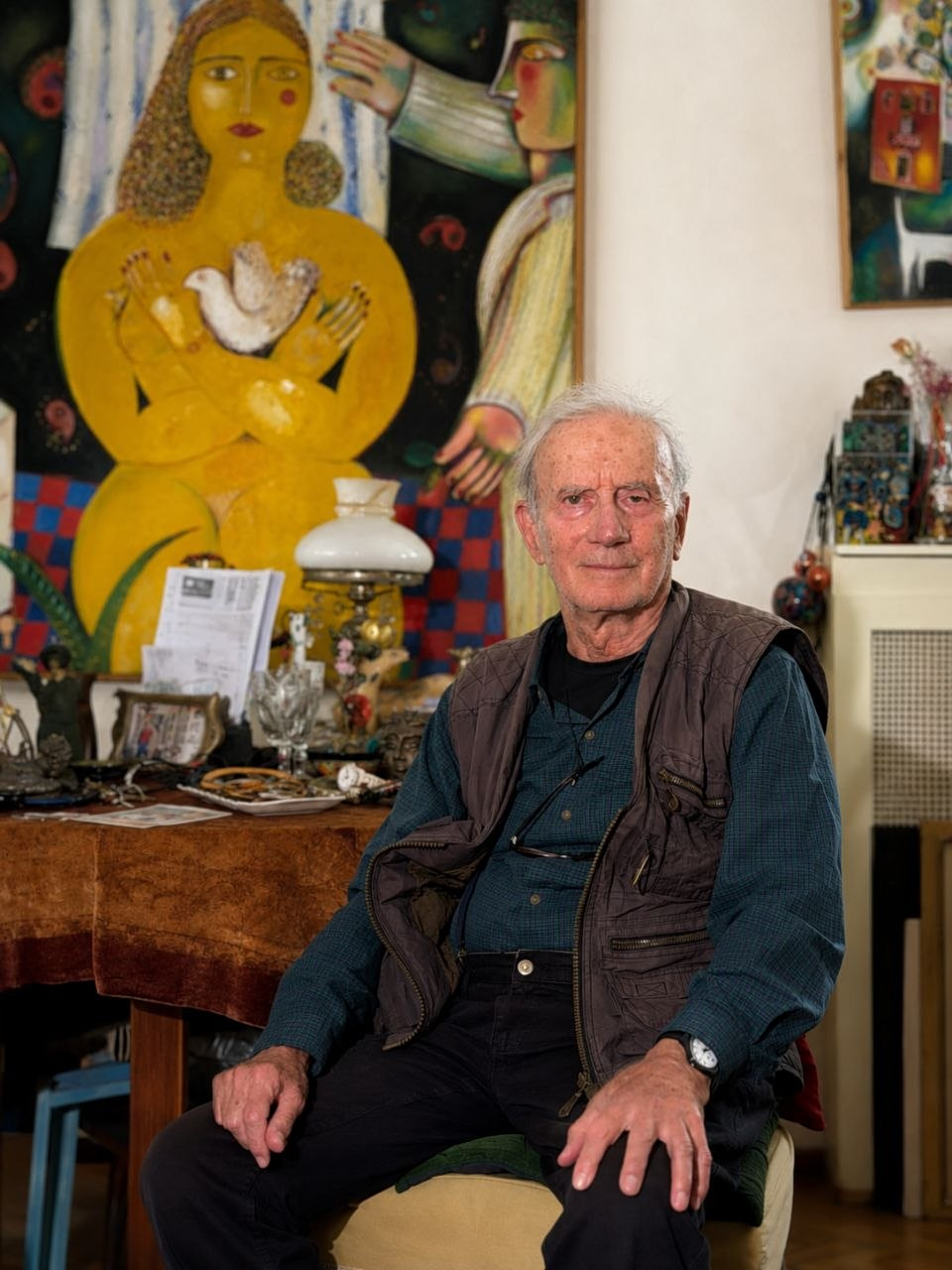
PHOTO BY PANOS KOUGIAS/TO BHMA INTL EDITION
You belong to a generation that came of age in the 1960s amid major political and social upheavals. How much did all that influence your painting?
The truth is that art served as an escape for me. I never felt the need to follow the political or artistic currents of the time, nor to change direction simply because the world around me was changing. The core of my painting has remained the same from the beginning.
I was influenced by painters I loved, but never by movements. I remember how, at the time, some people would tell me, critically: “The world is burning and you are painting women with fans.” Perhaps they were right from their own point of view. But for me, it was a necessity.
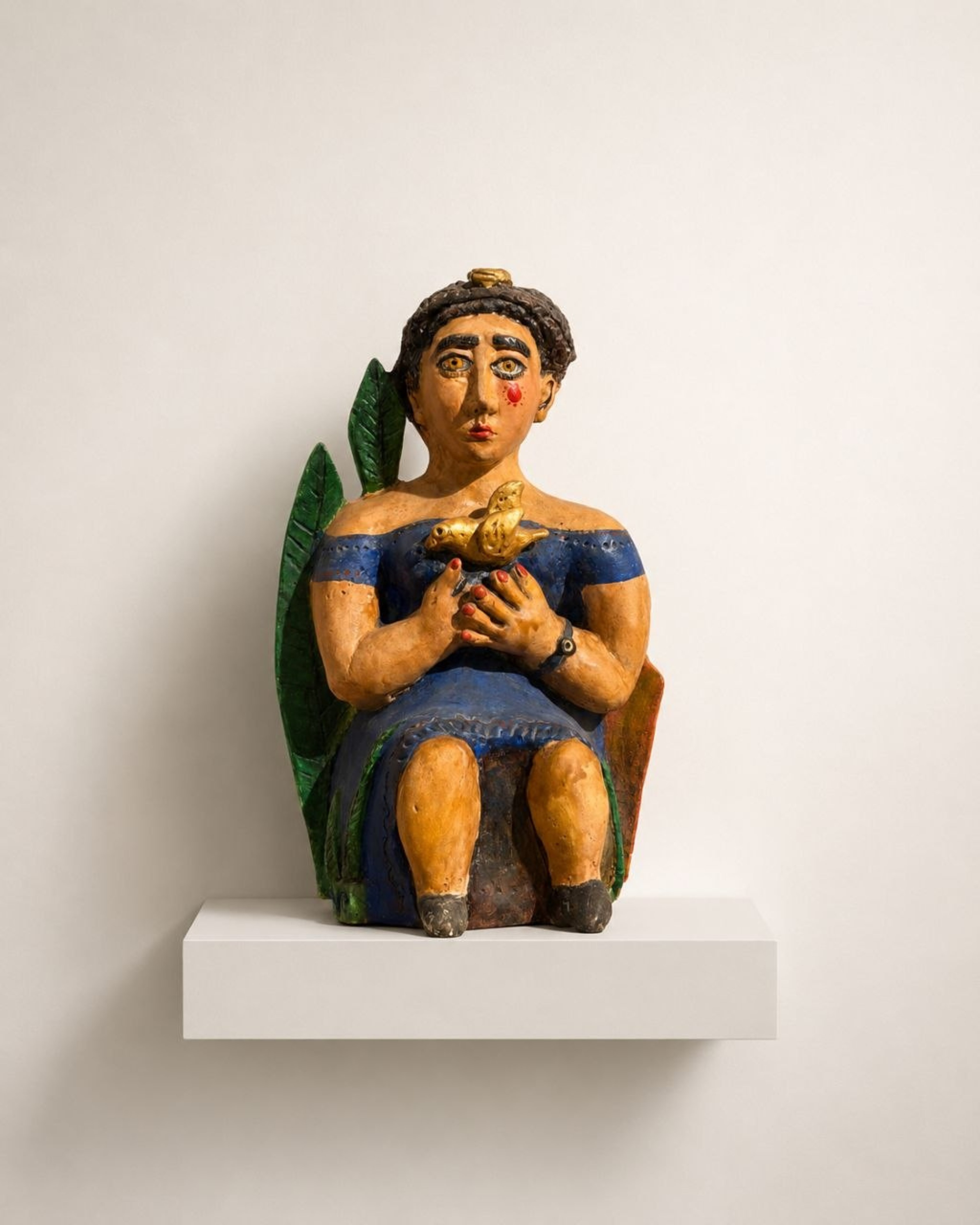
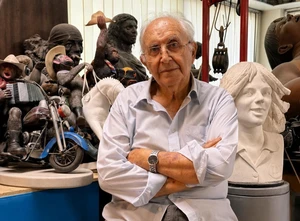
Painted plaster sculpture by Vassilis Sperantzas. PANOS KOUGIAS/TO BHMA INTL EDITION
Reality often hurt me, and painting was the way I endured it. I did not want to reproduce it; I wanted to create another world. Many times, shut away in the lithography and painting studios in Paris, surrounded by the various avant-garde movements of the time, I felt the need to keep my distance. Painting was never a profession for me. It was the way I created my own world and lived inside it.
In 1956, aged just eighteen, you leave for Paris. How do you remember the young man leaving Athens behind him?
As hugely enthusiastic, but with very little awareness of danger. I left without preparing almost anything beforehand. Most people asked me what exactly I was going there to do. I had only one goal: to get into the School of Fine Arts. Fortunately, I succeeded on my first attempt. From then on, my life was almost entirely devoted to my studies. I worked constantly. I went to exhibitions, spent hours in museums and met painters. Paris was an enormous revelation. Of course, it was not an easy city. During my first few years there, I lived in fairly difficult conditions. My first place was essentially an old bathroom that had been converted into a bedroom. Five square meters, with no window. Later, I found one of the well-known chambres de bonne, on the sixth floor of a Parisian apartment building. Small, with the toilet in the corridor. But none of that bothered me. I had gone there to learn how to paint.
What was it that moved you most deeply in Paris?
The opportunity to see up close, every day, things that until then I had known only from books. Picasso, Matisse and Chagall were the great names of the century. From the very beginning, I felt a particular attraction to Chagall. It took me longer to understand the other two. But that did not worry me: I never felt I had to follow some prescribed path in my preferences. Perhaps because I was always more interested in slowly absorbing whatever genuinely moved me than in being impressed by something simply because it was new.
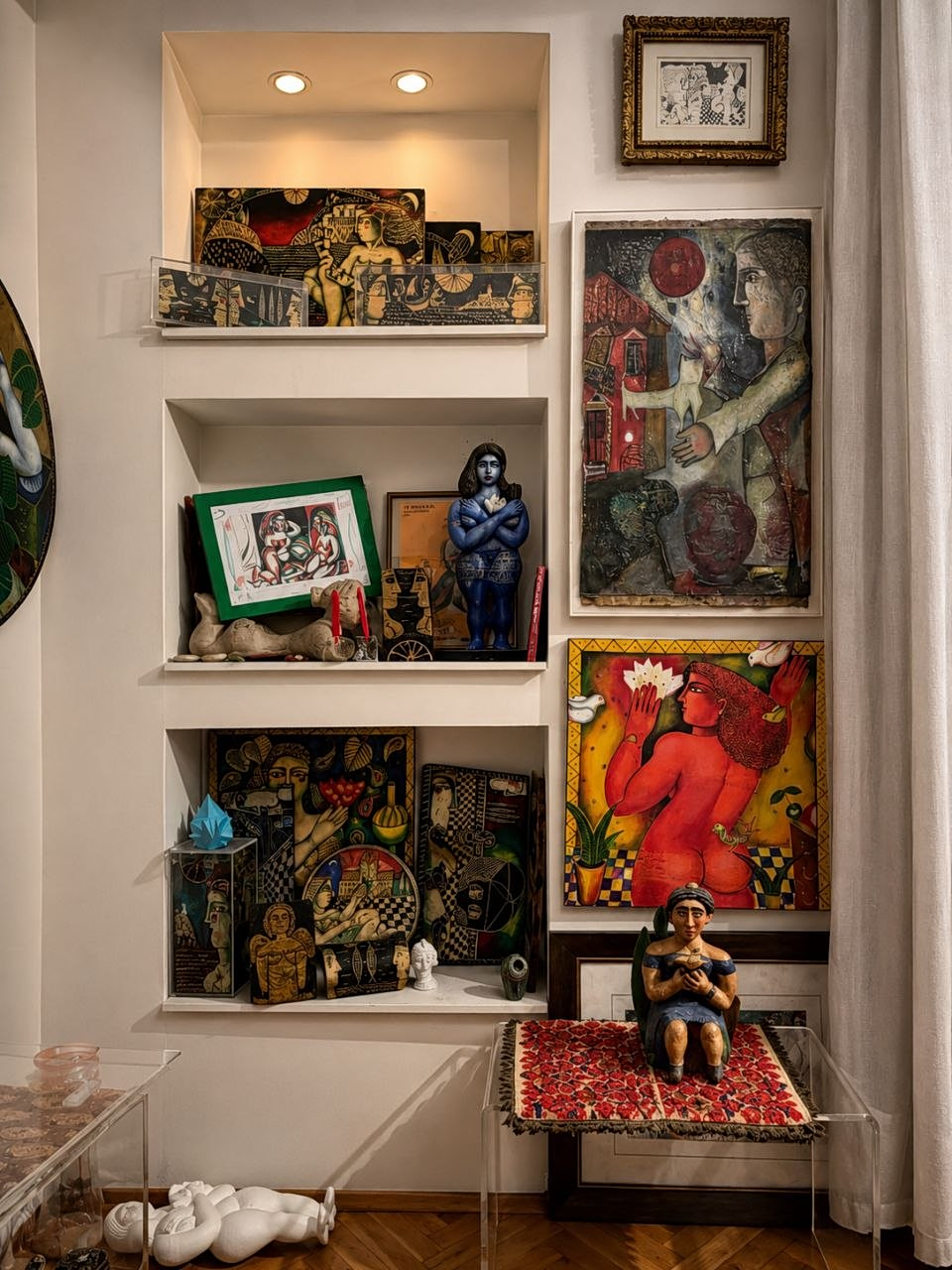
Paintings from different decades coexist with bronze and plaster sculptures, painted wooden works, and lithographs, all engaged in an ongoing dialogue with the creator. PANOS KOUGIAS/TO BHMA INTL EDITION
And yet, the longer you stayed in Paris, the more intensely Greece began to appear in your paintings.
I think nostalgia did that. I cannot explain it any other way. When I was in Paris, I missed Greece so much that sunsets, churches, islands and birds in the light began appearing in my paintings. It was as if I were returning through painting. I remember once in New York. It was a sunny afternoon. I took a ferry to a small island. The intense light, the shimmer of the sea, the pigeons flying through the last rays of the sun suddenly stirred a deep nostalgia for Greece in me. I immediately returned to my room and frantically painted sunsets, islands, churches, birds flying through the light. Those works took me back to my favorite places. I think this happens often: art comes to complete what is missing from our lives.
So the Greekness in your painting was born of distance more than it was of presence?
Yes, perhaps that is how it is. When you are far away from your homeland, you begin to see it differently. You do not reproduce what you see in front of you; you paint what you miss.
I remember walking through small neighborhoods at dusk, or late at night in the moonlight. These images remained inside me, and at some point I felt the need to paint them so that they would not be lost. Later, I came to know many great cities. But I was always seeking those first emotions within them. I think all my painting begins with personal experiences. Techniques come later.
In 1961, you meet Alekos Fassianos. It is a meeting that would prove decisive for both of you.
We worked together for quite some time. What united us most was more than painting; it was Greece. We were both living in Paris, but we constantly talked about Athens, about the working-class neighborhoods, about Papadiamantis, about all those things we missed and said we would find again when we went back in the summer. A little later, Nikos Stefanou also arrived. It was him who told us about a house in Kallithea, with a wonderful garden, which the National Gallery was renting at the time to young painters. He suggested that we all work there together. We could not have imagined then how important that place would become in our lives.
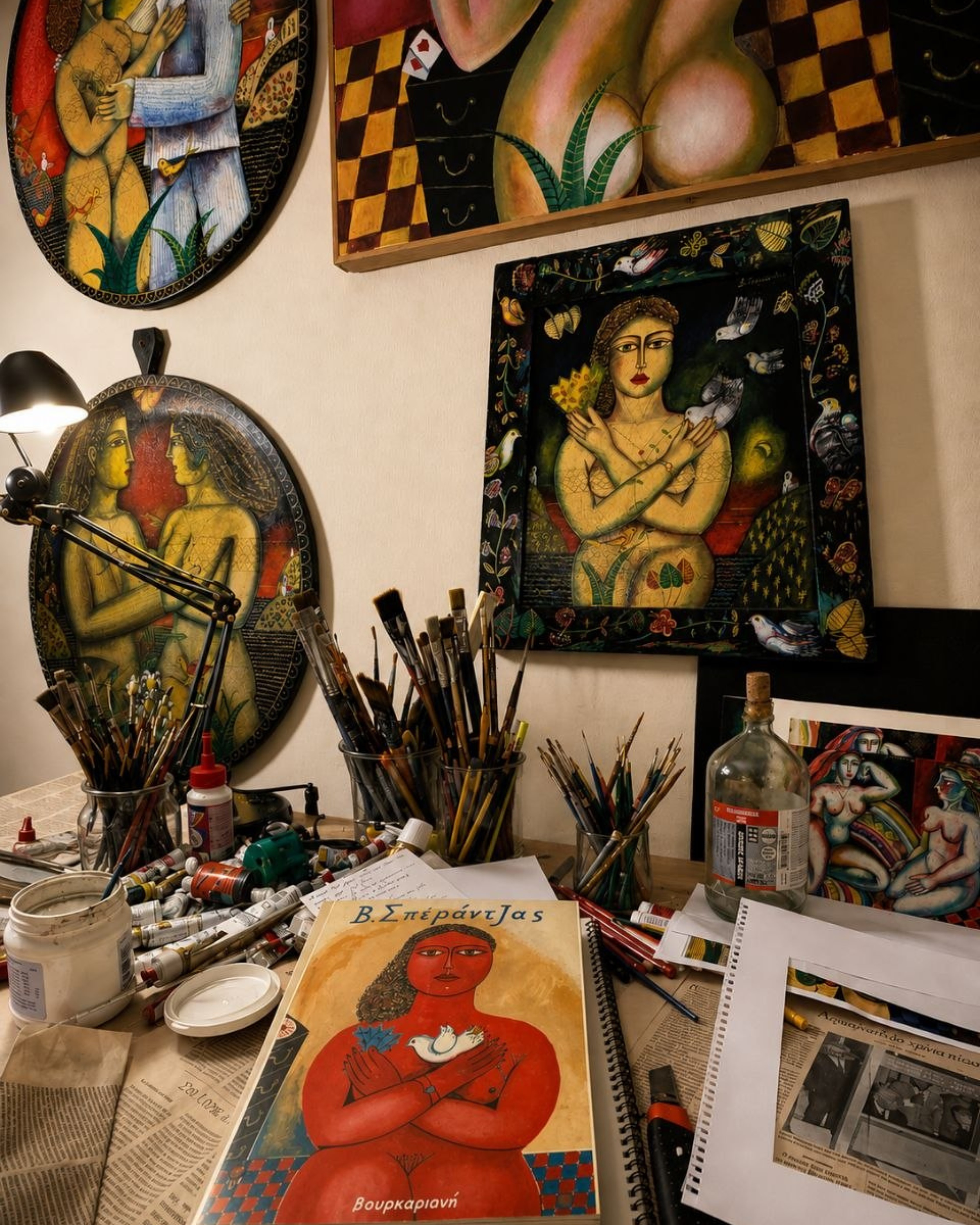
“Where do you paint now?” I ask—”Here, on this table.” PANOS KOUGIAS/TO BHMA INTL EDITION
The Kallithea house has acquired almost mythical dimensions in the history of modern Greek painting. What was it actually like?
Above all, it was a place of freedom. When I returned to Greece to do my military service, the first thing I did was rent a space there as well. I’d report for duty at the barracks at dawn, but as soon as I finished, I’d head straight back to the studio. And spent the whole rest of the day there.
The house had a large garden with palm trees and cacti. It was an old villa, full of light and quiet. I could work there without thinking about anything else. I truly felt far from the world and its problems. The only thing that concerned me was painting.
There was also a particular kinship between Alekos and me. We shared common references and often influenced one another. At the time, some people said I was influenced more by him, because he was already better known. That never concerned me particularly. We both knew very well what connected and what distinguished us.
Fassianos had already begun to emerge as a recognizable personality. You seemed to consciously keep your distance from publicity.
I was never a man for public relations. Alekos was a different kind of person. He knew Elytis, Karouzos, Embeirikos and many people from the literary world. He was outgoing in a way I am not. It is not that I did not love people. I simply always feared relationships built on ulterior motives. I remember a verse by Cavafy that made a real impression on me when I read it at a young age. It speaks of the danger of scattering oneself among countless social relationships and ultimately losing oneself. I have believed this very strongly all my life. Most people associate with others because they expect to gain something. I tried to avoid that. Perhaps that’s why I have always remained on the margins. It never bothered me. I preferred to move more slowly, but to feel that I had remained myself. Success was never my main goal. Painting was.
That period in Kallithea came to an abrupt end.
Yes, unfortunately. It lasted about five years. Then the dictatorship came and everything changed. I left for Paris almost immediately, because I felt that Greece had become suffocating. Alekos followed a little later. Nikos stayed longer. We all went our separate ways. During those seven years, I returned only for a few days in the summer. I did not want to live in that atmosphere. Then came work, teaching, everyday life in Paris, and eventually I stayed there much longer than I had initially imagined.
Yet there were also very specific experiences that changed the way you saw painting. You often refer to a small chapel in Pelion.
I will never forget it. It was hidden among dense vegetation. I found it completely by chance, around 1960. When I went inside, I was truly overwhelmed. The frescoes were the work of the folk painter Pagonis, whose name I did not even know at the time. Their power enchanted me. There was nothing contrived about them. On the contrary, they possessed a simplicity that concealed enormous richness. That was when I understood that one does not need to travel to the other end of the world to encounter great painting. Our country is full of such silent revelations. I think that little chapel taught me that the truth of art does not depend on fame or size; it depends on sincerity.
Today, looking back, is there anything you would change?
No. Perhaps I would have done some small things differently. But not the basic path I’ve followed. I feel grateful that I was able to live within painting. That is my great privilege. I never felt that I was doing it merely as a profession; painting is my life. And that is very different. Art has always been my refuge. Whenever the world became difficult, I have returned to painting. Painting gives me a world to which I can always return. I think that is what every person seeks: to find their own world. I am happy I found mine.
Leaving Vassilis Sperantzas’ home, the Thermaic Gulf still stretches calmly beneath the balcony. From the street come laughter, the voices of boys and girls flirting, and the sounds of a summer full of vitality, as if a nocturnal scene from one of his paintings had sprung to life to see me off. Just before the door closes, we return one last time to a painting. He looks at it silently, without commenting on it. Perhaps because, after all these years, he still believes there are things painting can say better than any interview.