 Μake us preferred on Google
Over the past decade, Greece has taken steps towards becoming a more inclusive society. This sense of urgency has been driven in part by the arrival of asylum seekers from countries in crisis, as well as by European Union regulations requiring member states to adapt to a changing world.
One of these regulations explicitly requires social environments, including the workplace, to be inclusive. It might seem self-evident that democratic countries should base their entire social system on inclusivity and equal opportunity, but we all know that this is still far from the truth.
Earlier this year, the Greek Ministry of Social Cohesion and Family Affairs introduced the EU-funded Diversity Label program, which certifies businesses that have equality and inclusion policies in place and are making efforts to create a working environment free from discrimination. The aim is to ensure employees are treated fairly regardless of gender, age, disability, ethnic or national origin, religion, sexual orientation or other personal characteristics.
This is Greece’s first official effort to assess private-sector businesses on their diversity and anti-discrimination practices. But does receiving this label guarantee that a business will treat employees and job seekers fairly? And what about the public sector?
Operating Inclusively
During its pilot phase, the program attracted considerable interest, which the ministry says reflects growing awareness among Greek employers that diversity is both a strategic asset and a necessity in an evolving labor market.
Of the 217 businesses that applied, 41 large private-sector enterprises received the label in the program’s first round, while 59 were identified as needing improvements. The initiative aims to support equal opportunity and encourage businesses to put diversity and inclusion policies into practice.
Certified companies are given access to digital tools, training programs, guidance on developing inclusive policies and relevant legislation, and self-assessment tests. The ultimate goal is for these businesses to integrate inclusion into their strategic identity and improve Greece’s overall track record with regard to equality.
“Inclusion does not begin when someone is hired; it starts the moment they decide to pursue an opportunity. It is defined not only by who joins a company, but also by who advances, who is evaluated fairly, and who receives support when facing challenges,” Social Cohesion and Family Affairs Minister Domna Michailidou said at the award ceremony.
The principle, she added, must be reflected in how companies recruit, evaluate, train, develop and support their employees. The label recognizes businesses that move from “believing in inclusion” to “operating inclusively”.
In a labor market competing for talent, Michailidou noted, inclusion is also a way to make the most of every employee’s potential.
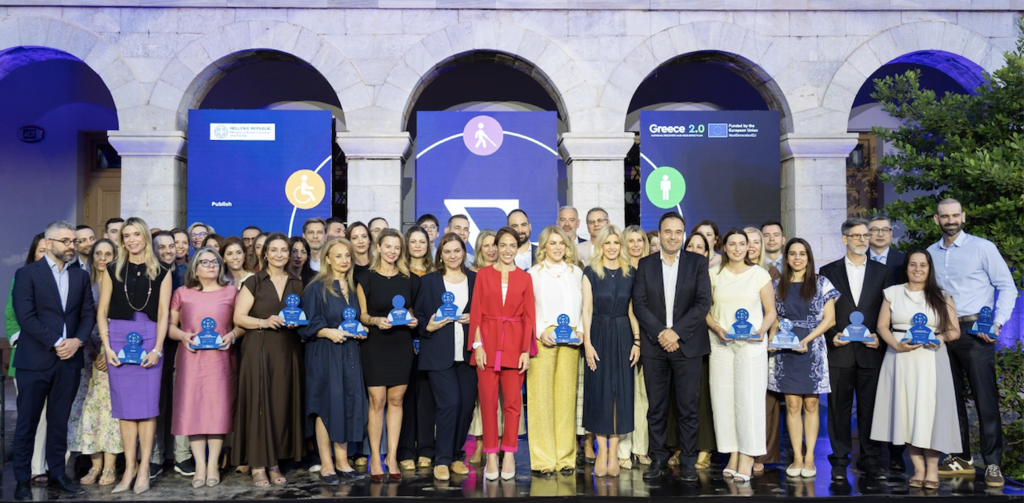
Domna Michailidou, Greece’s Minister of Social Cohesion and Family Affairs (C), with representatives of the 41 private-sector companies awarded the newly introduced Diversity Label earlier this year. MINISTRY OF SOCIAL COHESION AND FAMILY AFFAIRS
Label vs Reality
The initiative is undoubtedly a step in the right direction. But Greece needs to do much more before it can safely say inclusion in the workspace is a given.
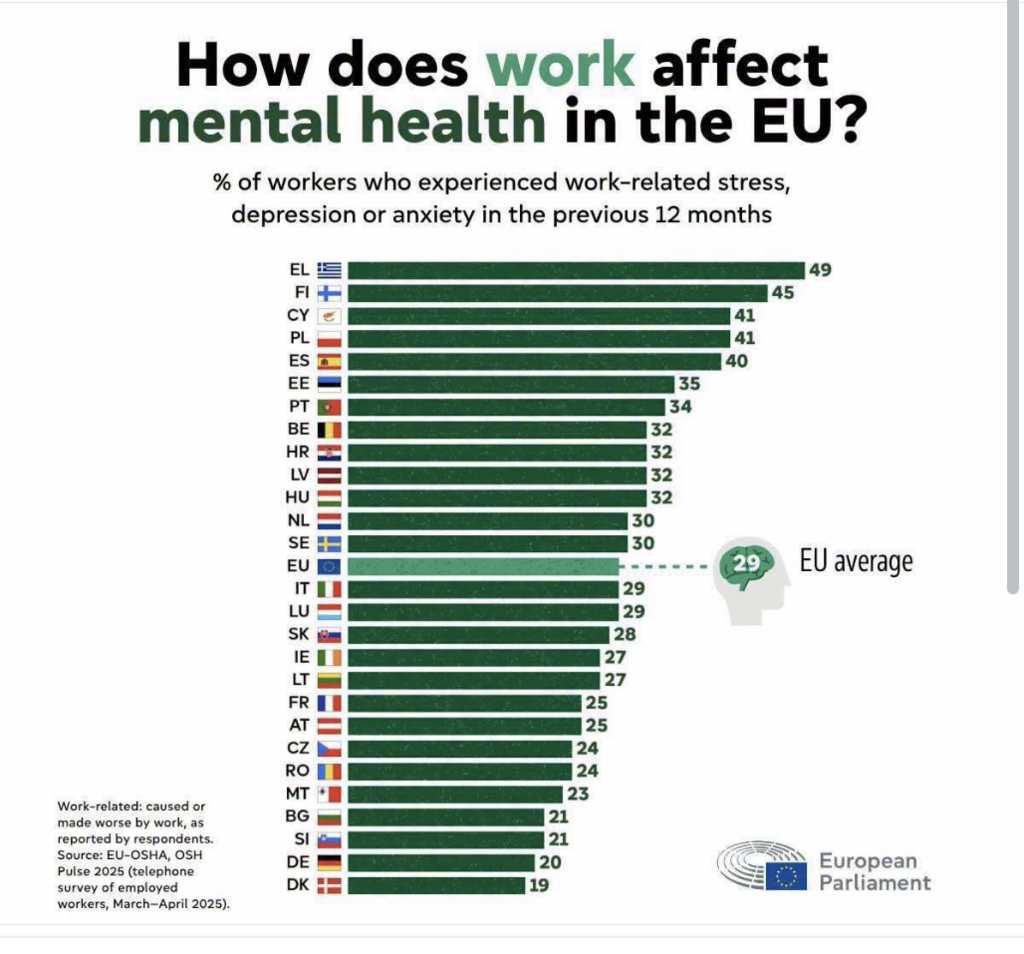
Only recently, among EU states, Greece reported the highest levels of work-related psychological distress. Nearly half (49%) of the workers surveyed said they had experienced work-related stress, depression or anxiety in the previous 12 months—well above the EU average of 29%.
The findings prompted the European Parliament in October to request that the European Commission take action to prevent, eliminate or reduce psychosocial risks at work, including those contributing to stress, burnout, and mental and physical health problems.
Proposed measures include addressing violence, harassment, bullying and discriminatory behavior, along with early-detection mechanisms and preventive measures to combat third-party violence.
Discrimination remains another concern. Two studies conducted by the Ecosystem Project and the Greek National Commission for Human Rights found that 85% of respondents in Greece had experienced some form of discrimination, with the workplace cited most frequently. Sex (33%), age (25%), and marital or social status (20%) were among the grounds reported.
Despite legal protections against workplace discrimination, unequal treatment persists.
A 2025 report by the European Union Agency for Fundamental Rights found that 32% of LGBTQ+ respondents in Greece had felt discriminated against at work in the year preceding the survey, compared with an EU average of 21%. Overall, 51% reported discrimination in at least one area of daily life.
Academic research by economist Nick Drydakis backs this up. His findings showed that gay men in Greece were significantly less likely to receive interview callbacks than heterosexual applicants with identical qualifications. For lesbian applicants, the probability of receiving a callback was 27.7% lower than for heterosexual women.
Other persistent challenges include age discrimination, whether in the form of a reluctance to hire older applicants or pressure on employees to retire early, and barriers faced by people with disabilities or chronic illnesses, who may struggle to secure reasonable workplace accommodations.
And Greece’s public sector is not exempt. In July, the European Commission referred Greece to the EU’s Court of Justice because it appears that Greek law discriminates against fixed-term public school teachers, who are subject to less favorable working conditions than permanent staff in areas that include maternity leave and sick leave.
Can Inclusion Be Measured?
To qualify for the label, businesses in Greece must demonstrate their commitment to inclusion through documented policies, concrete actions and measurable indicators. The assessment covers workplace practices and workforce composition, including representation in management and positions of responsibility, employee training, fair recruitment and promotion procedures, accessibility and work-life balance initiatives.
The ministry has even launched a digital platform offering a free three-hour training program to private-sector employees designed to build a more inclusive culture and combat workplace discrimination.
But what happens after a company receives the label? Can a young woman safely decide to have a child? Will an employee in a wheelchair have access to the restroom or the kitchen? Will an older, experienced candidate even be considered for the job?
Greece has certainly closed the gap on paper, but it may be some time before the realities on the ground mirror the norm in other EU nations.