Against a backdrop of global crises, Greek tourism is balancing strong demand with growing uncertainty.
Greek tourism is now navigating a complex new geopolitical landscape, the latest in a string of challenges spanning fifteen years of back-to-back crises, from the financial crash to the pandemic and the energy shock. Tensions in the Middle East, combined with persistent inflation and rising transportation costs, have created an environment where cautious optimism coexists with real concern.
Despite an impressively strong start to the year, booking trends are showing clear signs of slowing down, reflecting a broad “wait-and-see” stance from key source markets, driven largely by the economic instability that the Middle East crisis is injecting into the European economy. Tourism industry players are closely watching traveler behavior, airline planning decisions, since 75% of international arrivals to Greece come by air, and the forward booking curve.
No Wave of Cancellations at Greek Airports
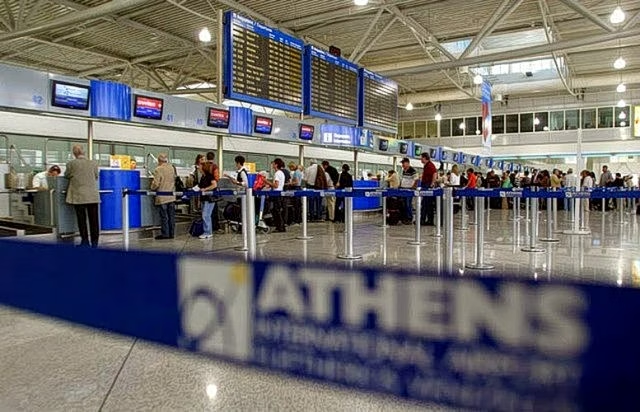
On the airline front, where many carriers are revising their flight schedules globally, the picture at Greek airports remains stable with no signs of disruption. While airlines internationally are moving to cancel routes that have become economically unviable due to high fuel costs, no particular trend of that kind has emerged in Greece. Sources from Athens International Airport report no notable pattern of cancellations or significant schedule changes among carriers. The same holds true at the regional airports managed by Fraport Greece, where scheduled flights are proceeding normally without any major alterations. The absence of mass cancellations supports the view that, at least in the short term, the market is holding its momentum.
Agapi Smpokos: Greek Tourism Is in a Prolonged Stress Test
On the hotel bookings side, which are at satisfactory levels for this time of year, the uncertainty of the moment was captured vividly by Agapi Smpokos, CEO of PHĀEA and Vice President of SETE and Marketing Greece, speaking at the Delphi Economic Forum. “It’s hard to predict what will happen this summer. It’s not just the geopolitical issues, it’s all the crises coming one after another,” she said, noting that “tourism is at the center of things and more vulnerable to a constantly shifting environment.”
Smpokos described the past fifteen years as a “prolonged stress test” for Greek tourism, pointing to the economic crisis, the pandemic, and ongoing geopolitical developments. She stressed, however, that Greek tourism has shown remarkable resilience — serving as a key pillar of the economy and recording one of the fastest post-pandemic recoveries of any destination in Europe.
Aegean Airlines Chairman Eftychios Vassilakis, also speaking at the forum, noted that the booking window has shrunk and “there is risk,” but that the situation remains manageable. He pointed out that despite the crisis, passenger traffic at Greek airports during the first four months of the year is tracking positive, with bookings running slightly ahead of 2025 levels. This, he argued, shows that tourism and consumer spending are not as fragile as often assumed, adding that recent years have seen multiple crises without derailing Greece’s growth trajectory.
Greece Holds Its Place at the Top of Travelers’ Lists
Despite global turbulence, Greece continues to be a powerful draw for international travelers. According to the latest data from the European Travel Commission for 2026, Greece is tracking the broader upward trend across Mediterranean markets, growing its market share by roughly 1.1 percentage points to 6%, and ranking fourth among Europe’s most popular destinations — behind Spain, Italy, and France.
A Strong Start to the Year
The international crisis arrived on the heels of an exceptionally strong opening two months of the year for Greek tourism. According to Bank of Greece data, inbound travel during January–February 2026 surged by 38.5%, reaching approximately 2.13 million visitors compared to 1.54 million in the same period of 2025. Travel receipts over the same period jumped by 70.7% year-on-year, coming in at €1.007 billion.