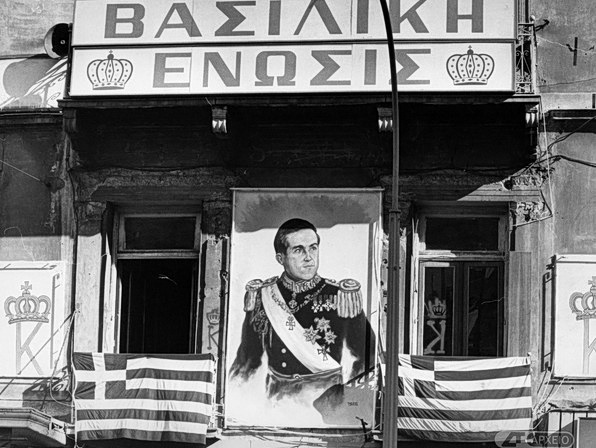
December 9, 1974, was the first day after the definitive abolition of the monarchy in Greece. Just a few hours earlier, the December 8 referendum had been held, establishing the system of a republic without a king.
Immediately after the fall of the Junta, on July 24, 1974, one of the foremost issues was resolving the “regime question”—that is, whether Greece would return to a monarchy or not. The answer would be given by the Greek people through a referendum on December 8, 1974.

Monarchy or Republic
According to the law of the Ministry of the Interior, the ballot for the monarchy read, “In printed capital letters in brown: ‘MONARCHICAL DEMOCRACY,’” while the ballot for the republic read, “In printed capital letters in green: ‘REPUBLIC.’”
On November 17, 1974, the first parliamentary elections since 1964 took place. Winners were Konstantinos Karamanlis and his newly founded party, New Democracy. Also participating was the newly established party of Andreas Papandreou.
The Parties’ Positions
As the day of the referendum approached, the overwhelming majority of the political world expressed support for the Republic. A cross-party “Panhellenic Committee for Democracy” was even formed, with dozens of members. Its presidium included Virginia Al. Zanna, Ioannis Masouridis, Iakovos Kambanellis, Marios Ploritis, and Antonis Samarakis.
At the same time, Prime Minister Konstantinos Karamanlis required his New Democracy party to maintain a neutral stance and asked its MPs “to refrain from any demonstration in favor of the monarchy.”
As TO VIMA noted, for the first time in Greek history, no political party officially supported the monarchy.
Constantine
On his part, Constantine, holder of the throne until the Junta’s arrival, in a statement from London where he was staying, said, among other things: “I never ceased to act by all means and struggle with all my strength for the political liberation of the Fatherland. You will judge whether I fulfilled my duty.”
On the morning of December 8, 75% of eligible voters went to the polls, with 69.18% voting in favor of the Republic and 30.82% for the monarchy.
Resounding Victory
On December 10, 1974, TO VIMA wrote in its editorial:
“A new situation arises in Greece with the resounding victory of the Republic, demonstrating that the overwhelming majority of the Greek people intend to self-govern, without granting dangerous privileges and rights to rulers by divine right.
“The verdict put an end to an anomaly in public life that had lasted over a century.
“Greece is thus freed from an anachronistic institution which, if it survives in a few other European countries, owes it to the fact that there the throne neither could nor wished to interfere in political power.
“If ever a regime question arose, it is certain that no European people would choose to maintain a monarchy.
“As for Greece, the Sunday referendum resolved a permanent source of division, a limitation on national independence, and impermissible interference in the electorate’s will.”
“The remarkable aspect is that this critical achievement occurred FOR THE FIRST TIME in Greek history, with the will of the people expressed freely and without coercion.
“For the first time, the constitutional issue was resolved without intervention by powerful actors, either for or against.
“For the first time, neither weapons nor intimidation dictated whether the throne would return or depart.
“This fact alone gives organic value to the establishment of the Republic, making it permanent, immutable, and unshakable. The nightmare of ‘divisions’ over the constitutional issue has definitively passed.”
Presidency of the Republic
The interim President of the Republic, until a new Constitution was ratified, was elected with 206 votes: the jurist and former President of the Council of State, Michail Stasinopoulos.
In June 1975, after the new Constitution had been passed, the new President of the Republic, with 210 votes, was elected: the legal scholar, philosopher, and former minister Konstantinos Tsatsos.