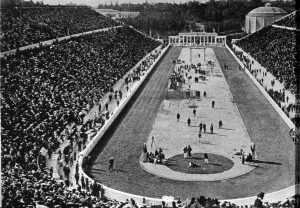
On April 6, 1896 (March 25 under the old calendar), the first modern Olympic Games began at the Panathenaic Stadium in Athens, marking the revival of an ancient institution that would go on to gain global significance.
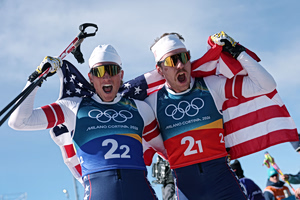
One hundred and thirty years later, the Olympic Games remain one of the world’s most important international events, embodying ideals of fair competition and peaceful coexistence—while also reflecting the contradictions of the modern era, from political tensions and economic interests to the growing commercialization of sport.
In its March 17, 1996 edition, marking the centenary of the first Games, the Greek newspaper To Vima published an extensive report by Christina Koulouri, Th. Kalpaxis, G. Kokkinos, and Eleni Fournaraki:
“On Easter Monday of 1896, which coincided with Greece’s national holiday of March 25, a global institution was born—one that would become associated both with the spirit of reconciliation among nations and with national and political rivalries; one that served the pure Olympic ideal, but increasingly also economic interests.”
The revival of the Olympic Games was far from inevitable. It reflected deeper transformations in 19th-century European society.
The growing emphasis on physical exercise, the search for inspiration in antiquity, and the development of sports across Europe created fertile ground for the re-emergence of an ancient institution in modern form:
“The decision to revive the ancient Olympic Games […] fully corresponded to the values and ideas of the modern world, which had begun to move beyond the Christian-influenced disregard for the body and to embrace physical exercise as a form of recreation.
“It also reflected a unique relationship with antiquity—both an inexhaustible source of models and an object of systematic research and study, aided by archaeological excavations that were flourishing during the very century in which the Olympic Games were revived.”
Historian Christina Koulouri, then an assistant professor at Democritus University of Thrace, described the atmosphere of those historic days:
“On Easter Sunday, March 24, 1896, under torrential rain, the statue of Georgios Averoff was unveiled in the forecourt of the Stadium. Thanks to his generous donation for the restoration of the ruined ancient stadium, the dream of reviving the Olympic Games became a reality.”
As noted, the idea of Olympic-style competitions had appeared earlier, but without an international character:
“Olympic Games had been held in Athens even before 1896, but they were neither international nor purely athletic in nature.
“As early as 1835, Ioannis Kolettis, then Minister of the Interior, proposed to King Otto the organization of annual pan-Hellenic festivals modeled on antiquity (Isthmian, Nemean, Pythian, Olympic Games) to celebrate Greece’s rebirth following the 1821 War of Independence. At that time, the anniversary of March 25 had not yet been officially established—it would be legislated three years later.
“Kolettis’ proposal was not adopted, but it reveals the distinctive relationship between modern and ancient Greece. For the young Greek state, antiquity was not only a source of legitimacy but also a constant object of admiration and emulation.”
The revival was not confined to Greece alone:
“Across Europe, admiration for ancient Greece was widespread, with many viewing themselves as its cultural heirs. The challenges lay in implementing the idea. The relationship of the medieval and early modern world to the body—shaped by Christian thought—differed greatly from that of antiquity. Physical exercise in the early 19th century was often viewed with suspicion, with emphasis placed instead on intellectual cultivation.”
“Perhaps this explains why the four Olympic Games organized in Athens between 1859 and 1889, according to the wishes of Evangelis Zappas, were not competitions of the body but of the mind.
“These events, known as the Zappas Olympiads, were called ‘Olympia’ due to their resemblance to the famed ancient Olympic Games.
“In reality, however, they were industrial exhibitions showcasing achievements in various sectors of the economy, with athletic competitions held on the sidelines.”
The decisive turning point came with the efforts of Pierre de Coubertin and Dimitrios Vikelas:
“Coubertin—an admirer of the English model that linked sport with education and social development—worked passionately to realize the idea he had publicly proposed in 1892.
“In 1894, he convened an international congress at the Sorbonne, initially intended to define the rules of amateurism and the concept of the sportsman, but which ultimately decided on the revival of the Olympic Games.
“Representing Greece at the congress was Dimitrios Vikelas, the sole Greek delegate and representative of the Panhellenic Gymnastic Club. Renowned for his intellect and literary work, Vikelas was appointed the first president of the International Olympic Committee, which decided that the first modern Olympic Games would be held in Athens.”
The decision, however, was not immediately embraced in Greece:
“The government of Charilaos Trikoupis, amid a climate of national bankruptcy, ‘resisted stubbornly,’ according to contemporary accounts, considering the plan unfeasible.”
It ultimately took political intervention, international pressure, and intense mobilization for the Games to become a reality.
By the spring of 1896, Athens was gripped by an unprecedented wave of excitement:
“During the week from March 25 to April 1, 1896, Athens was swept up in the magic of a celebration unlike anything it had ever experienced in terms of noise, intensity, and enthusiasm. Seventy thousand people, newspapers wrote, flooded the city—shouting, gesturing, celebrating.”
Amid this atmosphere, King George I proposed that the Olympic Games be held permanently in Greece:
“The new president of the International Olympic Committee, who succeeded Vikelas and was none other than Pierre de Coubertin, preferred instead the rotation of host cities.”
“Greece later proposed the idea of intermediate Games—so-called Intercalated Olympics—held between the regular four-year cycles. This proposal was implemented only once, in 1906.
“The 1906 Intercalated Games in Athens, though largely absent from official Olympic histories, were highly successful and helped sustain the institution at a time when it had been shaken by the failures of the Games held in 1900 in Paris and 1904 in St. Louis.”
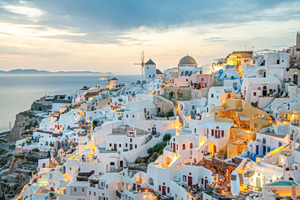
Although the Games were never permanently established in Greece, Athens would host them again in 2004—closing a historic circle more than a century after the first modern Olympiad.