January 27, 1945, was the day of the liberation of the Auschwitz extermination camp, near Kraków, Poland. For this reason, January 27 has been recognized as International Holocaust Remembrance Day, a day honoring the memory of millions of Jewish victims and reminding us how destructive Nazism was—and how it could re-emerge—for all of humanity.
Nazi Germany had for years carried out the systematic persecution and genocide of European Jews, and the concentration and extermination camps played a decisive role in this plan, which ultimately led to the death of six million Jews.
Auschwitz was the largest complex of concentration and extermination camps of the Nazi regime.
As the Soviet Red Army advanced toward Germany, it reached neighboring Poland. The countdown to the Nazis’ final defeat had begun. On January 24, 1945, mounted soldiers of a Red Army patrol came upon the Auschwitz facilities by chance.
Moments later, they encountered thousands of prisoners crammed into barracks, at the brink of death.
As they retreated, the Nazis took thousands of prisoners with them, forcing them on exhausting death marches. They attempted to destroy warehouses and gas chambers so as not to leave behind traces of the inhumane extermination process of Jews, and then fled.
Those prisoners who, due to their emaciated physical condition, could not walk were abandoned in the extermination camps to die from starvation and cold.
“TO VIMA” of January 23, 2005 published testimonies of people who managed to survive the hell of Auschwitz.
Heinz Salvador Cohn: “You will all go through the chimney”
“Friday, March 12, 1943, Thessaloniki. In the morning a group of militia members came to our house. They ordered us to prepare our belongings and go to the Baron de Hirsch camp. On Sunday we departed for Auschwitz.
I was fifteen and a half years old. We took with us one blanket, one spoon, one fork. Sixty people were packed into each railcar. Mobile prisons—no space, hunger, unbearable heat, and something even worse. Our wagon, inevitably, also became a toilet. This bitter journey lasted six days.
March 23, 1943, 11:00 p.m. We arrived at Auschwitz. ‘This camp has only one exit: the tall black chimney from which that thick smoke comes out. You will all pass through there…’—that was the SS officer’s ‘welcome.’
Selection was carried out according to age, physical condition, and health. Most believed, and not unjustifiably, that they would never see their loved ones again. Reality vanished in an instant, as if a bomb had exploded next to us. I became number 109,565.
Anxiety was the defining feature of our lives there. Every day the weakest were selected for the crematorium. There were months when victims exceeded 3,000–4,000. I went through seven selections. Discipline at Auschwitz was brutal. We spoke as little as possible, calculated the consequences of every action, had eyes only for what concerned us, and became blind to everyone else.
At Auschwitz, rebellion was attempted only twice, the second time by Greeks and Russians. Before they died, they blew up Crematoria II and III at Birkenau. As a Greek, I felt very proud.”
In mid-January 1945, selections were held for transfer to Germany: Gross-Rosen, Mauthausen, Melk. In April, 1,411 of us were transported by train to the Ebensee camp. On May 6, 1944, the Americans liberated us.
The Greeks made a flag from dirty sheets and the blue clothing of electricians and sang the national anthem. We spent the night doubting whether we were truly free or whether the Germans would return. At the first opportunity, we returned to Thessaloniki.”
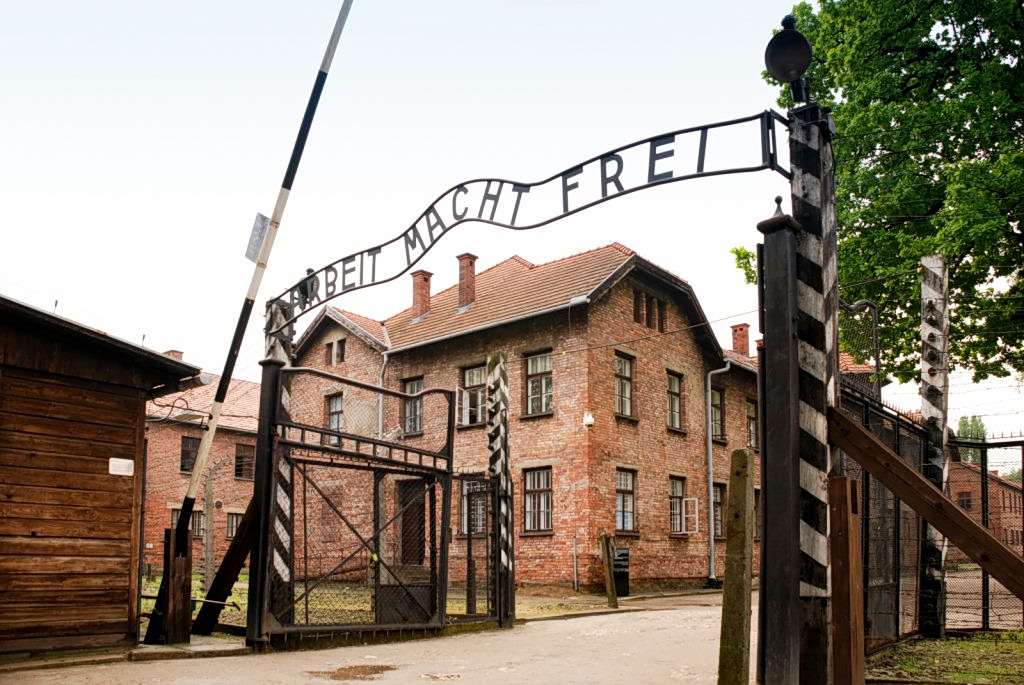
Arbeit macht frei — Work sets you free. Nazi slogan at the entrances of concentration and extermination camps.
Berry Nahmia: “In Auschwitz, production is death”
“My family lived in Kastoria. When news began arriving from Thessaloniki about the deportation of Jews, my father begged my brother and me to flee to the mountains. We did not leave. We were transported by trucks to Thessaloniki and from there to Auschwitz.
We walked toward the railway station without strength, human rags, like automatons, with dogs barking over us. As many as 80 people were crammed into each wagon. Claustrophobia, suffocation, hunger, thirst. In Vienna, the doors did not open. We begged for water from mothers in a nearby park, but they remained indifferent and did not even look at us.
On a gray winter day we arrived at Auschwitz. Poorly dressed people in striped uniforms stared at us strangely, as if we had come from some familiar yet distant planet. And then the chimneys. My God, what a terrible smell of burning!
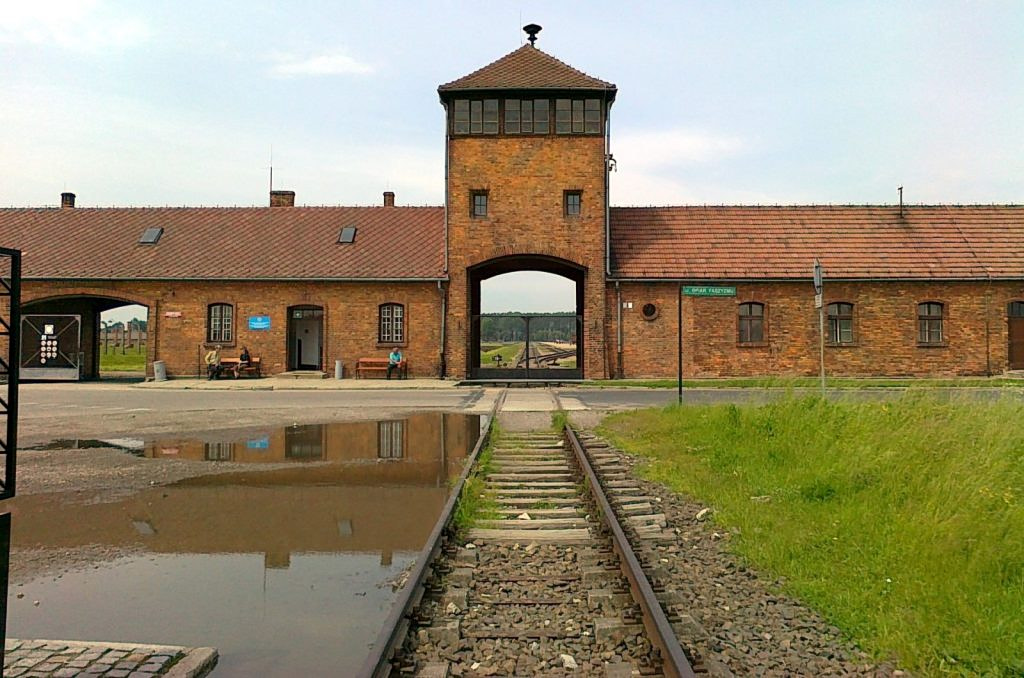
The entrance gate to the inferno of the Auschwitz-Birkenau extermination camp.
I became number 76859. I wore camp clothes—a dress stained with fresh blood—and two shoes, one men’s and one women’s. The food was a disgusting black liquid. I felt shaken. My friend Dora gave me her bread. ‘If you want to survive, look for a great inner source of strength,’ she said. When I learned about the crematoria, my mind nearly broke.
They told us: ‘Here is Birkenau. Here production is stone. In Auschwitz, it is death.’ They made us carry unbearably heavy stones a mile away.
They brought women from Block 10, Mengele’s block, without ovaries, in terrible pain; pregnant women were taken for experiments. I was transferred to work in “Kanada Kommando.” I did not know what it was until I stood before piles of suitcases full of clothes, mountains of glasses, sheets, canned goods—the belongings of people who were being burned nearby.
In the piles I found an embroidered bedspread, the dowry of my cousin Rebecca. In January 1945 we began the ‘death march’: Prague, Ravensbrück, Retsow. On May 1 we woke to find the camp gates open, the Germans gone, crowds walking along the highway. My cousin and I joined them and did not look back, fearing we might return to hell.”
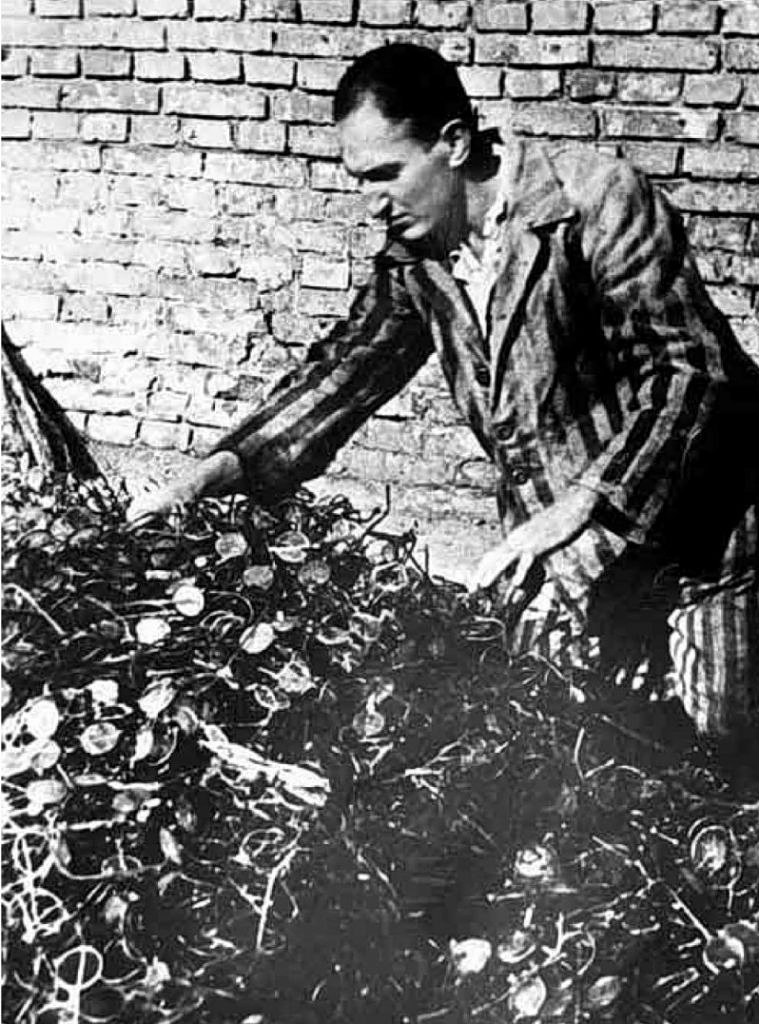
TO BHMA, 23.1.2005 Historical Archive “TO BHMA” “TA NEA”
Eva Carasso: “They made me dig my own grave”
“I was born in Hungary. I arrived in Auschwitz in 1944, unsuspecting, and I became number ‘8670031’. I immediately searched for my sister; at night I ran through the blocks with a thousand precautions. I did not recognize her at once with her head shaved—she looked terrible.
I gave her my food because she was very weak and they might have taken her in the selection. At night we slept, 28 girls, on a single plank like sardines. When one wanted to turn over, we all turned together. Then they took us elsewhere.
We carried tree trunks to the river. One day an officer asked me to clean his office and gave me a red scarf to hide my shaved head. That’s how my second husband noticed me, Iosif Pepo Karasso, from Thessaloniki. We did not understand how love came.
One day I fell ill; he worried and sent me a little note. ‘Why didn’t you come? I miss you… I love you…’. Unfortunately the Germans caught it; Pepo received 25 lashes and they made me dig my own grave. My sister, who worked as a cleaner in the commander’s house, fell to her knees and begged him to kill her first. Strange, but he—whom I cannot call a human being—was moved.
One day we set off for Tyrol. For six days we walked in the mountains without food or water. I carried my sister on my back. As soon as we reached the forest outside the city, they would kill us. Suddenly we heard trumpets and songs behind us; the Germans abandoned their weapons and ran.
We saw the Americans. I cannot describe to you what we felt. We kissed the ground they walked on. They gave us canned food and chocolates; the sudden eating killed many people. In Tyrol they gave us a house. There my husband found me; there was a priest and we married immediately. We came to Thessaloniki and we live happily with our children and grandchildren.
I hear some people say that these are fairy tales and I want to tell them: ‘I come directly from there.’ To explain to them what it is like to be 20 years old without parents, grandparents, uncles, cousins. In difficult moments I simply looked up at the sky. Worse were my children’s questions: ‘Mom, don’t we have grandfathers and grandmothers? Are we all alone?’”
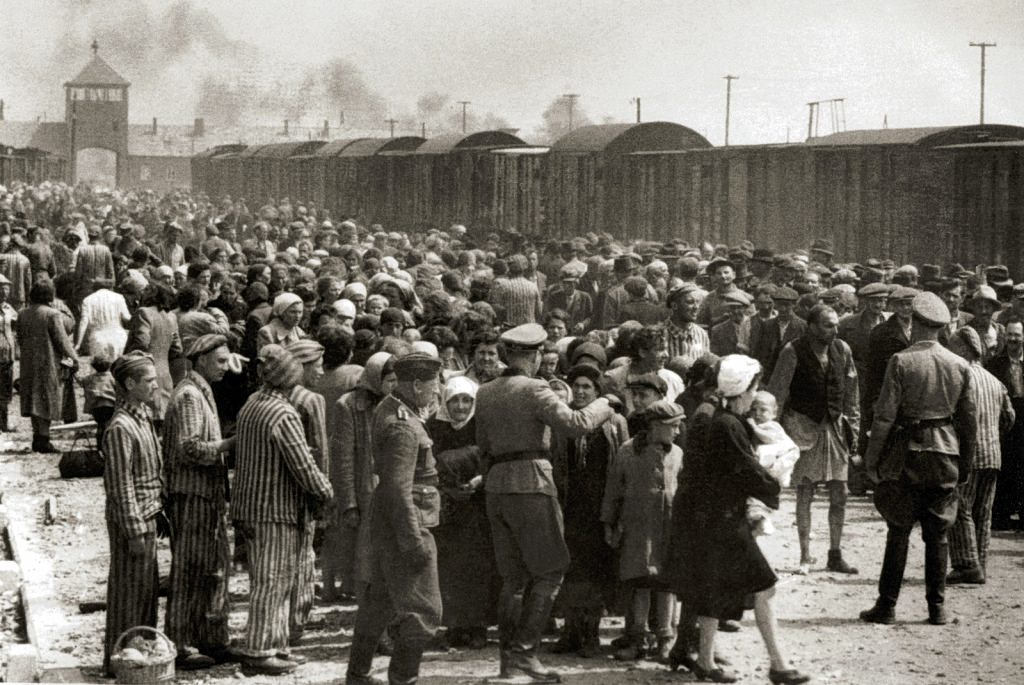
“Badly dressed people, in striped tracksuits, were looking at us strangely as if we were coming from some familiar but distant planet of theirs.”
Iakovos Kambanellis: “The air smelled of burnt flesh…”
“At the Mauthausen concentration camp, I was imprisoned from the summer of 1943 until the end of the war. Our reception by the SS was by name. We entered in groups of five. The air smelled of burning flesh…
The gravel on the road was mixed with ashes and pieces of bones. Between the first building and the wall, 265 dead were laid out on the cement—the day’s dead.
In barrack number 10, Jozef Balina advised me, ‘In here, to survive, you need a crust of madness around your mind.’ I joined the crew for loading sand. On the road there were piles of ashes… The ashes were better material for paving roads than fine gravel. They did not turn to mud. After all, humans are always the best material. Almost irreplaceable.
The SS in the camps built careers, competing over who could be the worst. They preferred Jews or Russians. The Russians, prisoners of war, always sang. Their songs were the churches of Mauthausen, where we received communion of courage.
In April 1944, they brought from Dachau, where Zachariadis was also held, Antonis from Ampelokipoi. Then they brought Italian officers who had rejected Mussolini, and an English officer, very calm until he found in his soup a piece of meat that looked like human flesh.
Mauthausen was liberated on May 5, 1945. Shortly before noon, a huge American tank smashed the gate and entered the compound. We screamed, tore at our clothes, shook like madmen, trampled each other trying to reach the tank. Time soon taught us prudence; the days for work came.
I was in the International Committee helping the Americans. We organized groups to return to their homelands. Many requested to go directly to Palestine. At that time, after the unprecedented tragedy, we believed that the Jews were entitled to have a homeland.
Who could have imagined that a new tragedy would arise, that of the Palestinians? We must not forget what happened in the concentration camps. Hitler was not only the product of his own countrymen. Responsibility lies with the English, the French, and many others. Today many admire America. I do not equate America with Nazi Germany, but I say it has a leader who creates dangers for humanity.”