Georgios-Alexandros and Georgios Gennimatas played a central role in PASOK’s initiative to secure the legal right to abortion in 1986. The positions of political parties, reactions, and extreme statements made in the Greek Parliament are documented.
The issue of abortion—and every woman’s right to decide over her own body—has been settled in Greek society for over four decades.
However, it resurfaced recently following statements by Maria Karystianou, who claimed the matter remains “a topic of public consultation.”
The Greek state, however, decided in 1986, through legislation, to protect this right.

Current Law
Specifically, under the current Law 1609 of 1986, the Criminal Code (Article 304) states:
“Artificial termination of pregnancy is not an unlawful act if performed with the consent of the pregnant woman by an obstetrician-gynecologist with the participation of an anesthesiologist in an organized medical facility, provided one of the following conditions is met:
a) Pregnancy has not exceeded twelve weeks.
b) Prenatal diagnosis indicates a serious fetal abnormality that would result in a pathological newborn, and pregnancy has not exceeded twenty-four weeks.
c) There is an unavoidable risk to the woman’s life, or a risk of serious and permanent physical or mental harm. In such cases, certification by the relevant physician is required.
d) Pregnancy is the result of rape, seduction of a minor, incest, or abuse of a woman unable to resist, and pregnancy has not exceeded nineteen weeks.
If the pregnant woman is a minor, consent from one parent or guardian is also required.”
Additionally, Law 1609/1986 specifies that “the state is responsible for ensuring the protection of women’s health and the provision of care in organized medical facilities during pregnancy termination.”

FILE PHOTO: Anti-abortion and abortion rights protestors demonstrate on the anniversary of the decision by the United States Supreme to overturn Roe v. Wade, outside the U.S. Supreme Court, in Washington, U.S., June 24, 2024. REUTERS/Evelyn Hockstein/File Photo
PASOK Government’s Rationale
This law was passed by majority under the PASOK government, led by Prime Minister Andreas Papandreou, on June 6, 1986. The bill was introduced for discussion in Parliament on May 26.
TA NEA of May 27, 1986 reported the statements of then-Minister of Health Georgios Gennimatas and the positions of opposition parties:
“With the bill on ‘artificial termination of pregnancy,’ the government seeks primarily to safeguard women’s mental health. To protect them from the many risks they faced over the years when the state’s neglect had created a hypocritical system, where the law criminalized abortion but women who had them were treated as criminals, undermining the state’s credibility.”

Both Minister Gennimatas and MPs G.A. Magkakis (parliamentary representative of PASOK for the bill and main drafter) and Ath. Filippopoulos (PASOK rapporteur) criticized New Democracy (ND) for hypocrisy when calling the bill a “form of homicide” because it allows women, under certain conditions, to terminate a pregnancy within the first three months.
New Democracy
ND’s bill rapporteur, V. Sotiriopoulos, argued that legalizing abortion freely was unrealistic for Greece and bypassed family planning and contraception. He said ND opposed the bill because it “allows the termination of life at the embryonic stage.”
MPs A. Synodinos and A. Benaki criticized the bill as violent, claiming it undermined the sanctity of life. ND parliamentary representative Io. Kefalogiannis said, “PASOK prioritizes health and legalizes abortion, while ND prioritizes life and opposes abortions.”
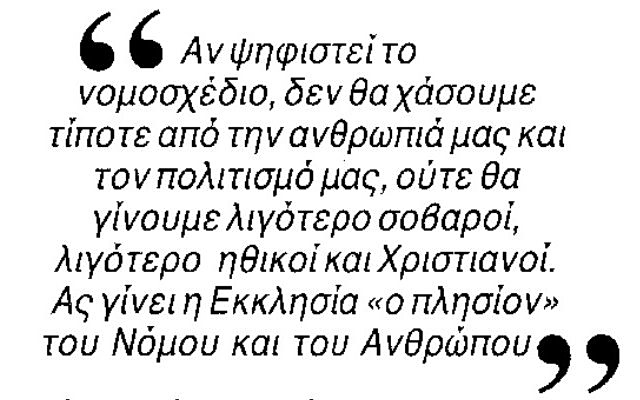
The quote reads, “If the bill is passed, we will not lose any of our humanity and our culture, neither will we become less serious, less morally right and Christian. Let the Church become [closer] to law and the human.”
KKE
The KKE parliamentary representative M. Damanaki emphasized measures to reduce abortions, advocating that abortion should not be used as contraception. She stressed the need to end the hypocritical system of “allegedly illegal” abortions, which encouraged profiteering in private health and harmed women’s mental health. The KKE supports decriminalization while also pursuing family planning measures.
Democratic Renewal (DIANA)
DIANA representative N. Anastasopoulos stated opposition to abortion as a medical procedure but supported decriminalization and full insurance coverage.
The Church
The Church was strongly opposed to recognizing the right to terminate pregnancy.
TO VIMA, April 30, 1986: “The Holy Synod expressed strong opposition to legalizing abortion and requested the government to withdraw the bill. Among the most vocal critics was the future Archbishop of Athens and All Greece, Christodoulos.
The Synod unanimously condemned the bill. Metropolitan Dimitriadis drafted a statement, but most Synod members considered it too aggressive and harsh toward the government. The final version was milder and… civilized.”

Article written when the law on abortions passed in Greece.
In Parliament
Tina Politi and the magazine Tachydromos documented parliamentary discussions, which at times were absurd and comical:
- D. Manousakis (DIANA) said: “We cannot accept the opinion that at the moment of Mr. Gennimatas’ conception, someone else would later be born.”
- I. Palaiokrassas (ND) compared allowing mothers to decide over life and death to dictatorship.
- B. Sotiriopoulos (ND) noted that abortion legalization often began in authoritarian states, first in Russia in 1922.
- G. Solomos (PASOK) added that early contraceptive programs were funded by Rockefeller, Ford, and other foundations from America.
Statements

- G. Sourlas (ND) joked about Christ and Marx not being born.
- A. Xarchas (ND) questioned why lesbians would care about abortion.
- P. Koutras (ND) said the Church should gather 500 priests to protest at Parliament.
- Other MPs referenced mental health of spouses, royal succession, and personal freedoms.
- PASOK defended women’s autonomy and the regulated practice of abortion.
Closing Statements
Some ND members framed abortion as morally destructive. PASOK MPs argued for women’s rights, health, and access to safe medical care. These debates highlighted tensions in Greek society between evolving social norms, political ideology, and religious influence, ultimately leading to legal recognition and regulation of abortion.