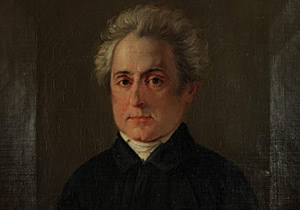
On February 27, 1943, one of the most emblematic figures of modern Greek letters, Kostis Palamas, died at the age of 84. His passing, in an Athens shackled under Nazi occupation, would spark an event that transcended mourning and entered the realm of history.
Palamas’ funeral evolved into the largest act of resistance staged by the Greek people against the German occupiers. It was a moment when grief turned into defiance, and poetry into protest.
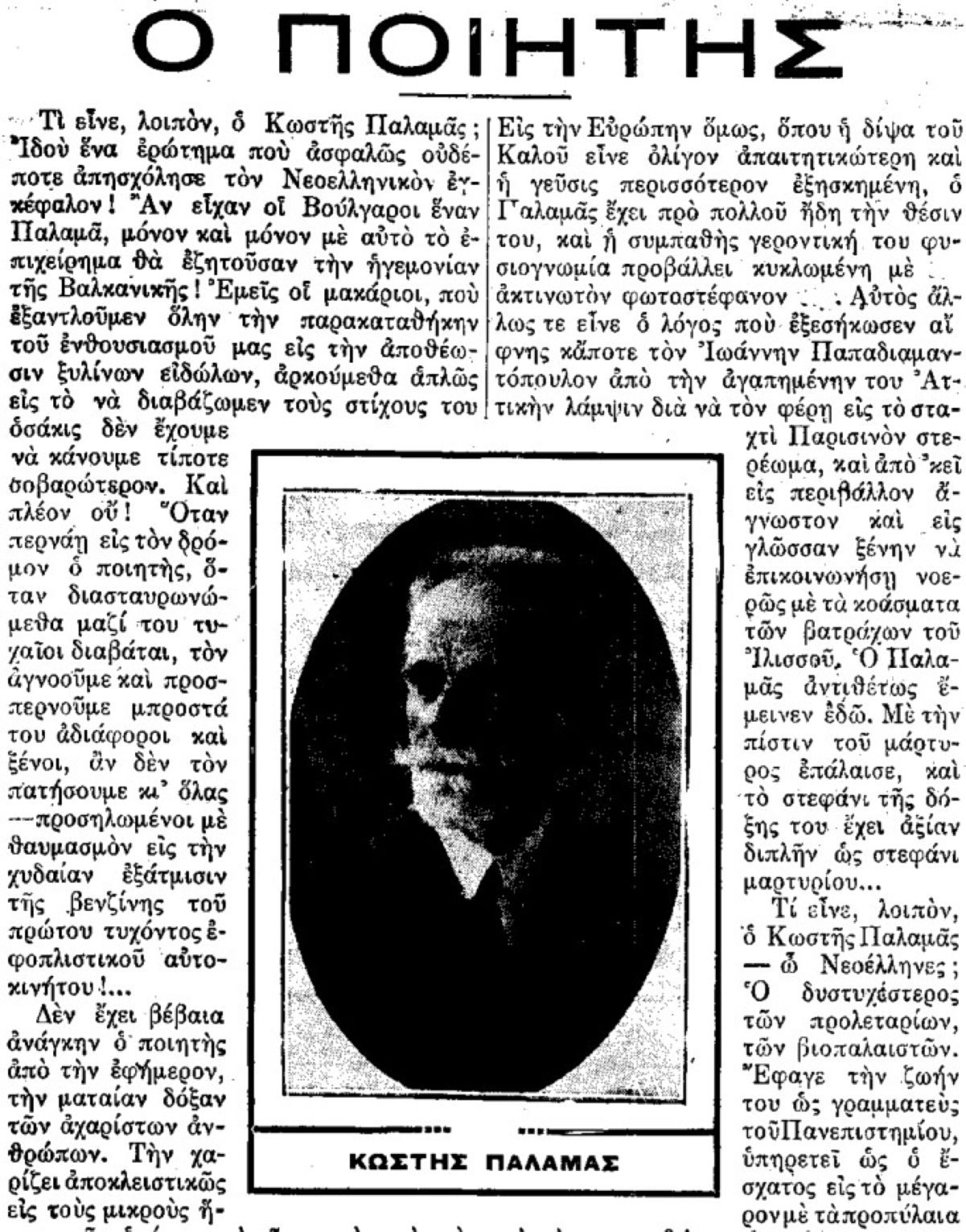
At the time, the press operated under strict Nazi censorship. Newspapers such as To Vima were unable to report the true scale and spirit of what unfolded. It was only a decade later, in February 1953, in a Greece finally free, that the distinguished writer and longtime To Vima contributor Ilias Venezis recounted how he experienced those charged days.
“Athenians will remember that day in February 1943,” he wrote. “The days of servitude were dreadful. The second harsh winter of bitterness, hunger, and death had just ended. Nothing yet foretold the day of redemption.”
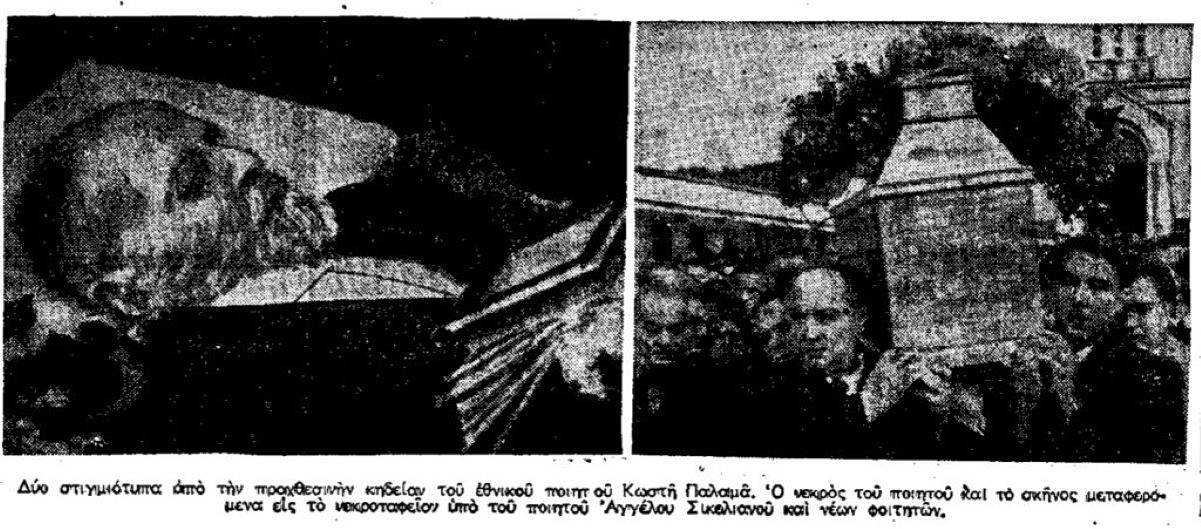
Then, one February morning, the news spread like a tremor through the capital: Kostis Palamas was dead.
“All of Athens rose,” Venezis recalled.
From the city’s farthest corners, waves of people began moving toward the cemetery hill to escort the Poet to his final rest. Were they all devoted readers of his verse? Had they been summoned by some hidden call for political expediency?
“None of that,” Venezis insisted. “It was a truly spontaneous, nationwide outpouring — an instinctive movement. That instinct spoke to everyone, even the simplest among them.”
It told them that this death marked the end of a great chapter of Greece — one destined, by the unbroken law of Hellenic continuity, to be followed by another. Athens had to be present at that passing. The people had to remind their conquerors that this land could not be enslaved in spirit. For at its core, it was a realm of intellectual eternity.
The funeral became an unspoken proclamation: that whenever Greeks stand and fight on their bare earth, in their mountains and gorges and seas, they defend not merely soil, fields, huts, or ancient olive trees. They defend what they inherited from their fathers and their fathers’ fathers — the Greek spirit itself.
And the occupiers needed to understand something more: for Greeks, their greatest hours as a nation are not only those of victory, but also those of defeat.
Palamas on Poetry and Creation
In 1927, during celebrations in Thessaloniki marking the fiftieth anniversary of his literary career, Palamas spoke to Eleftheron Vima. His reflections on poetry and language remain a rare and revealing document.
“Call it what you will,” he said. “The truth is that I devoted my entire life to poetry. I wanted every aspect of my life to culminate and find its completion in a poem. It was poetry that warmed both my mind and my soul.”
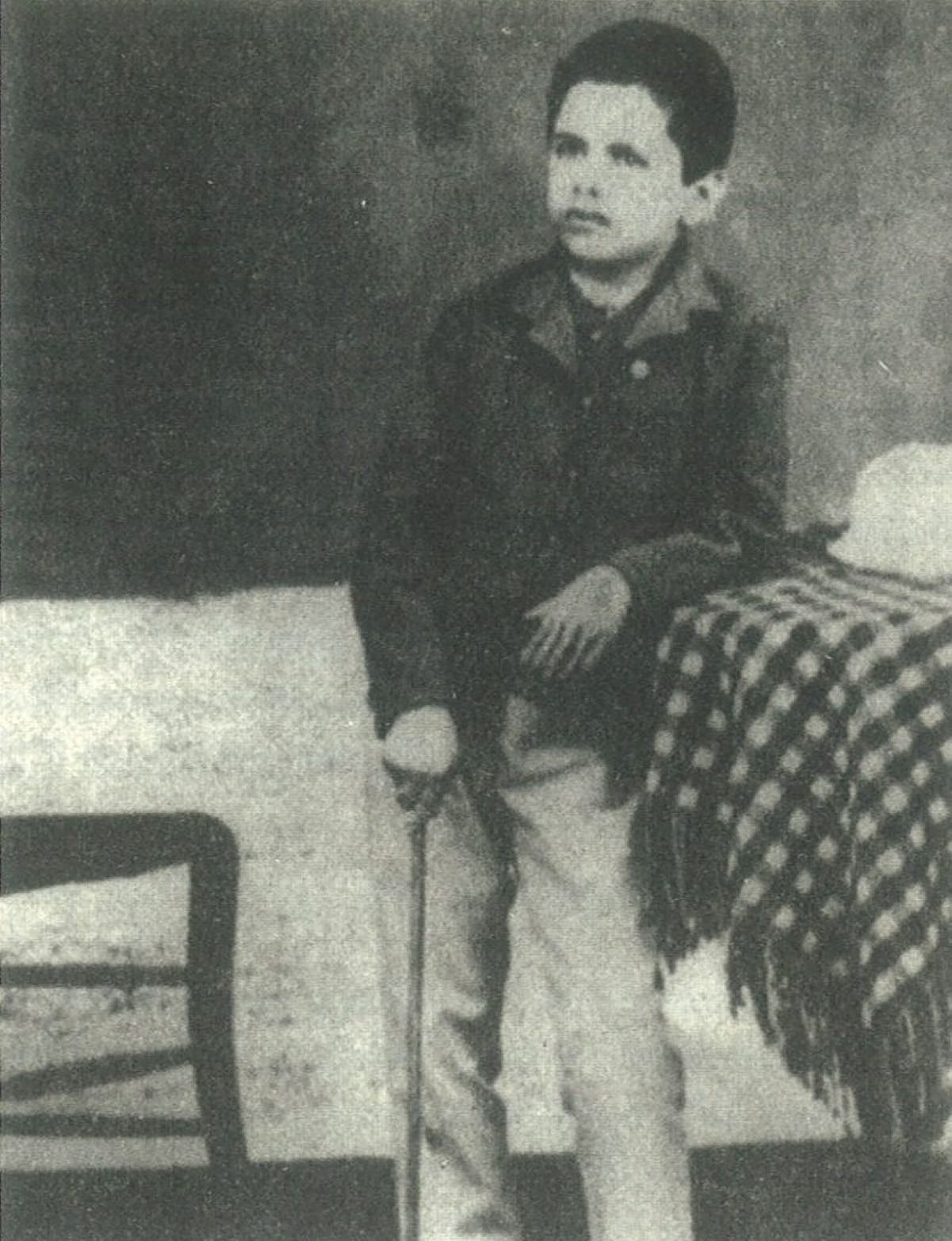
He had begun young — astonishingly young.
“From the age of ten,” he recalled. “I read every book of verse that fell into my hands. Soon after — I cannot remember exactly when — I wrote my first poem, ‘Giouli,’ a love poem, of course.”
Women move through his work in many forms — some faintly sketched, others vividly drawn — yet none corresponds precisely to a single living model.
“The first impulse comes from reality,” he explained. “But before a poem is created, a thousand secret, elusive transmutations and transformations take place within us. So that, often, to write a love poem, it may have been five or six women who warmed our imagination and heart — not just one.”
In life and in death, Palamas embodied what he most revered: the enduring, transforming power of the Greek spirit. His funeral was not merely a farewell. It was a testament — that poetry, at its height, can become history.