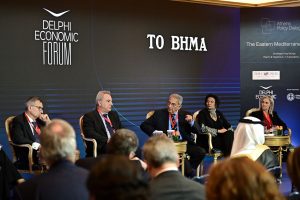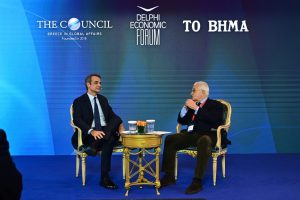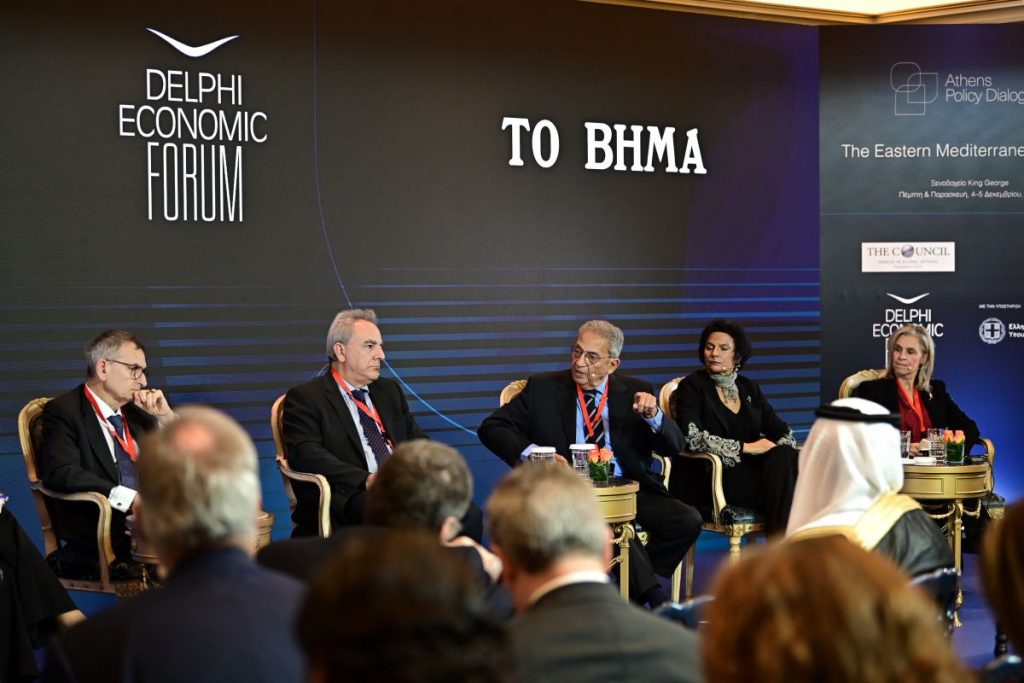
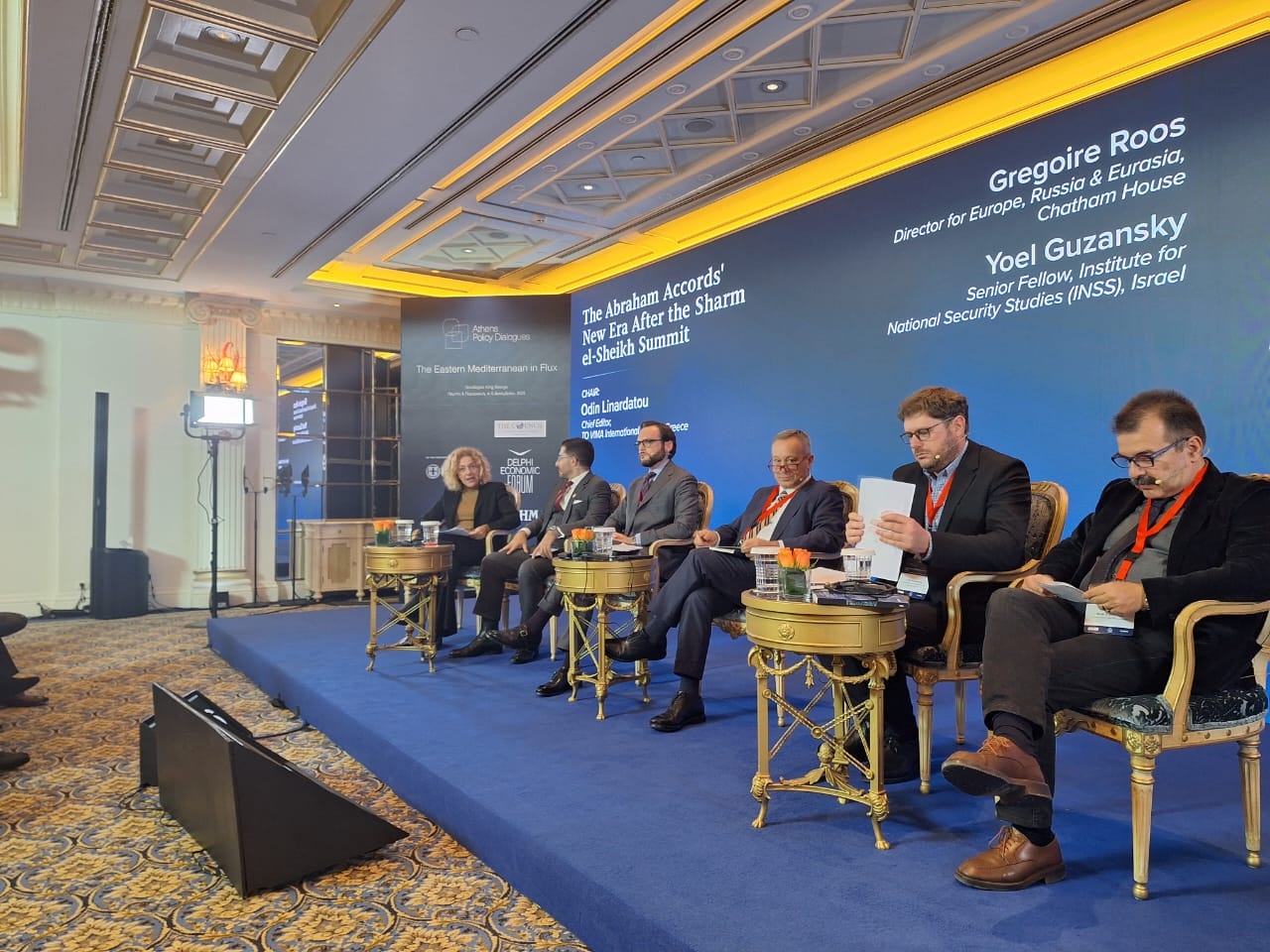
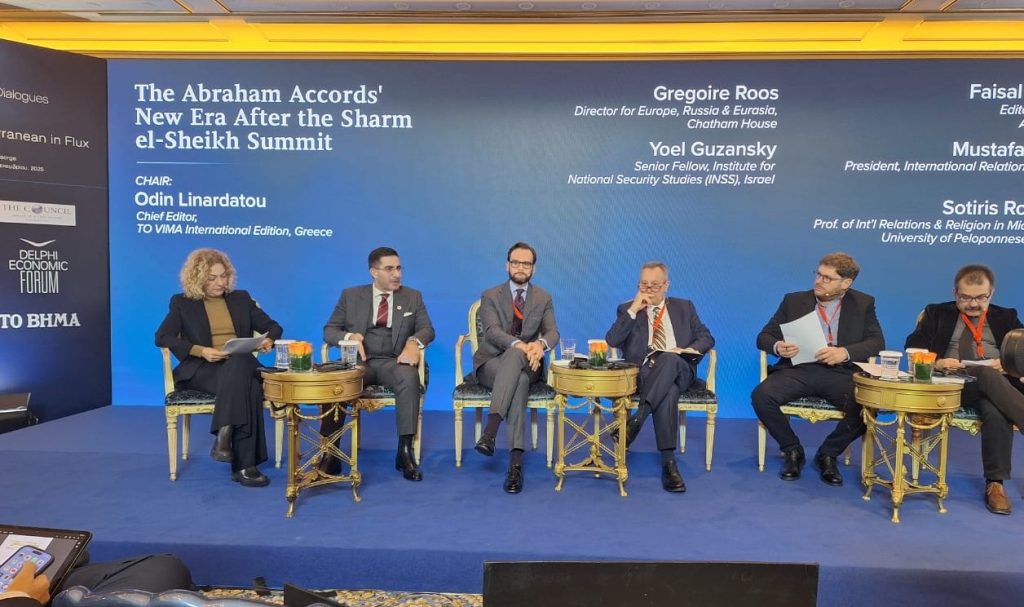
The Abraham Accords after the Sharm El-Shekh Summit, the multinational meeting which ended most of the warfare in Gaza, was the focus of a mid-afternoon panel discussion on Thursday during the first day of the Athens Policy Dialogues.
The event is being organized and hosted by the Delphi Economic Forum, The Council – Greece in Global Affairs and the historic Athens weekly “To VIMA” (Το Βήμα), with this year’s theme entitled ‘The Eastern Mediterranean in Flux’.
The session included panelists Gregoire Roos, the director for Europe, Russia and Eurasia at Chatham House, Yoel Guzansky, a senior fellow at Israel’s Institute for National Security Studies (INSS), Faisal Abbas, editor-in-chief of Arab News, Mustafa Aydin, the president of the International Relations Council in Turkey and Sotirios Roussos, a professor of international relations and religion in the Middle East at the University of the Peloponnese.
To Vima International Edition chief editor Odin Linardatou moderated the discussion.
According to Abbas, the problem with Israel isn’t ideological, but rather a matter of illegal settlements and occupations, not a matter of identity. He also pointed out that none of the countries that signed the Abraham Accords have actual borders with Israel. “Prosperity is being held hostage by this conflict.”
Asked about the relationship between Athens and Riyadh, the Saudi journalist said both sides have great potential as a strategic partnership, while due to Greece’s close ties w Israel it can promote a two-state solution.
Gregoire Roos referred to a significant geopolitical shift regionally and globally, although fragmentation is accelerating. Touching on Europe’s presence and influence, he said that despite its competitive advantage, its multi dynamic tools and assets it has disappeared from the map, “it is not seen or heard.”
Turkish expert Aydin declared himself as “not optimistic”, saying that the United States, for instance, has aimed to reorganize and reshuffle the Middle East three times since the Cold War, and has failed each time.
The first time it had more legitimacy yet failed; the second time it was more comprehensive yet failed; and the third time which is now, it’s a ‘chaotic program’ built on ‘wishful thinking’. We are not close to the second level and even the first level of the ceasefire is proved dubious as killings (in Gaza) have not stopped.”
Aydin estimated that Israel has never been so “powerful”, meaning economically robust and politically influential, while he dismissed assertions of a strategic clash between Israel and Turkey.
“Turkey has not stopped anything with Israel despite its stance, it hasn’t removed ambassadors, it continues supplying Azerbaijan oil, trading; and even if Israel doesn’t like admitting it Turkey was essential in the peace talks as it was the only one who would talk to Hamas. Because at the end of the day Hamas terrorist organization or not, you need communication with it, Turkey provided just that.”
Yoel Guzansky noted that the EU could play a bigger role but, unfortunately, once again it’ll miss another opportunity.
As per the actual conflict at hand, he said the “elephant in the room” is Hamas’ disarmament. He said he fears that Hamas is aiming for a “Hezbollah model”, which it is working on behind the scenes.
“After October 7th trust is difficult to rebuilt because of individual and shared trauma; if we had elections in the West Bank tomorrow Hamas would win.”
Asked about the potential release from an Israeli prison of Palestinian political leader Marwan Barghouti, he said the latter “has a lot of Israeli and Palestinian blood on his hands”.
Finally, Prof. Roussos first noted that Greece previously used to have many channels of dialogue with Middle East actors, “but now we don’t we are alone, thankfully Egypt is still a great partner and bridge…but we are becoming irrelevant in the region”