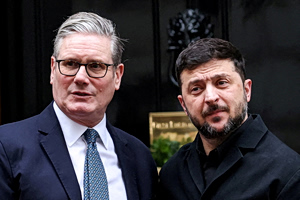
A pale spring light settles over Westminster, glinting off the Thames as commuters drift past the Palace of Westminster. Tourists linger by the gates, snapping photographs, while inside, MPs move through corridors thick with speculation. The mood is uneasy. With local elections looming on 7 May, the scene feels less like routine democracy and more like a prelude to upheaval.
A referendum in all but name
At the centre of that unease is Nigel Farage, who has framed the elections in stark terms.
Launching Reform UK’s campaign, he declared the vote a “referendum” on the premiership of Keir Starmer. For Farage, strong local results would represent not merely council gains but a “stepping stone to change in national government”.
Polling suggests he may have reason for confidence.
A large-scale survey, earlier this week, indicates Reform could take control of between 56 and 69 English councils – a dramatic showing for a party that, until recently, operated on the fringes.
Labour, by contrast, faces the prospect of losing hundreds of councillors, particularly in London, where up to half its current seats could fall.
The idea that local elections serve as a verdict on the government is hardly new. Yet this year, analysts suggest, the effect may be unusually pronounced.
Professor Sir John Curtice of the University of Strathclyde puts it plainly: “there are two big questions. One is more political. What might the impact of the results be on the future of Keir Starmer? The second, and arguably bigger question, is what does this tell us about the future of Britain’s traditional two-party system?”
Curtice adds a stark warning: “these elections take place at a time when Labour’s poll rating is very low, and everybody is looking to see whether or not these do or do not confirm the poll results.” If they do, he suggests, “there may just be a determined attempt to push him (Starmer) out.”
Labour’s gathering storm
For Labour, the immediate outlook is bleak. In England, key battlegrounds such as Sunderland, Barnsley and Gateshead – once reliable strongholds – are now under threat from Reform.
In London, the Greens are poised to challenge in inner boroughs.
Curtice outlines what he calls a worst-case scenario: “If Reform win control of Sunderland, the Greens win control of Lewisham and Labour come third in Wales, that is Keir Starmer’s nightmare.”
The devolved nations offer little respite. “It looks as though the SNP will once again be running the Scottish government,” Curtice notes, while in Wales “the Labour Party is heading for defeat for the first time… since 1931”, potentially leaving it “a poor third”.
Professor of Politics at Queen Mary University of London Tim Bale reinforces the scale of the challenge. “For good or ill, local elections in the UK are almost always a way of voters passing judgement at whoever is in power at Westminster. It’s likely to be a bloodbath,” he says.
He adds that “the government is so unpopular at the moment that it will be doing well not to lose between 1500 to 2000 council seats.”
Professor of Politics in the Department of Politics, School of Histories, Languages and Cultures at the University of Liverpool, Jon Tonge offers a similar assessment. “They are a free hit for voters – an easy way to register dissatisfaction with Starmer’s government but without risky consequences,” he says.
The results, he adds, “set the mood music for the following political year.”
A fragmented political landscape
Beyond the immediate fortunes of Labour, a deeper shift may be underway. Curtice highlights that combined support for Labour and the Conservatives has fallen below 40 per cent in some polls – a striking indicator of eroding dominance.
“The uncertainty is just how much,” he says, referring to gains by smaller parties, “and to what extent these parties actually gain control of individual councils.”
Professor Murray Stewart Leith, Professor of Political Science, Director of the Centre for Migration, Diaspora, Citizenship and Identity at the University of the West of Scotland, situates this within a broader trend.
“Voters now perceive other political parties (and not the Conservative Party) as viable ruling parties,” he explains, pointing to Reform and the Greens as key beneficiaries of public dissatisfaction.
He adds that “local elections remain good indicators of UK wide voting intentions”, and that recent by-elections show Reform and the Greens “often vying against each other for victory.”
Taken together, these developments suggest Britain may be edging towards a more fragmented, multi-party system – a departure from decades of two-party dominance.
Orbán’s fall and Farage’s dilemma
Hovering over this domestic contest is an unexpected international dimension: the fall of Viktor Orbán in Hungary.
For years, Orbán cultivated a network of conservative influence stretching across Europe, including into British politics.
Figures associated with Reform UK have engaged with institutions linked to his government,
Figures associated with Reform UK, including Matt Goodwin and John O’Sullivan, a former speechwriter to Margaret Thatcher and conservative commentator who has participated in Budapest-based think tanks linked to the Hungarian government, have engaged with institutions linked to his government and Farage himself once praised Orbán as “the strongest leader in Europe and the EU’s biggest nightmare”.
But Orbán’s defeat – after 16 years in power – alters that landscape.
“His removal by opposition leader Péter Magyar not only disrupts a key node of this transnational network, but also deprives figures such as Farage of an important ideological ally,” say senior figures within the British government.
The timing is significant. Reform UK enters the May elections at a moment of domestic strength, yet the broader international movement it has drawn from appears less certain.
The weakening of Orbán’s network could limit the flow of ideas, platforms and legitimacy that have helped shape parts of the European right.
At the same time, Keir Starmer has sought to frame Orbán’s defeat as a vindication of democratic values, calling it “an historic moment for European democracy”. That contrast may sharpen the political divide at home.
For Farage, the question is whether Reform’s momentum can be sustained without such international backing. Its appeal – rooted in economic discontent, cultural anxieties and policy positions such as expanded North Sea drilling – remains potent.
But translating local success into national power will require more than protest votes.
A defining moment for Westminster
As the sun sets over Westminster and the lights come on along the embankment, the stakes of the coming elections are hard to ignore.
For Labour, they represent a reckoning with voter dissatisfaction and internal uncertainty. For Reform, an opportunity to transform insurgency into power.
Curtice offers a final note of caution about what may follow. Even if Labour’s position deteriorates sharply, “whether or not in the end moves are made to try and get rid of him (Starmer) is highly uncertain.” The absence of an obvious successor, he suggests, complicates any swift resolution.
What is certain, however, is that these elections will resonate far beyond council chambers.
They will shape perceptions of leadership, test the resilience of established parties, and signal whether Britain is entering a new political era.
On 7 May, as ballots are counted across England, Wales and Scotland, Westminster will be watching closely.
By morning, the political landscape may look very different indeed.