
 Μake us preferred on Google
 The enlargement of the European Union (EU) has reemerged as one of the most pressing issues on Europe’s political agenda. Public opinion across member states shows a clear trend: citizens are broadly supportive of welcoming new countries, provided they meet all necessary criteria.
Widespread Support Across the Bloc
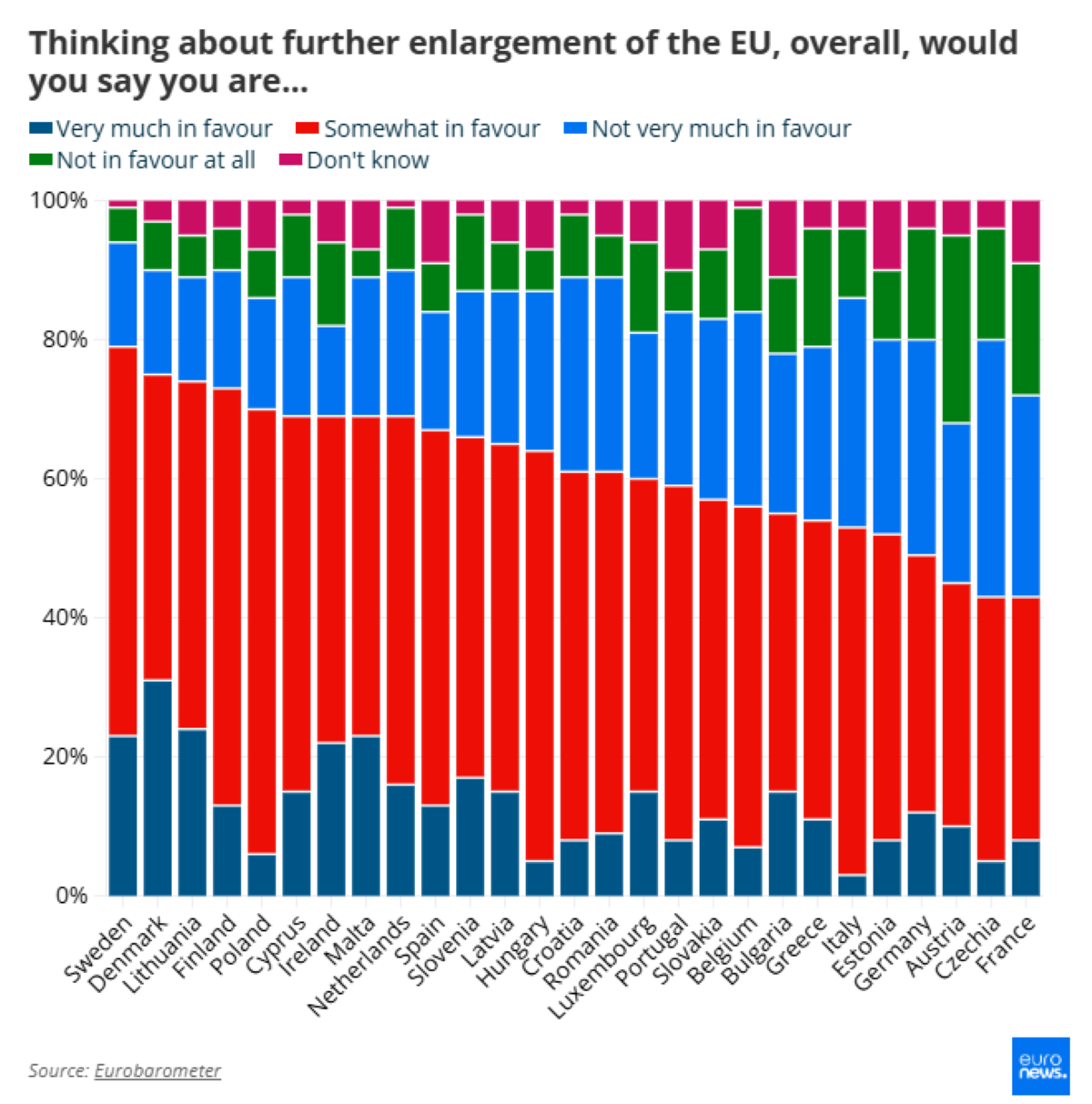
According to the latest Eurobarometer survey, more than half of EU citizens back further enlargement, with around one in ten declaring themselves “strongly in favor.” In 23 of the 27 member states, at least 50% of respondents expressed positive views on admitting new members. Sweden (79%), Denmark (75%) and Lithuania (74%) recorded the highest levels of approval.
Youth Driving Enthusiasm
Younger generations are especially supportive. Two-thirds (67%) of people aged 15–24 favor enlargement, followed by 63% among those aged 25–39. For many young Europeans, expansion is not just a political move but an opportunity for cooperation, mobility and shared growth.
Perceived Benefits and Key Candidates
Citizens see clear advantages in enlargement: greater EU influence globally (37%), expanded markets (37%), more job opportunities (31%) and stronger solidarity among states (30%). Currently, ten countries are seeking membership, including Ukraine, Moldova, Montenegro, North Macedonia, and several Western Balkan states, alongside Turkey.
Ukraine enjoys the highest support, with more than half of Europeans backing its accession. Yet its bid, like Moldova’s, faces obstacles due to Hungary’s veto. Montenegro also fares well, with 51% support overall and ranking as the most favored candidate in seven member states. By contrast, Turkey lags far behind, with fewer than 40% supporting its accession even if it met EU criteria.
Concerns Remain
Despite the broad approval, many Europeans voice reservations. The main worries include uncontrolled migration (40%), corruption and crime (39%), and the financial burden on taxpayers (37%).
The debate on enlargement thus reflects a mix of optimism, pragmatism and caution—signaling both hope for a stronger Europe and anxiety over the challenges ahead.