 Μake us preferred on Google
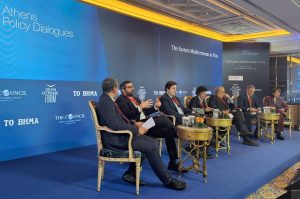
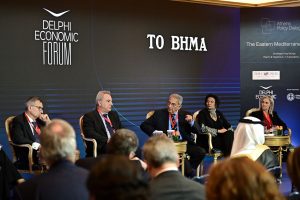
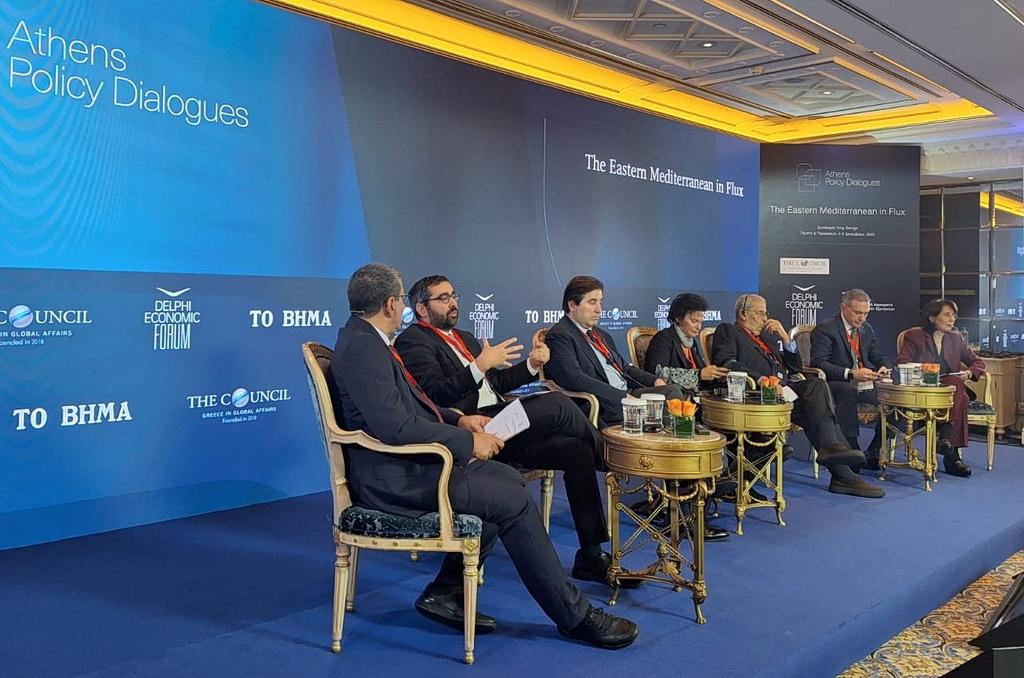
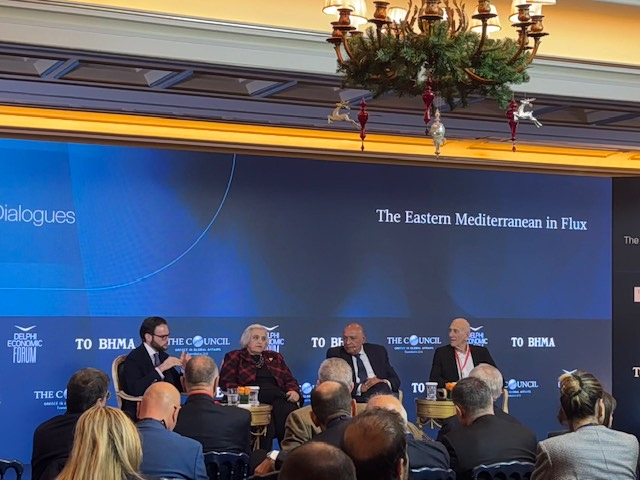
 At the two-day Athens Policy Dialogues in the Greek capital, focusing on the Eastern Mediterranean, a panel — which included Former Israeli Prime Minister Ehud Olmert, Egypt’s former Foreign Minister Sameh Shoukry, and Greek Deputy Foreign Minister Alexandra Papadopoulou, moderated by Gregoire Roos of Chatham House — focused on the “day after” in the Middle East, exploring whether recent developments could pave the way for long-term stability.
Co-hosted by To Vima, the Council on International Relations, and the Delphi Economic Forum, the event brought together political leaders, analysts, and global figures to discuss the shifting geopolitical landscape in the Eastern Mediterranean and the Middle East.
Former Israeli Prime Minister Ehud Olmert delivered an expansive, at times strikingly candid assessment of the war in Gaza and the broader regional dynamics, underscoring that the current ceasefire does not signal a true end to the conflict. Appearing at the conference for the first time — he remarked that past invitations to Athens had fallen through due to war-related flight cancellations making this his first opportunity to attend the conference. Olmert warned that, “The war in Gaza is not over yet completely.”
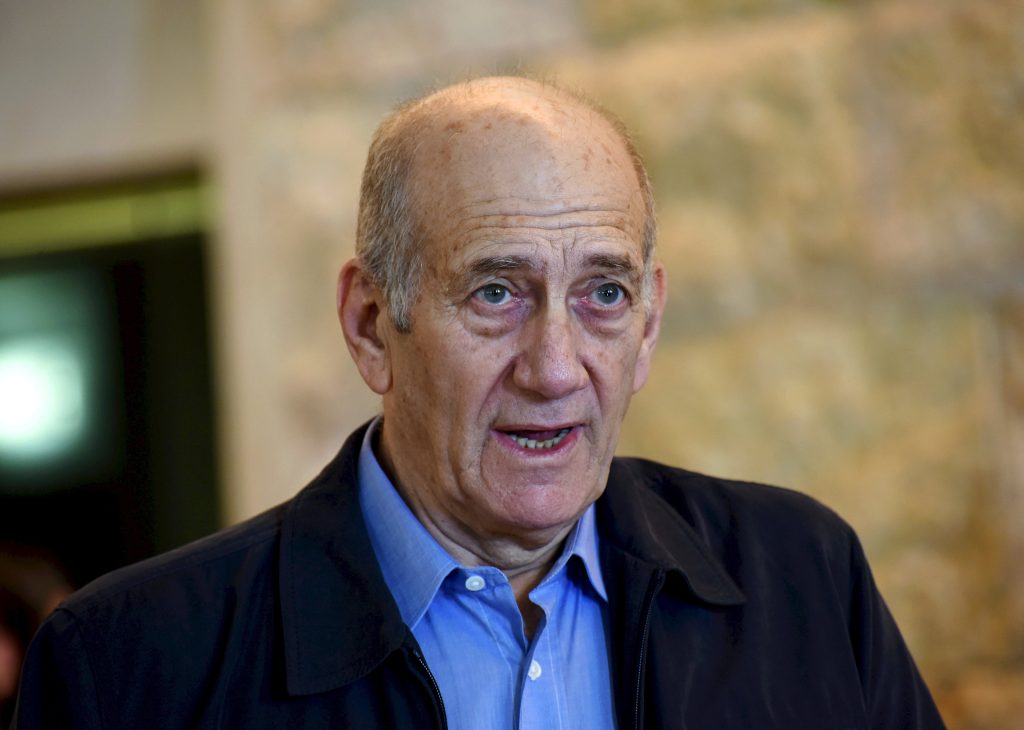
Former Israeli Prime Minister Ehud Olmert REUTERS/Debbie Hill/Pool/Files
He explained that what exists now is a ceasefire agreement linked to a 20-point plan attributed to President Donald Trump, which he stressed is “not a comprehensive peace between Israel and Palestine, but a framework for what will hopefully become a permanent end.” Olmert placed particular emphasis on what he called the “21st point” of the plan — a vague element that he said appears to open a potential political pathway for Palestinians.
According to Olmert, Trump is “anxious for the second phase” of the process; the establishment of a new multinational security force, who he believes should be composed of Palestinians and representatives of “moderate Arab countries” including Egypt, Jordan and the United Arab Emirates. He also stressed that European participation would be beneficial. This force, he said, is intended to “provide the alternative to the military control of Hamas in Gaza,” leading to the group’s disarmament, a new governing structure, and eventually “allowing Israel, according to the framework, to pull out from Gaza.”
Olmert argued that the true strategic breakthrough for the Middle East would begin with renewed dialogue on a two-state solution. While acknowledging he has “no more information than anyone else,” he reflected on the uncertainty surrounding Trump’s larger plan, “I wish I knew, and I wish they knew as well.” Yet he insisted that normalization between Israel and countries such as Saudi Arabia, Indonesia, and states in North Africa could reshape the region in unprecedented ways.
Such normalization, he said, could bring together the resources of major Arab economies with Israel, the United States, and Europe, creating “a dramatic new situation” in which more than half the Islamic world would have diplomatic relations with Israel. This, he suggested, could make the region “one of the most powerful economic areas in the world.” He also noted that Israel has long experienced “a lack of friendship” on the global stage
However, he argued that only one individual has the power to trigger the necessary political shift; “Donald J. Trump.” Olmert praised the efforts of European leaders — mentioning Emmanuel Macron, Keir Starmer, and others — but insisted none of them can influence Israel’s leadership in the way Trump can. “Unless one person carries out their total influence on Prime Minister Netanyahu… and this guy is Donald John Trump,” he said, adding that despite global doubt to Trumps self claimed greatness, if he forces a breakthrough, “the whole world will recognize what he knows about himself — that he is the greatest.”
Reflecting on his own record, Olmert recalled the proposal he presented as Israeli prime minister in 2008: a comprehensive two-state plan involving the end of occupation, Israeli withdrawal from relevant territory with a land swap, and a shared administrative arrangement for Jerusalem. “There can be no peace if one side has exclusive sovereignty over the holy sites,” he said. He noted that the Palestinian leadership at the time did not sign the proposal.
Despite past failures, Olmert maintained an optimistic view: “It could have been done in 2008, but unfortunately it did not. Now it can be done.”

Egypt’s former Foreign Minister Sameh Shoukry underscored the importance of longstanding alliances in the region, highlighting the cooperation between Egypt and Greece. “What matters is recognizing the traditional alliances with many countries,” he said. “For example, Egypt’s relationship with Greece has produced results. Our maritime borders opened a window of optimism for energy resources. This relationship is important for the European Union, as our interests often run parallel.”

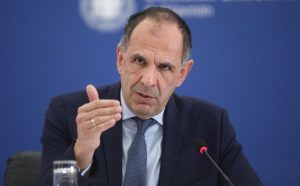
Greek Deputy Foreign Minister Alexandra Papadopoulou pointed to broader regional shifts that are reshaping the Middle East. “The challenges we face are evident,” she noted. “There are many rivalries in the Middle East, and gradually a new map is forming — not one of changing borders, but of a new reality emerging. If one chooses to be optimistic, the end of this path must include a Palestinian homeland and Israel’s integration into the regional security architecture.” She also highlighted that “certain forces and conditions do not want peace in the region.”
Speaking on the region of the Middle East, she emphasized the existent complexities. “The beauty and curse of the Middle East, is that so many problems are connected, and are interlinked… you don’t know where to start or where to finish”