

 Μake us preferred on Google
 According to the European Commission’s Investing in Education 2025 report, one additional year of education can increase a person’s income by around 7% in Europe. Data from Eurostat show that, across 36 European countries, university graduates consistently earn more than those with only medium or lower levels of education.
In 2024, the average disposable household income in the EU was €21,644 after taxes and deductions. When broken down by education level, the differences become stark:
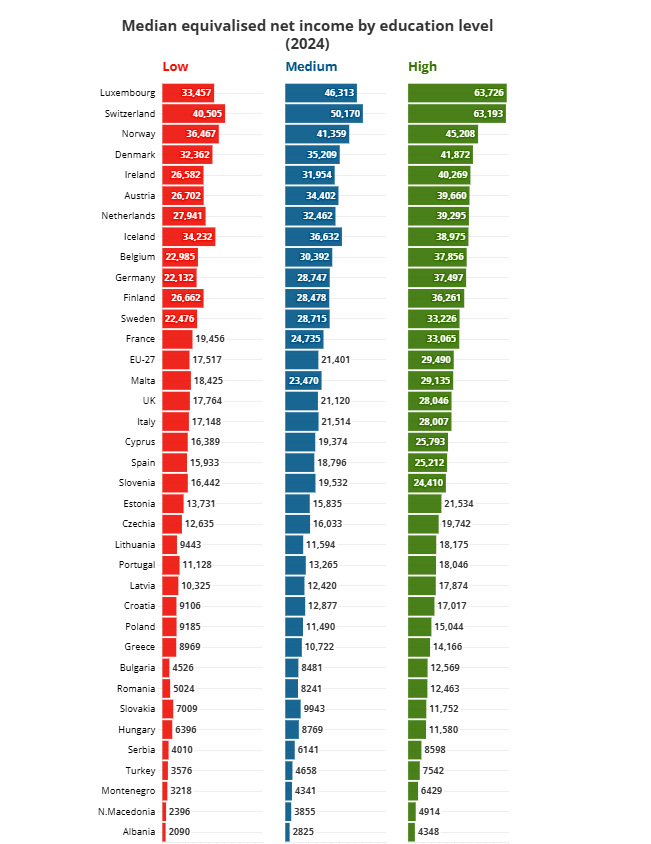
- Low education: €17,517
- Medium education: €21,401
- High education (university level): €29,490
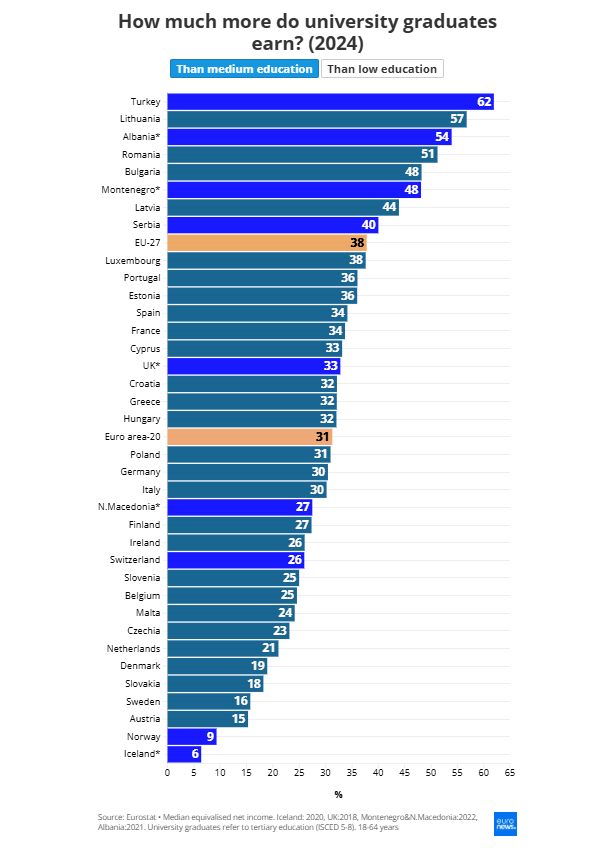
This means that graduates earn 38% more than those with medium education and 68% more than those with lower education.
Income Gaps by Country and Region
The income gap between high and medium education varies greatly—from just 6% in Iceland to 62% in Turkey. Within the EU, it ranges from 15% in Austria to 57% in Lithuania. In Greece, the gap stands at 32%, close to the Eurozone average of 31%.
Regional patterns are clear:
- Eastern and Southeastern Europe show the largest disparities. In countries such as Lithuania, Romania, Bulgaria, Albania, and Serbia, graduates enjoy significant income advantages.
- Scandinavia and parts of Central Europe report smaller gaps, including Iceland (6%), Norway (9%), Sweden (16%), Denmark (19%), and Austria (15%).
- Western Europe’s major economies show moderate gaps: 30% in Italy and Germany, 33% in the UK, and 34% in France and Spain.
High vs. Low Education
The differences are even more pronounced when comparing graduates to those with only basic education. Across the EU, the gap averages 68%, but it ranges widely—from 29% in Denmark to 178% in Bulgaria.
In seven countries—including Bulgaria, Romania, Serbia, Turkey, and Albania—graduates earn at least double what low-educated workers do. By contrast, the smallest gaps are found in Iceland (14%) and Norway (24%).
Greece Among Lowest Graduate Incomes
Despite the advantages of higher education, some countries with lower overall wage levels see graduates earning far less in absolute terms. Among the ten countries with the lowest average net income for university graduates are Albania (€4,348), North Macedonia (€4,919), Montenegro (€6,429), Turkey (€7,542), and Greece (€14,166), which ranks tenth.
Why the Differences Exist
Experts point to national tax and welfare systems, labor market structures, and collective bargaining traditions as key factors. Countries with strong unions, robust minimum standards, and active labor policies—such as those in Scandinavia and Central Europe—tend to show smaller education-related income gaps.
In Germany, Austria, and Switzerland, dual vocational training systems help boost incomes for those with medium education, narrowing the gap with graduates. Conversely, weaker safety nets, greater informal employment, and smaller average company sizes in Eastern and Southeastern Europe contribute to wider disparities.