
Hungary’s political landscape is set for a dramatic after projections on Sunday evening indicated a sweeping victory for the center-right and pro-EU opposition, prompting long-time Prime Minister Viktor Orbán to concede defeat following 16 years of uninterrupted rule by his nationalist and Eurosceptic Fidesz party.
Hungary election results (projection)
🔵 EPP (Magyar) – 132
🔴 PfE (Orban) – 59133 needed for a super majority
29% reported pic.twitter.com/XaceKbkJH0
— Political Polls (@PpollingNumbers) April 12, 2026
With partial results showing a commanding lead, the centre-right opposition movement Tisza, led by Péter Magyar, is projected to secure a two-thirds parliamentary majority — a result that could fundamentally reshape Hungary’s political system.
Orbán Concedes ‘Painful but Clear’ Result
Speaking to supporters in Budapest, Orbán acknowledged the scale of the defeat, even as final results were still pending.
“The election result is not final yet, but it is understandable and clear. The election result is painful for us, but clear,” he said. “The responsibility and possibility of governing was not given to us. I have congratulated the winner.”
Orbán added that Fidesz would transition into opposition and continue to serve Hungary from that role — marking a significant shift for a party that has dominated the country’s politics since 2010.

Peter Magyar, leader of the opposition Tisza speaks during a press conference, on the day of the parliamentary election, in Budapest, Hungary, April 12, 2026. REUTERS/Leonhard Foeger
Opposition Claims Historic Mandate
Magyar confirmed the concession in a social media post, writing that Orbán had personally called to congratulate him on the victory.
“Just now Prime Minister Viktor Orbán has congratulated me on our victory in a phone call,” he said.
According to Hungary’s national election office, with 45.7% of votes counted, Tisza is projected to win 135 seats in the 199-member parliament — enough for a two-thirds supermajority. Such a margin would grant the incoming government sweeping powers to amend laws and implement deep institutional reforms.
By contrast, Fidesz is projected to secure just 57 seats, a dramatic reversal of fortunes for the long-dominant party.
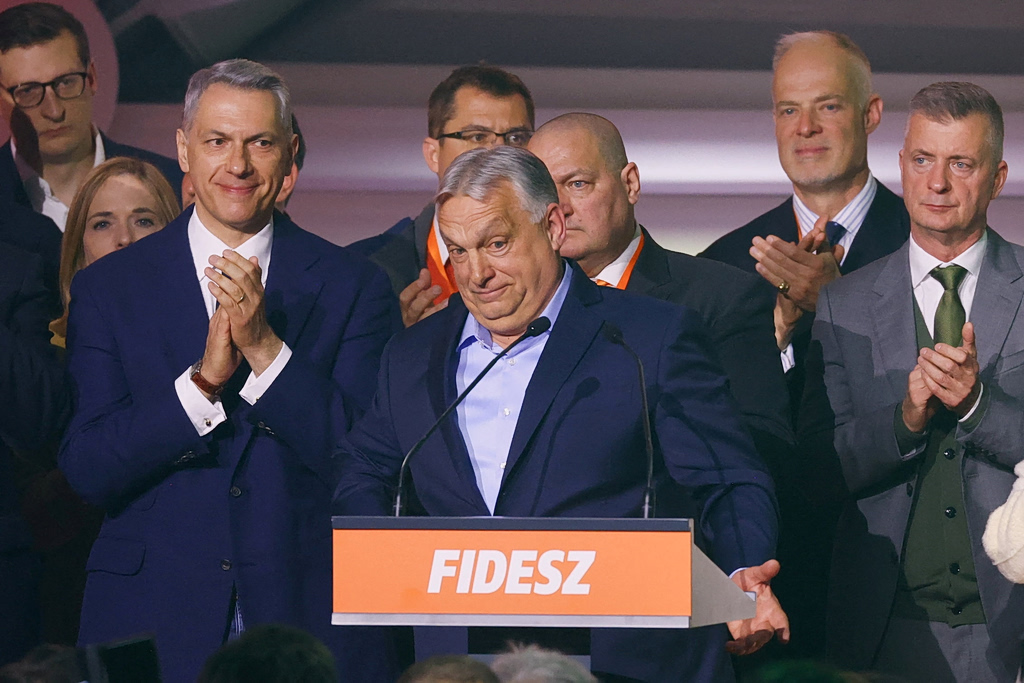
Hungarian Prime Minister Viktor Orban reacts as he addresses supporters after the announcement of the partial results of parliamentary election in Budapest, Hungary, April 12, 2026. REUTERS/Bernadett Szabo
A Turning Point for Hungary
The projected outcome signals a potential turning point for Hungary, where Orbán’s tenure has been defined by nationalist policies, clashes with the European Union, and the centralization of power.
A two-thirds majority for Tisza would allow Magyar’s government to overhaul key institutions, potentially reversing many of Orbán’s constitutional and structural changes over the past decade and a half.
Final results are expected later, but early projections already point to one of the most consequential political shifts in Hungary’s post-communist history.
Magyar posted this on his Facebook account, reading “Thank you Hungary!”: