Protests continued across Iran late Friday and into Saturday despite authorities cutting internet access and international telephone lines and issuing increasingly stark warnings of a severe crackdown on demonstrators.
The unrest, which began in late December over Iran’s worsening economic conditions, has evolved into the most serious challenge to the Islamic Republic’s leadership in years. At least 65 people have been killed since December 28 and more than 2,300 detained, according to the U.S.-based Human Rights Activists News Agency.
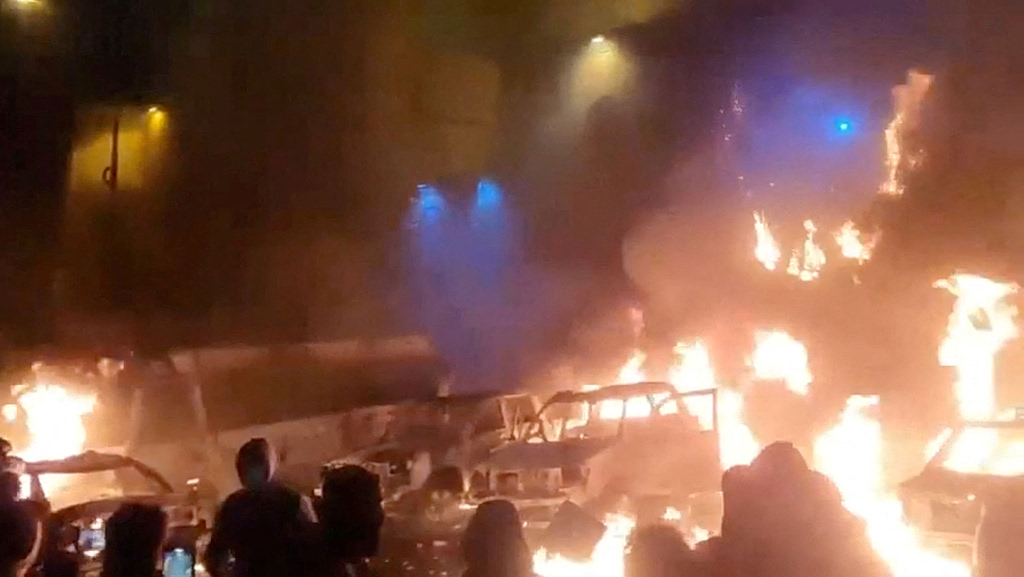
Protesters gather as vehicles burn, amid evolving anti-government unrest, in Tehran, Iran, in this screen grab obtained from a social media video released on January 9, 2026. Social Media/via REUTERS VERIFICATION: – Buildings, business signage and traffic light matched file and satellite imagery – Date not verified – Witnesses told Reuters protesters gathered in the streets on Thursday (January 8)
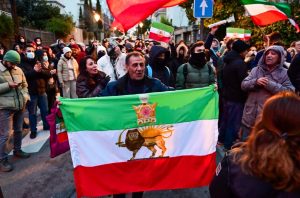
Despite communication restrictions, videos shared by activists appeared to show protesters chanting against the government around bonfires, with debris littering streets in Tehran and other cities. Demonstrations reportedly resumed Friday night even after security forces warned families to keep their children at home. It was not immediately possible to assess the full scale of the protests.
According to the BBC, hospitals in Tehran have been overwhelmed by the number of injured demonstrators. One doctor told the broadcaster that an eye hospital in the capital had entered crisis mode, while another medic said their facility lacked enough surgeons to cope with the influx of patients.
Crackdown intensifies
On Saturday, Iran’s authorities signalled a further escalation. The semi-official Tasnim news agency reported the arrest of 100 “armed rioters” in the town of Baharestan, near Tehran.
In a statement broadcast on state television, the Islamic Revolutionary Guards Corps (IRGC) accused “terrorists” of targeting military and law enforcement bases over the past two nights. The IRGC said several civilians and security personnel had been killed, while public and private property had been set on fire.
Safeguarding the achievements of the Islamic Revolution and maintaining security was described as a “red line” for the force.
Iranian protesters set fire to Karaj District Municipality building. pic.twitter.com/ceKsTAPqcZ
— Clash Report (@clashreport) January 10, 2026
Iran’s regular army also issued a statement saying it would “protect and safeguard national interests, the country’s strategic infrastructure, and public property,” underscoring a unified stance among the country’s security institutions.
A witness in western Iran told Reuters by phone that Revolutionary Guards had been deployed in the area and were opening fire. The witness declined to be identified for safety reasons.
Medical staff also reported worsening violence. Speaking to Reuters, a doctor in northwestern Iran said large numbers of injured protesters had been brought to hospitals since Friday. Many showed signs of severe beatings, including head injuries, broken arms and legs, and deep cuts.
The doctor said at least 20 people in one hospital had been shot with live ammunition, five of whom later died.
Hard line from Iran’s leadership
Earlier, Supreme Leader Ayatollah Ali Khamenei vowed not to back down, accusing demonstrators of acting on behalf of opposition groups abroad and the United States. Iranian state media labelled the protesters “terrorists,” raising fears of a violent crackdown similar to those seen during previous unrest.
Addressing supporters at his compound in Tehran, Khamenei dismissed U.S. President Donald Trump, saying his hands were “stained with the blood of Iranians,” as crowds chanted “Death to America!”
Iran’s judiciary chief, Gholamhossein Mohseni-Ejei, warned that punishment for protesters would be “decisive, maximum and without any legal leniency,” while a public prosecutor threatened death sentences.
International reaction and U.S. warnings
Late Friday, German Chancellor Friedrich Merz, British Prime Minister Keir Starmer and French President Emmanuel Macron issued a joint statement condemning reports of deadly violence and urging Iran to allow citizens to express themselves without fear of reprisal.
Nobel Peace Prize laureate Shirin Ebadi called on Western governments to denounce Iran’s leadership, saying the regime “has made cruelty a governing method.”
President Trump reiterated threats of U.S. military action if protesters were killed, warning Iranian leaders: “You better not start shooting because we’ll start shooting too.”