Patrice Caine is not simply the chairman and chief executive officer of the Thales Group, one of the largest defense companies worldwide. He represents the embodiment of a French and European ecosystem with the mentality that Europe can and must do more to become independent in the defense sector.
In this exclusive and rare interview, in the sense that he does not often speak to the media, he tells “To Vima” that the only thing preventing Europe from “emancipating itself” from its past in the field of defense is political will. He shares the view of many in Europe that the continent possesses all the necessary technological and financial guarantees to become a global player in defense procurement and to fill the gap in the areas for which it relies on the USA.
Mr Caine, you have said that Europe can already produce everything it needs for its defense. In which areas must it focus to achieve independence?
“This, first of all, is primarily a political decision of each country separately. Defense is a national, not a European, prerogative. The argument that European countries or companies would not be in a position to supply defense systems of any kind on a par with those of the USA is a lie. It may be a politically pretextual argument, but it is not the reality. Europe already has companies that possess the knowledge and the ability to manufacture fighter aircraft, helicopters, submarines, warships, battle tanks. There are very, very few capabilities that Europe does not have. However, we possess the technological know-how to provide them, if we are asked”.
What would be one such example?
“Early warning for the detection of intercontinental ballistic missiles. At this moment Europe, including France, does not have it. We rely on the capabilities of the USA. There are two ways to detect a launch of intercontinental ballistic missiles: ground-based radars or space platforms. As regards these two capabilities – and here I am speaking on behalf of Thales, not on behalf of European industry as a whole – we possess the skills and the technologies to do it”.
For both?
“Yes. First, for ground-based radars, capable of ‘seeing’ several thousand kilometers away, we have been conducting studies for years that are funded by the French Ministry of Defense and we know exactly what we must do. It is simply a question of priorities and funding. Second, for the space-based early-warning capability that is based on infrared technology. Infrared technology is the same that has been developed and used in weather-forecasting satellites. Therefore, we have it. And I repeat, it is not a question of whether we possess the technology or the skills, it is a question of money. If several countries across Europe say that they want to use this technology jointly and to fund it, Europe can become independent in this field”.
So, must this be the number one priority for Europe?
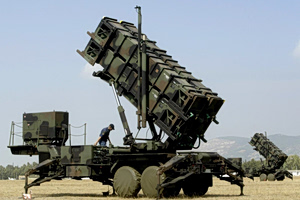
“It is a capability that is unquestionably lacking in European countries. A second priority is supersonic missiles. European countries do not have them. Incidentally, a decision has been taken by France, Germany and the United Kingdom to work on them. This shows that Europe truly believes that it possesses the skills and the ability to move autonomously, without turning to the USA. And would the USA even be willing to export missiles of this type? Perhaps yes, perhaps not”.
Your position echoes what the French president Emmanuel Macron has said.
“Yes, it is consistent with what President Macron has said since 2017. More and more European leaders, including incidentally those in Greece and in other countries such as in Scandinavia, think the same. Denmark, for example, is buying the SAMP/T air-defense system from France and Italy. European countries have truly begun to change their mentality and to say ‘we must gain control of our destiny’”.
Have you spoken about this with your colleagues in the defense industry?
“Of course! I do not believe that I am the only one who thinks this way. If you discuss it with the chief executive officer of Leonardo or Airbus, I think that you will receive similar answers. And allow me to add one more thing that is important: this does not constitute an anti-American position. Quite the contrary! Thales has 4,000-5,000 employees in the USA and we produce work for many American clients, even for the US Department of Defense. As Thales we follow a multinational strategic approach: when we serve European countries our aim is to do so within Europe, using European capabilities. This in no way excludes cooperation with the USA or their support, they are our allies”.
The U.S. asked Europe to acquire such capabilities. In essence, they demanded it.
“You are right to remind us that it was a clear request from the USA to Europe, to take its fate into its own hands. That is, to invest money, to develop and to buy such systems, instead of relying on NATO – which in reality means on the USA. The only, perhaps, drawback of the American demand is that they ask Europe to continue buying American systems. This has been expressed, indirectly admittedly, but in any case this is not fully consistent with taking your fate into your own hands. However, the Americans’ request that Europe itself pay for its security is legitimate. I cannot dispute it”.
Even if the U.S. had not said it…
“We should have done it spontaneously. Correct! But now the Americans are urging us on. Let us do it, then! Let us mobilize sufficient financial resources. We have the engineers, we have the skills, we have the technologies in almost all areas, in 99% of cases. It is only a matter of political will to emancipate ourselves from our history”.
How would you characterize the strategic relationship between Greece and France in the broader context of things? They have come closer than ever at a strategic level.
“First, I too observe the same. The strategic relationship between France and Greece has never been as close as it is today. I think that this is excellent for both countries. Second, this is reflected in the fact that France shares with Greece key systems such as the Rafale, the FDI and others. When the two countries share the same means, this constitutes a factor that facilitates strategic cooperation. Perhaps it is also a matter of personalities, we cannot ignore the human aspect of a bilateral relationship and although ultimately it is about two countries, the relationship is also determined by the individuals. Finally, the more interconnected Greek and French industries are, the stronger and more sustainable this relationship will be, which means that it will not depend on the – currently excellent – relationship between the Greek prime minister and the French president, but will broaden autonomously”.