A South Korean court on Friday sentenced former President Yoon Suk Yeol to five years in prison, delivering the first ruling in a series of criminal cases stemming from his failed attempt to impose martial law in December 2024.
The Seoul Central District Court found Yoon guilty of obstructing authorities who sought to arrest him, ruling that he mobilized the presidential security service to block investigators from executing a lawful arrest warrant. He was also convicted of fabricating official documents and failing to follow the legal procedures required to declare martial law, which must be discussed at a formal cabinet meeting.
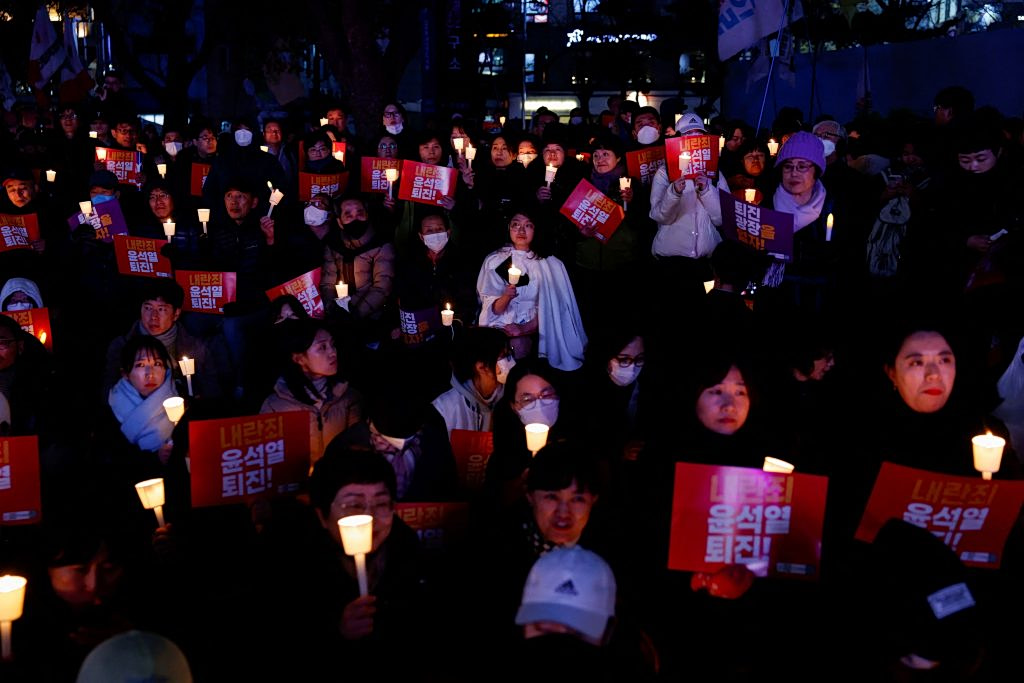
People attend a candlelight vigil condemning South Korean President Yoon Suk Yeol’s surprise declaration of martial law last night, which was reversed hours later, and to call for his resignation, in Seoul, South Korea, December 4, 2024. REUTERS/Kim Kyung-Hoon
“The defendant abused his enormous influence as president to prevent the execution of legitimate warrants,” the presiding judge said, adding that Yoon had effectively used state officials loyal to the Republic of Korea for personal protection and gain.
Yoon, 65, listened silently as the verdict was read during televised proceedings. Looking noticeably slimmer than when the investigation began, the former prosecutor showed no visible reaction as the sentence was announced in a courtroom filled with supporters.
One of his lawyers, Yoo Jung-hwa, said Yoon would appeal the ruling, calling the decision politicized. As reported in Reuters, prosecutors declined to comment on whether they would seek an appeal, which is permitted under South Korean law.
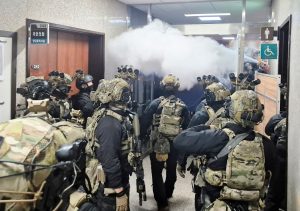
The obstruction charges carried a possible sentence of up to 10 years in prison. They relate to Yoon barricading himself inside his residential compound in January last year and ordering the presidential security service to block investigators. He was eventually arrested in a second operation involving more than 3,000 police officers, becoming the first sitting president in South Korea to be taken into custody.
Yoon remains in detention at the Seoul Detention Center on the outskirts of the capital. He has argued that declaring martial law was within his presidential powers and said the move was intended to warn of what he described as obstruction of government by opposition parties.
Outside the court, dozens of supporters gathered under heavy police security, holding placards claiming Yoon was the victim of a political witch hunt and insisting he remained the legitimate president.
Parliament moved swiftly to overturn Yoon’s surprise martial law decree, which lasted about six hours, and later impeached him with support from some members of his own conservative party. The Constitutional Court formally removed him from office in April last year, ruling that he had violated his constitutional duties.
Yoon also faces separate trials, including one in which prosecutors have sought the death penalty for allegedly masterminding an insurrection by attempting to impose military rule and suspend parliament.