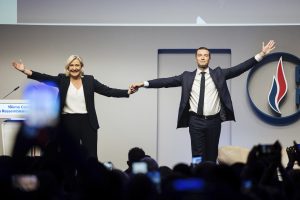
The recent publication of the United States National Security Strategy (NSA) triggered reactions in Europe that went beyond the narrow debate on geopolitics. For many, the NSA was interpreted as an indirect intervention in favor of the European far right. Not because it explicitly supports far-right parties or figures, but because it legitimizes themes—such as security, internal threats, and closed national borders—that constitute the core of the far-right agenda.
Europe appears primarily as a field of strategic confrontation and less as an autonomous political space, while the democratic crisis is described mainly as cultural rather than social; it is associated with changes in national-cultural identities rather than with inequalities, socio-economic problems, and successive crises. While the recent US NSS does not constitute (yet) a direct intervention in the traditional sense in favor of the European far right, it represents something more subtle—and perhaps for that reason more effective: by shifting the framework in which the far right no longer appears extreme, Washington contributes to the further normalization of its discourse and stakes, and thus to its political acceptance, opening the way for electoral support.
Of course, this history of transatlantic normalization of the far right does not start with Trump. Pre-Trump official US strategy aimed to strengthen liberal democracy and “export” it beyond the West, to support the EU as a partner, and to collaborate with established center-right and center-left parties in power, while the European far right was considered incompatible with the values officially promoted by US foreign policy.
However, gray areas can already be identified from earlier times. American conservative think tanks, particularly those with neoconservative or ultra-conservative ideological leanings, maintained informal contacts with nationalist circles in Europe and shared positions on issues such as migration, security, and anti-Islamism. In this way, they helped shape a transatlantic discursive framework with strong references to criticizing multiculturalism, simultaneously acting as ideological hubs and bridges for arguments on both sides of the Atlantic. Especially after 2001, intense security rhetoric and Islamophobic discourse in certain US media and circles indirectly favored the strengthening of European far-right narratives, without implying direct cooperation.
Regarding Eastern European countries, the US cooperated with nationalist parties or governments (Hungary, Poland, Baltic states, etc.), not due to support for far-right ideology, but primarily because of the anti-communist orientation of parties and governments in the former communist bloc. The qualitative shift in this relationship occurred after 2016, during Trump’s first term, when the US abandoned its prior practice of distancing from the European far right and developed an open rhetoric supporting European far-right parties and endorsing their positions.
The break in prior political stances did not officially come through the State Department but through figures in Trump’s circle (e.g., Steve Bannon) who established contacts with far-right networks aiming to create an international front. While this front did not consolidate, it created a sense of political legitimacy and laid the foundations for international support for the European far right. For the European far right itself, this development was decisive, as it provided prestige and access to networks, contributing to its destigmatization and long-term perception as a force with elective affinities to totalitarian pasts.
The acceleration of far-right normalization is not limited to the transatlantic environment but occurs simultaneously in the broader international sphere. From Latin America to Asia, and from northern to southern Europe, authoritarian right-wing populist political forms are emerging, which, despite ideological differences, share common features: instrumentalizing security issues, strengthening executive power, and invoking “popular will” over mediating institutions.
The rise of leaders such as Bolsonaro in Brazil, Bukele in El Salvador, Milei in Argentina, Orbán in Hungary, and of course Trump in the US demonstrates a dynamic that is not limited to party structures but is expressed through personalized models of authoritarian power, further reinforcing the international normalization of the far right. While the postwar European far right was isolated, stigmatized, without political allies or meaningful networking prospects, in the 21st century it has established itself as an international phenomenon, now presented as a political option adaptable to different political contexts. This is achieved not through ideological dominance, but primarily through normalization of its discourse and gradual redefinition of the politically acceptable value framework.
In Greece, the far right does not appear as a strong party force or a stable component of the party system. Nevertheless, the normalization process has advanced significantly. Anti-immigration positions have spread widely across the political spectrum, ethnocentrism often resurfaces in public discourse under the pretext of “national issues,” while established socio-cultural topics (e.g., gender identities and personal choices) are easily stigmatized as a “woke agenda.” Although Greece belongs to the European core as the tenth EU member, “hard” anti-European sentiment gained traction during the economic crisis and continues to function as a convenient mechanism for shifting responsibility. The EU is often transformed into a “scapegoat,” behind which chronic weaknesses of the Greek state (clientelism), governance rigidities (rejection of political consensus), and the egoistic attitudes of the political elite are hidden, favoring simplistic interpretations that further contribute to the normalization of far-right logic.
The “transatlantic revisionism” is one side of the coin; the other is the transatlantic and international normalization of the far right, a process in which Trump acted as an accelerator, but not as the sole protagonist of the ongoing evolution.
Vassiliki Georgiadou is Professor of Political Science at Panteion University, and director and president of the board of the National Centre for Social Research (EKKE).