
 Μake us preferred on Google
 U.S. President Donald Trump announced a sweeping new trade agreement with Japan late Tuesday, calling it “perhaps the biggest deal ever made.” The deal introduces reciprocal 15% tariffs on goods exchanged between the two countries, replacing a previously threatened 25% U.S. tariff and ending a temporary 10% rate that had applied during negotiations.
The agreement marks a bold continuation of Trump’s aggressive trade stance, even toward key allies. Dozens of countries now face a looming August 1 deadline to reach similar deals or risk increased U.S. tariffs.
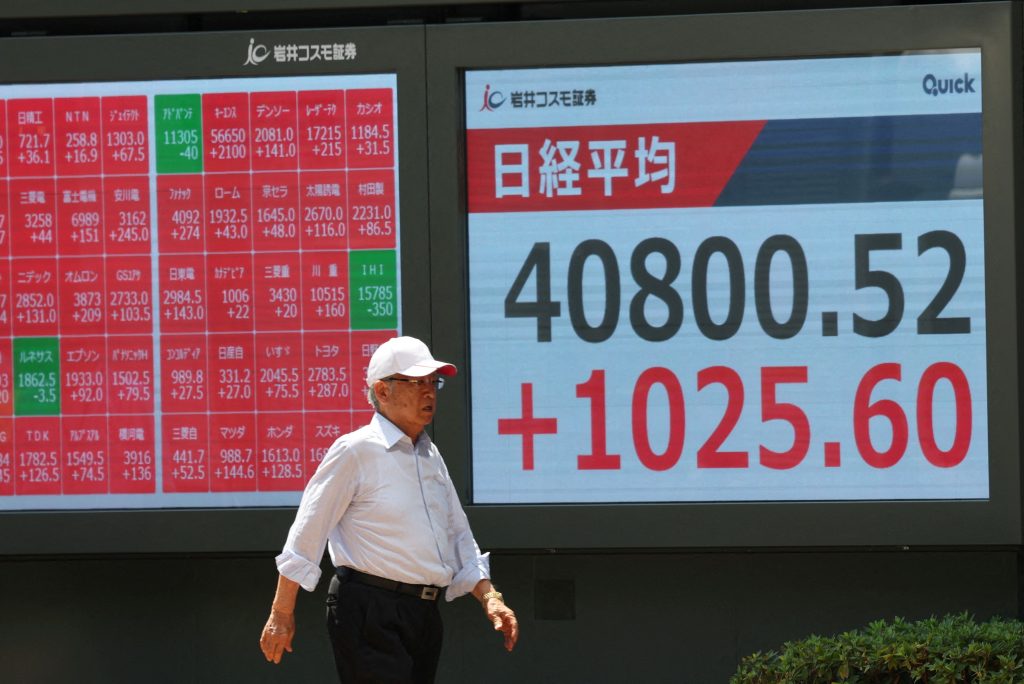
A man walks in front a stock quotation board showing the Nikkei share average outside a brokerage in Tokyo, Japan, July 23, 2025. REUTERS/Kim Kyung-Hoon TPX IMAGES OF THE DAY
Market Access and Tariff Adjustments
As part of the agreement, Japan has committed to opening its markets to U.S. automobiles and rice — two sectors that had long been contentious in bilateral trade talks. Japanese Prime Minister Shigeru Ishiba confirmed that Japan will reduce its tariffs on automobiles and parts to 15%, down from 25%, and without imposing any quotas. U.S. officials echoed that the U.S. will apply a matching 15% tariff on Japanese car imports.
Despite these developments, Trump did not clarify whether Japan would receive relief from the steep 50% U.S. tariffs on steel and aluminum imports.

FILE PHOTO: People react as they read a special edition of Yomiuri Shimbun newspaper reporting the tariff deal agreement between U.S and Japan, in Tokyo, Japan, July 23, 2025. REUTERS/Kim Kyung-Hoon TPX IMAGES OF THE DAY/File Photo
Industry Reactions and Market Response
The announcement caused a spike in Japanese automotive stocks: Toyota and Honda shares jumped by 9%, while Subaru and Mitsubishi Motors rose over 12%. Japan’s Topix stock index climbed 2.1% in early Tokyo trading. However, the yen fell slightly against the dollar.
The American Automotive Policy Council, representing Ford, GM, and Stellantis, expressed concern. President Matt Blunt warned that the deal could harm the U.S. auto sector if it provides Japan preferential treatment while maintaining high tariffs on North American-made vehicles with significant U.S. content.
Multi-Billion Dollar Japanese Investment in the U.S.
Trump also claimed Japan would invest $550 billion into the U.S. economy — an extraordinary figure for which he did not offer specifics on timing or funding sources. He asserted the U.S. would capture 90% of the profits from those investments, which he said would generate “hundreds of thousands of jobs.”

FILE PHOTO: U.S. President Donald Trump meets with Japan’s Prime Minister Shigeru Ishiba at the White House in Washington, U.S., February 7, 2025. REUTERS/Kent Nishimura/File Photo
Prime Minister Ishiba stated the investment would target critical supply chains in semiconductors, shipbuilding, aviation, energy, and artificial intelligence. Trump added that the two countries would also launch a liquefied natural gas (LNG) joint venture in Alaska.
A Deal Amid Domestic Shifts
The trade deal comes at a politically turbulent time for Ishiba, whose Liberal Democratic Party recently suffered losses in Japan’s Upper House elections — a blow that could limit his legislative agenda.
While the U.S. has recently concluded trade discussions with the UK, Indonesia, and other Asian nations like Vietnam and the Philippines, most of these agreements have yet to be formalized in writing. The U.S. has also signaled a partial de-escalation in tariffs with China.