U.S. President Donald Trump’s lunch with Pakistan’s military chief at the White House has drawn sharp concern from New Delhi, leading to a private diplomatic protest and a broader reassessment of India’s regional strategy, including its approach toward China, Indian officials and analysts said.
The high-profile meeting with Field Marshal Asim Munir marked a notable shift in U.S. policy towards Pakistan and came just weeks after a deadly flare-up between the two nuclear-armed neighbors. Indian officials say the move undermines trust with Washington and risks unsettling years of close cooperation.
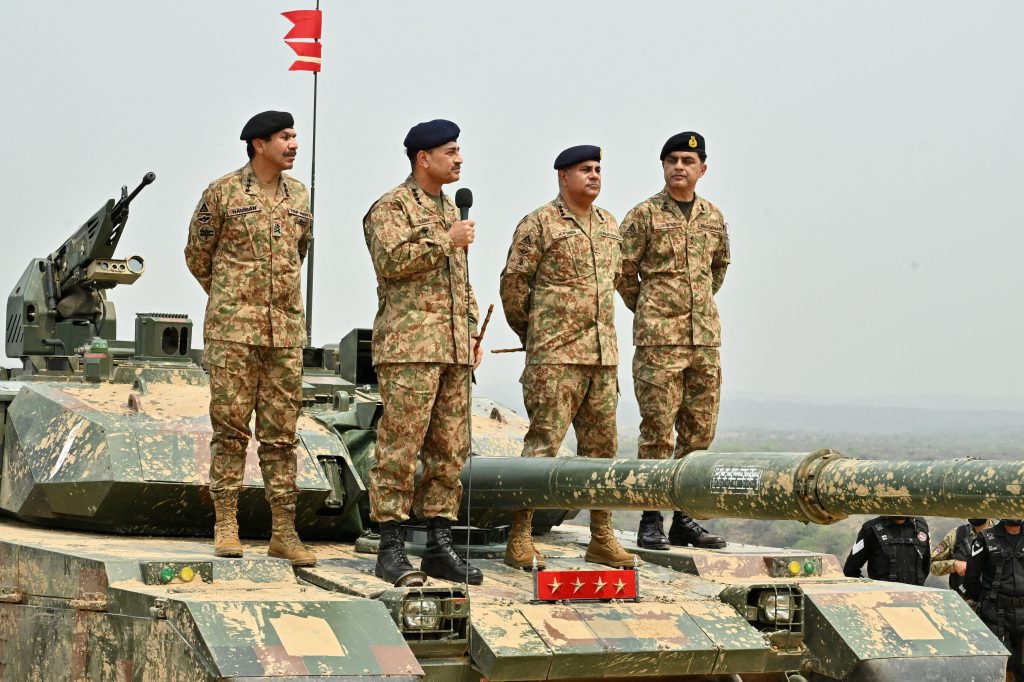
FILE PHOTO: Chief of Army Staff of Pakistan Asim Munir holds a microphone during his visit at the Tilla Field Firing Ranges (TFFR) to witness the Exercise Hammer Strike, a high-intensity field training exercise conducted by the Pakistan Army’s Mangla Strike Corps, in Mangla, Pakistan May 1, 2025. Inter-Services Public Relations (ISPR)/Handout via REUTERS THIS IMAGE HAS BEEN SUPPLIED BY A THIRD PARTY/File Photo
Indian leaders conveyed their disapproval in separate calls to U.S. counterparts shortly after the June 18 meeting, warning that Trump’s warm outreach to Pakistan’s military—seen in India as the architect of cross-border attacks—sends the wrong message.
India accuses Pakistan’s military of backing militant activity, especially in Kashmir. Pakistan denies the charge and has consistently said that India has failed to present evidence of its claims.
Although U.S.-India ties have deepened over the past two decades, largely fueled by shared concerns over China’s rise, the recent developments have introduced a rare chill.
A Shift in Balance
The situation has already slowed trade negotiations and prompted India to reject Trump’s invitation for a Washington visit after the recent G7 summit. Prime Minister Narendra Modi’s office, which has not publicly commented on the Trump-Munir meeting, is reportedly recalibrating ties with China as a strategic hedge.

FILE PHOTO: U.S. President Donald Trump listens as Indian Prime Minister Narendra Modi speaks during a joint press conference at the White House in Washington, D.C., U.S., February 13, 2025. REUTERS/Nathan Howard/File Photo
According to Reuters, Harsh Pant, head of foreign policy at the Observer Research Foundation, a New Delhi-based think tank, said that “There is certainly an outreach to “And I think it is mutual… China is also reaching out.”
Last week, Indian Foreign Minister Subrahmanyam Jaishankar traveled to Beijing for the first time since the deadly 2020 border clash. India has also begun easing restrictions on Chinese investments imposed after the same incident.
While relations between the two Asian powers remain tense, analysts believe India’s concern about Trump’s unpredictable dealings with Beijing has encouraged a temporary thaw.
Lunch That Stirred the Region
Trump’s decision to host Munir—unaccompanied by civilian Pakistani leaders—has particularly unsettled New Delhi. It was the first time a U.S. president had invited a Pakistani army chief for such a meeting, raising fears that renewed U.S.-Pakistan military collaboration could destabilize the region.
According to Pakistani sources, as reported by Reuters, Trump and Munir discussed counter-terrorism cooperation and future arms support—another flashpoint for India, which worries that any U.S.-supplied weapons could be used against it in future conflicts.
“The concern this time around is Trump’s unpredictability extending into the trade realm, with his approach to tariffs,” said Michael Kugelman, a Washington-based expert at the Asia Pacific Foundation. “The U.S. engaging Pakistan so actively without addressing India’s concerns is contributing to a sense of diplomatic unease.”
Strategic Setbacks and Symbolism
The tension comes on the heels of a four-day military conflict in May, when India carried out strikes against what it described as terrorist camps in Pakistan following an attack on Hindu tourists in Kashmir. The skirmish ended in a ceasefire, but Trump’s claim that U.S. mediation helped avert nuclear war triggered a sharp rebuttal from Modi’s government, which credited army-level negotiations instead.
India’s Jaishankar has accused Munir of holding an extremist religious ideology, citing the Kashmir incident. Pakistan, meanwhile, says Modi’s own Hindu nationalist policies are marginalizing Muslims and driving regional instability.

FILE PHOTO: A man walks past a screen displaying U.S. President Donald Trump, at the Bombay Stock Exchange (BSE) ahead of Trump’s tariff plans, in Mumbai, India, April 2, 2025. REUTERS/Francis Mascarenhas//File Photo
Despite public displays of warmth in previous years, Trump and Modi now appear increasingly at odds. India’s recent move to propose retaliatory tariffs at the World Trade Organization underscores how far the mood has shifted.
While India remains wary of China’s ambitions and its close military ties with Pakistan, the current strategic recalibration reflects a desire to keep options open in a rapidly evolving geopolitical landscape.