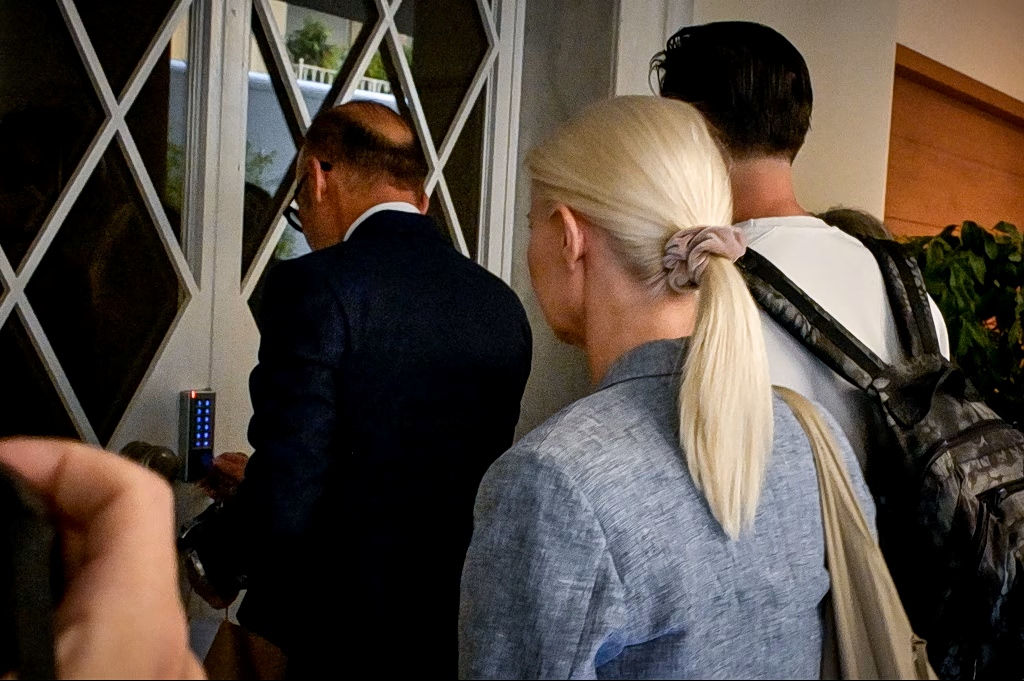
What was already one of the art world’s most politically charged events in recent memory took a dramatic turn Thursday, when the entire international jury of the Venice Biennale resigned nine days before the opening of the world’s oldest and most important contemporary art fair — the latest and most striking move in a months-long battle over Russia’s return to the exhibition.
The Biennale confirmed the resignations of all five jurors — president Solange Oliveira Farkas, Zoe Butt, Elvira Dyangani Ose, Marta Kuzma, and Giovanna Zapperi — without providing an official explanation, according to NPR. The jurors themselves were less reticent: in their resignation letter, they cited their refusal to engage with “those countries whose leaders are currently charged with crimes against humanity by the International Criminal Court” — language understood to refer to Russia and Israel.
Alongside the resignation announcement, the Biennale said it would scrap its traditional jury-awarded Golden Lion prizes entirely and replace them with two awards to be decided by visitors. Any ticket holder who visits at least two exhibition sites can cast a vote — one for the best international participant, one for the best national artist. The prizes will be handed out on the final day of the exhibition in November, rather than at the May 9 opening. In what organizers described as a response to the “exceptional geopolitical situation,” the new system opens the competition to all participating countries, including Russia and Israel, according to Politico.
How It Got Here
The dispute has its roots in the Biennale’s decision to reopen its Russian pavilion, which has been closed since Moscow launched its full-scale invasion of Ukraine in 2022. Russian artists withdrew voluntarily that year, and Russia did not present an exhibition in 2024, lending its pavilion instead to Bolivia. Its last participation in the International Art Exhibition was in 2019, according to NPR.
Biennale director Pietrangelo Buttafuoco has refused to reverse the decision to readmit Russia, pointing to a structural reality: Russia owns its pavilion outright — it has since 1914 — and under Biennale rules was only required to notify organizers of its intention to return. “La Biennale di Venezia does not have the authority to prevent a country from participating,” the organization stated. “Any country recognized by the Italian Republic may request to participate.”
That position has drawn fire from multiple directions. Earlier this month, EU foreign policy chief Kaja Kallas announced the European Commission would cut funding to the Biennale over its decision to admit Russian artists to the 2026 edition, according to Politico. This week, Italian Culture Minister Alessandro Giuli — who had already announced he would boycott the May 9 opening ceremony — sent ministry inspectors to Venice to investigate whether Russia’s participation is “compatible with the existing sanctions regime.” The move drew praise from EU Culture Commissioner Glenn Micallef, who welcomed the minister’s “principled position.”
The Culture Ministry later clarified that the inspectors’ visit was aimed at gathering documents in response to an EU request for information, and stated that the ministry had no role in the jury’s resignation, according to NPR.
A Government Divided Against Itself
The Italian government’s position has been notably contradictory. Giuli has openly opposed Russia’s inclusion while simultaneously expressing strong support for Israel — whose pavilion the jury had also effectively ruled out of prize contention. The minister held a phone call this week with the Israeli Pavilion’s artist, Belu-Simion Fainaru, to express solidarity in the face of what his office described as “recent attacks,” reaffirming “the Italian government’s commitment against every form of discrimination and antisemitism in Italian cultural institutions,” according to NPR. Fainaru responded by stating his opposition to “discrimination, racism, and boycotts in all their forms” and his belief in “the fundamental principles of freedom of creation and freedom of expression.”
Prime Minister Giorgia Meloni, speaking shortly after the resignations became public, reiterated the government’s opposition to Russia’s inclusion but stopped short of condemning the Biennale, acknowledging its autonomy. It was her government that appointed Buttafuoco. She said she did not know whether the resignations were connected to the ministry’s decision to send inspectors to Venice, according to NPR. Deputy Prime Minister Matteo Salvini struck a different tone altogether, welcoming the new public voting format. “So it will be an autonomous and democratic Biennale,” he said. “It doesn’t get any better than that.”
The Biennale, for its part, has held firm, defending its founding principles of openness and dialogue and describing the exhibition as “a place of truce in the name of art, culture and artistic freedom.” It has resisted pressure to exclude countries in the past — including Iran and Israel — and shows no sign of changing course now.
Sources: Politico, NPR