An American citizen now appears to be in charge of Mexico’s most powerful drug cartel, potentially complicating U.S. efforts to eradicate the narcotics trade here.
No sooner was slain kingpin Nemesio “El Mencho” Oseguera buried in a golden coffin in early March, serenaded by popular ballads and surrounded by carloads of floral displays, than his California-born stepson began ascending to the throne of the Jalisco New Generation Cartel, Mexican and U.S. officials said.
The rise of 41-year-old Juan Carlos Valencia González marks the formal crowning of the Valencia family dynasty from western Mexico at the head of the organization known for its paramilitary prowess and territorial conquest, these officials said.
U.S. intelligence agencies may now face legal hurdles in directly targeting and collecting personal data on Valencia González because of his place of birth. That risks hindering a significant tactical partnership that has developed between Mexican President Claudia Sheinbaum and Washington that is making increasing use of information provided by U.S. military, law enforcement and intelligence agencies.
Under the rules for surveilling Americans overseas, the U.S. would usually need to get signoff from the attorney general, and also persuade a secret foreign intelligence surveillance court that Valencia Gonzalez is acting as an “agent of a foreign power” such as an international terrorist group. Although the hurdles are surmountable, the additional procedural requirements could hobble a fast-moving operation, current and former U.S. officials said.
Law enforcement agents, meanwhile, are more limited in the investigative tools they use on American citizens and aren’t allowed by Mexico to conduct operations in the country.
High-definition surveillance provided by Central Intelligence Agency drones was crucial in eliminating the previous boss, Oseguera. Mexican military intelligence identified a man close to one of Oseguera’s lovers who took the woman to Tapalpa, a weekend getaway community in western Mexico, said Mexican Defense Secretary Gen. Ricardo Trevilla.
At Mexico’s request, the CIA positioned an unarmed Predator drone over a Tapalpa vacation compound, where it observed a man exit a vehicle and warmly embrace Oseguera’s lover, according to people familiar with the operation. Intelligence officials reasoned that the man had to be Oseguera himself, since who else would dare be so familiar with the capo’s girlfriend? Within hours, Mexican special forces stormed the hideout, killing Oseguera and eight of his bodyguards.
Targeted assassinations
Valencia González’s citizenship would dramatically raise the stakes should Trump follow through with his publicly expressed desire to carry out targeted assassinations against Mexican drug lords.
“Can the government kill a U.S. person overseas or even at home without a trial if they are perceived to be a threat to the U.S.?” said Steven Cash, a former CIA official who also served under President Joe Biden as a senior adviser to the undersecretary for intelligence at the Department of Homeland Security.
During the Obama administration, CIA drone strikes killed several American citizens , including Anwar al-Awlaki, a New Mexico-born cleric who became a leader in al Qaeda’s Yemen branch.
Obama’s legal team argued that the killing was a necessary act of self-defense, saying al-Awlaki’s operational role in the terrorist organization made him a legitimate military target under both U.S. and international law.
Privately, administration officials said two other slain Americans, including al-Awlaki’s teenage son, were in the wrong place at the wrong time. A wrongful-death lawsuit filed by relatives was dismissed by a federal judge, who said the suit raised serious constitutional issues but would “impermissibly” draw the court into the “heart of executive and military planning and deliberation.”
Since the Trump administration designated eight Latin American criminal groups as terrorist organizations , the U.S. military has killed over 150 people, described by U.S. officials as “narco-terrorists,” on speedboats in the Caribbean and the eastern Pacific. Rights groups said the killings amount to extrajudicial executions.
Sheinbaum and senior Mexican officials have rejected offers of lethal U.S. military action against cartels on Mexican soil, and the U.S. so far hasn’t blown up any purported smuggling vessels in the country’s territorial waters.
But senior members of the Trump administration continue to press the issue, noting that six Mexican cartels now carry the terrorist designation. After watching on television as violence spread throughout Mexico after Oseguera’s death, President Trump said he telephoned President Sheinbaum and told her that Mexico had to stop the chaos and offered to send U.S. forces to battle drug gangs.
People knowledgeable about the conversation said Sheinbaum calmed down an angry Trump, acknowledging the importance of U.S. intelligence in tracking down Oseguera and saying that the Mexican military had quickly restored order.
During the South Florida launch of a new security initiative called the Shield of the Americas that convened conservative Latin American and Caribbean leaders, White House deputy chief of staff Stephen Miller said that there is “no criminal-justice solution to the cartel problem” and that these organizations can only be defeated with military power, “just as we fought al Qaeda and ISIS with the tip of a very lethal spear.”
Point of no return
Mexican officials say that the Sheinbaum administration is now at a point of no return as it deals with the aftermath of the kingpin’s death. Several World Cup soccer matches will take place this summer in Guadalajara, the Jalisco state capital where the cartel enjoys a monopoly.
“We have embarked on this route and there is no turning back,” one Mexican official said. “Otherwise, they can kill us all.”
Many Mexicans feared a wave of killings across the country led by rival Jalisco lieutenants fighting a bloody war of succession to control the cartel’s business empire. It makes billions from running U.S.-bound cocaine, methamphetamine and fentanyl smuggling routes. Operatives also sell clandestine fuel and defraud U.S. seniors in Mexican vacation timeshare deals.
But Valencia González is now seen as the leader with the greatest internal legitimacy to ensure a peaceful transfer of power and prevent a breakup of Jalisco’s vast dominions, said Eduardo Guerrero, a Mexican security consultant.
Oseguera’s eldest biological son, Rubén Oseguera González, also a California-born U.S. citizen, wasn’t available to receive the promotion: He was sentenced to life in prison in a Washington, D.C., federal court last year.
One person familiar with cartel dynamics said that at least two senior lieutenants have agreed not to contest Oseguera’s stepson’s claim to the throne to ensure the continuity of business, including Audias “The Gardener” Flores, who controls a swath of territory in Jalisco and other western states with trucks fitted with .50 caliber guns. The Drug Enforcement Administration is offering a $5 million reward for his capture.
Valencia González, whose nicknames include “Baldy,” “Bimbo” and “R-3,” was born in Santa Ana, Calif. He also has a $5 million U.S. bounty on his head.
He also comes from drug dealer royalty on both sides of the family, said Margarito Flores, a former top U.S. drug dealer who once did business with Oseguera. “It’s pedigree,” said Flores, who now runs a consulting firm that teaches police officers how to catch drug traffickers.
Valencia González’s biological father, Armando Valencia Cornelio, was the founder of the Milenio Cartel in the 1970s. Known as “Maradona,” Valencia Cornelio was released from a U.S. prison in 2020 for health reasons.
His mother, who remarried Oseguera, is Rosalinda González Valencia, who made her bones with the “Cuinis” gang, named after a small, fast-breeding squirrel. The “Cuinis” became a sophisticated financial arm of Oseguera’s Jalisco cartel, and key to the organization’s success at home and abroad.
Many heirs of family clans have taken the reins of Mexican criminal organizations, such as the sons of imprisoned Sinaloa cartel founders Joaquín “El Chapo” Guzmán and Ismael “El Mayo” Zambada. Both clans are now engaged in a bloody turf war for control of Sinaloa.
A recent report by the Mexican Attorney General’s Office describes Valencia González as extremely violent. But officials familiar with the criminal group think he will try to stay out of the crosshairs of U.S. law enforcement after Oseguera’s death.
Valencia González was one of the leaders of the Delta and Elite Group units deployed by the cartel in paramilitary incursions against rival criminal organizations to secure lucrative routes and territories across the country. The Jalisco cartel, known for the military training of its hit men, has killed more than 100 state officials, including a former state governor. It also shot down a military helicopter in 2015.
Six years ago, two dozen Jalisco hit men tried to assassinate Omar García Harfuch, then Mexico City’s security chief. The Jalisco hit men riddled his armored car with more than 400 rounds from Barrett automatic rifles as he was driven down Mexico City’s most elegant avenue. Wounded three times, the dapper García Harfuch survived to become Sheinbaum’s federal security chief and the face of Mexico’s offensive against organized crime.
More than two dozen so-called “narco ballads,” which take the form of traditional Mexican folk songs, have emerged in recent years singing the praises of Valencia González.
“If you are on his good side, he’s very good, but get on his bad side, and he’s the devil himself,” goes one.
Other narco ballads written since Oseguera’s death paint a bloody picture of what could be a savage succession struggle if Valencia González falters.
“When the boss fell, the storm began, the territory was distributed, through lead and treason,” says one, with a video showing a ghostly depiction of Oseguera in the sky with armed men flanked by fighting cocks. “An empty throne provokes disaster.”
Tinted windows and glitchy internet
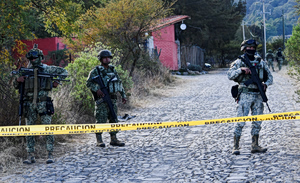
The senior Oseguera and the Jalisco cartel had a strong and longstanding presence in Tapalpa, the scene of the massive gunfight where he was mortally wounded. Residents, afraid to use their names, said that every few months convoys of big SUVs with tinted windows would make an appearance, a silent announcement of the presence of drug bosses.
Internet service would fail when drug bosses were in town, presumably to hinder surveillance. “It was obvious when he was in town,” said one resident, a retiree. “I’d see a convoy of 20 or 30 SUVs and spotters, cellphone in hand, ready to give the alarm.”
A large iron gate marks the entrance of an estate with two mansions set next to pine forests in the Sierra Madre mountains around Tapalpa, a favorite weekend retreat for wealthy Guadalajara businessmen. The gate is adorned with a sculpted round medallion of Oseguera’s trademark, two roosters. Oseguera, who was also known as the “Lord of the Fighting Cocks” for his love of the sport, hid in one of the houses on the estate during his last days.
The Sunday he was killed, fire from the house, which now sits empty, hit one of the helicopters, forcing it to make an emergency landing, said a person familiar with the gunbattle.
Not far from the gate are the hulks of two burned-out cars. Bodies were taken away from the cars by authorities in the wake of the battle, according to a local construction worker who said he witnessed the running battle that led to Oseguera’s death.
A few hundred yards below the house, there’s a gated community of about 10 empty weekend cabins. Three days after the gunfight, the gates were wide open, and window drapes billowed in the breeze. Clothes, medicines, food, shoes, blankets and sheets were scattered on the floors and tables of the houses, evidence of a hasty search.
In one house, two dozen .50 caliber shells were scattered on a terrace. But no bullet holes mar the walls of any of the houses. One bullet was left behind in a home that boasts a dining room with an elegant high ceiling and a wall adorned with the hunting trophies, including the mounted heads of a zebra, an antelope and a gazelle.
The firms that owned the gated community were placed in the U.S. Treasury’s blacklist in 2015, banning them from engaging with U.S. persons or companies because of their alleged links to the Jalisco cartel.
No matter who leads them, the cartels are sure to keep their hold on many Mexicans. Some poor residents laud Oseguera and other cartel bosses because they provide work for local people, helping them by doing everything from drilling wells to paying for their town’s traditional fiestas.
“They do more for the people than the government does,” the local construction worker said.
Write to José de Córdoba at jose.decordoba@wsj.com and Santiago Pérez at santiago.perez@wsj.com