
Employers have a warning for the Class of 2026: Next spring’s graduate-hiring market is likely to be even worse than this year’s.
Six months out from graduation season, more than half of 183 employers surveyed by the National Association of Colleges and Employers rate the job market for the Class of 2026 as poor or fair. That is the most pessimistic outlook since the first year of the pandemic, according to the survey, which is widely seen as an early signal of graduate hiring each year.
A cooling job market is darkening that outlook. In recent months, employers from Amazon.com to United Parcel Service have revealed plans to cut thousands of jobs. The latest is Verizon Communications , which, according to people familiar with the matter, plans to cut 15,000 jobs over the next week in its largest reduction ever.
Companies say the uncertain economic outlook has pushed them to hire more conservatively, and many are giving priority to recruits with some experience as opposed to fresh-from-college graduates . More executives are also speaking openly about the potential of artificial intelligence to bring deep job cuts and take over more tasks that new graduates are traditionally tapped to do.
For college seniors, that means they are also competing against junior workers who have been recently laid off. The unemployment rate for recent college graduates was 4.8% in June, greater than overall unemployment that month and the highest June level for recent graduates in four years, according to a Federal Reserve Bank of New York analysis.
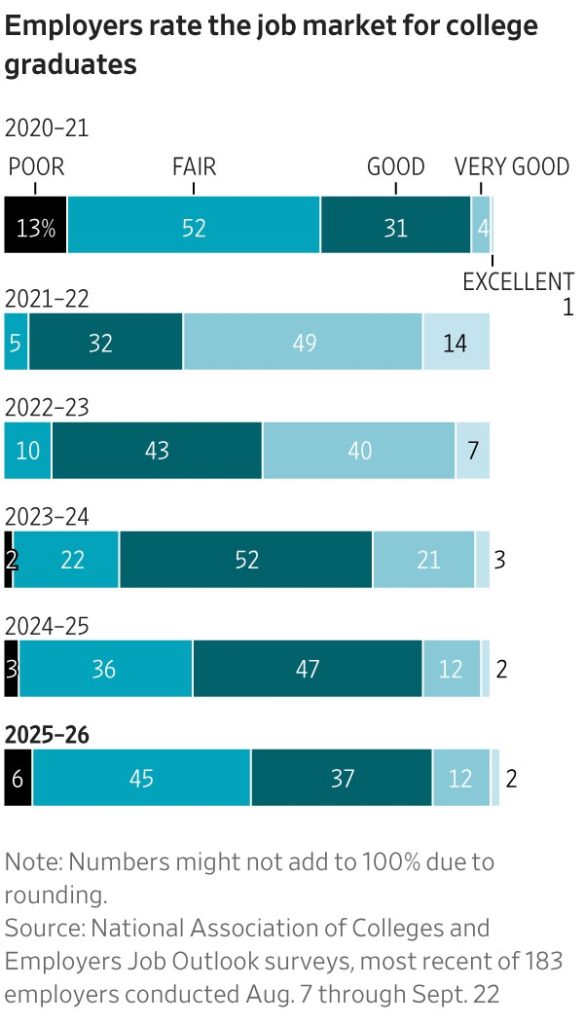
Overall, employers say they expect a 1.6% increase in hiring for the Class of 2026, down considerably from their plans for the Class of 2025 last fall, according to the semiannual survey. College recruiting for full-time jobs typically kicks off in the fall or earlier, and by the spring, employers have a clearer sense of where hiring will land. In recent years, employers have revised their spring plans downward from the fall survey.
Annika Swenson, a senior at the University of Iowa, said layoffs at companies like Amazon have made her more anxious about the search. The sheer number of applicants to positions and the fast-moving pace of AI have also increased her stress level.
In a year, it is possible “there just wouldn’t be a person needed to do that job anymore,” she said of some entry-level positions. “That’s just wild to me.”
Swenson, 22, is studying marketing and this week alone has applied for about five to 10 jobs. She kicked off her search over the summer. “I just need to get one,” she said.
The early-career job-search platform Handshake found that in August, full-time job postings had declined more than 16% year-over-year, and there are an average of 26% more applications per job. More than 60% of 2026 graduates said they were pessimistic about their careers.
Christine Cruzvergara, Handshake’s chief education strategy officer, said employers are falling into three buckets. Some have paused hiring amid economic uncertainty, some have laid off staff in the name of efficiency and some are growing modestly. Fields seeing job growth include healthcare, education and manufacturing, she said.
Meanwhile, students are applying “to hundreds and hundreds of jobs. They just shoot off application after application,” she said. This strategy can backfire: Many employers are turned off by generic applications, she said.
Giavanna Vega, a former entry-level recruiter and internship program director at Automation Anywhere, which streamlines business processes, described the hiring environment as at a standstill.
“Because we’re in a state of uncertainty, they don’t know where to invest,” she said of companies’ recruiting strategies amid tariffs and AI developments. That is coming down harder on new graduates: “They don’t have the training.”
Vega, based in San Jose, Calif., said she was laid off from her recruiting role in 2023. After a contract role in tech that ended a year ago, she has worked as an esthetician as she applies for corporate jobs.
It has been a competitive search. “People that have more experience are willing to take entry level positions because they can’t find anything,” she said. Worn down by many rejections and “ghosted” applications, she has focused on her skin care business more recently.
Write to Lindsay Ellis at lindsay.ellis@wsj.com