
After Jeffrey Epstein’s death, Svetlana Pozhidaeva said she finally felt free and started building her life. The former Russian model, who became one of Epstein’s “assistants” and a victim of his abuse, changed her name and moved to another city.
Then the Epstein files dropped.
She didn’t pay much attention, preferring not to revisit that period—the years from 2008 to 2019, when she had been caught in Epstein’s web. She assumed her name would be redacted like the other women who were vetted by settlement administrators in previous victim lawsuits.
The Justice Department did redact her name as the sender and receiver in most emails, but mistakenly left it in the body of some messages. She was among the dozens of victims whose personally identifiable data was initially left unredacted in the Jan. 30 release.
Since the files dropped, Pozhidaeva said she has been playing whack-a-mole with the Justice Department, sending emails to flag redaction errors. The Justice Department addressed initial errors, but when it reposted corrected files, some instances of her name remained exposed.
The Justice Department has said only a fraction of the released files had redaction errors and it is fixing any mistakes when notified by victims or their attorneys. The department didn’t respond to requests for comment.
For Pozhidaeva, the pressure reached a breaking point in recent days, when a blogger started contacting her family and announced plans to expose her new name on the grounds that she was in her 20s at the time of the abuse and said her links to Russia disqualified her from victim protections. The Wall Street Journal isn’t publishing her current name.
“I am so exhausted. I haven’t slept or eaten properly for weeks,” she said in a recent interview. “I’d rather tell this embarrassing story myself and get it over with once and for all so I can finally be free and close this chapter.”
Adult victims
Pozhidaeva spoke with the Journal in 2023 for an investigation into Epstein’s continued abuse of women after his 2008 conviction. She is one of several women Epstein sexually exploited under the guise of “assistant” roles. She explained without revealing her name in 2023 how Epstein controlled her immigration, finances and housing, and pressured her into introducing him to other models. Now she is speaking on the record.
“It’s been hard for me because for many years I’ve been so embarrassed that I wasn’t underage when I met him. I was in my early 20s,” she said in the recent interview. “I kept thinking that I was at fault for putting myself in this situation.”
Confusion about how sex trafficking works and who qualifies as a victim has compounded the problem. The government’s 2019 indictment charged Epstein with trafficking minors between 2002 and 2005, the period covered by his earlier Florida plea deal. The adult women Epstein entrapped after his 2008 conviction weren’t included in the indictment.
In 2019, prosecutors brought charges using the minimum number of victims needed to apprehend Epstein in order to keep the case secret and avoid him fleeing, according to people familiar with the investigation.
Prosecutors continued interviewing victims after his July 2019 arrest and had planned to expand the indictment, including potentially to adult women, had Epstein not died the following month, according to these people and a 2019 Justice Department memo released in the files.
For sex-trafficking cases involving adults, prosecutors must prove the victim was compelled into sexual exploitation through force, fraud or coercion. Fraud typically involves false promises of employment or a better life; coercion can be psychological and take the form of threats of deportation, blackmail or debt bondage, lawyers said.
Federal prosecutors have successfully prosecuted cases of adult sex trafficking. In 2019, the Nxivm group founder Keith Raniere was convicted for his exploitation of adult women and sentenced to 120 years in prison.
Most recently, the Alexander brothers were convicted in a case in which adult women testified that they had been lured to exclusive parties and trips, then drugged and assaulted. Lawyers for the Alexander brothers said they planned to appeal.
Pyramid scheme
After his 2008 plea deal, Epstein shifted his focus to adult women who looked like teenagers—many of them fashion models from Europe and Russia. He dangled fake jobs linked to his famous connections, promising work at places like Victoria’s Secret. He rarely delivered.
Once inside his orbit, the women said they were coerced into performing massages that escalated into sexual demands. Several have said he required at least one such encounter a day, and when no other women were available, he turned to his “assistants.”
Epstein took control of their finances, health bills, immigration and housing. Money he gave to some women and their families came in the form of loans, leaving them unable to disconnect from him.
Sex-trafficking operations often function like pyramid schemes, with traffickers using victims to recruit other victims. Raniere built a secret inner group, DOS, in which each “master” was required to recruit “slaves,” who in turn recruited more women, with victims coerced by handing over compromising photos as collateral.
Epstein’s operation worked similarly. He pressured victims to recruit additional victims, a pattern prosecutors noted in his 2019 indictment. Some victims have said they would offer up other women to Epstein in order to avoid being asked to participate in sex acts themselves.
Both Epstein and Raniere created a power-imbalance with adult victims and used “continuous drips of promises” alongside “implicit threats” to coerce women to participate in sex acts and trafficking, said Moira Penza , the lead prosecutor on the Raniere case who is now a partner at Wilkinson Stekloff.
Penza said the argument that “they could have just left” misunderstands how consent works in these types of cases. She said once a predator creates an environment of dependency, “consent just becomes irrelevant. There really is no way to consent.”
Brad Edwards , a lawyer who has represented dozens of Epstein accusers including Pozhidaeva, said that documents and victim testimony show that after his 2008 conviction Epstein deliberately shifted to women over 18 to use their age as cover to continue running his sex-trafficking operation—and that the strategy largely worked.
“He drew very little scrutiny from law enforcement,” Edwards said. “There was a DEA investigation opened, so it drew some attention, but not much.”
The recent files include a heavily redacted 2015 Drug Enforcement Administration memo about an investigation into suspicious money transfers by Epstein. Epstein was never charged for drug trafficking or financial crimes. The memo used the words “prostitution activities” and initially left one victim’s surname unredacted on one page.
The woman, a European model who was abused by Epstein, told the Journal that the redaction error prompted some news outlets to identify her in this context and has deepened an already painful public misunderstanding of what she experienced. She said she never received the large sum of money from Epstein cited in the memo and was never contacted by the DEA.
Trapped and ashamed
Pozhidaeva, who walked on runways for well-known European fashion brands, said she was introduced in 2008 to Epstein by Daniel Siad , a modeling scout who told her Epstein could arrange a Victoria’s Secret audition. Siad’s lawyer had no immediate comment. Siad recently said that he worked professionally to connect models with Epstein and was unaware of any wrongdoing.
In the U.S., Epstein secured her visa through MC2 Model Management and housed her at 301 E. 66th Street alongside other victims. He later used contacts, including former Russian minister Sergei Belyakov , to write U.S. immigration letters on her behalf, copies of which she showed the Journal in 2023.
Belyakov told the Journal that he “did not remember this letter” and declined to comment further. The former deputy minister of economic development corresponded with Epstein for several years, the files show.
Epstein closely monitored her, took compromising photos and expected regular updates on her interactions with other men, Pozhidaeva said. Money he gave to her and her family was structured as loans and tracked meticulously.
Other victims have told the Journal that Epstein sent them spending reports detailing what they owed him, a tactic that made leaving feel financially impossible. Pozhidaeva said Epstein also appeared to have powerful connections in Russia such as Belyakov , which made her fear for her family if she ever fell out of his favor.
When the promised jobs never materialized, Epstein blamed her for not being good enough. He asked her to take photos with prominent figures he met, and later conjured up roles at his nonprofit entities for her. It wasn’t until after his death that Pozhidaeva said she came to understand there had never been real positions and that he had been making the same false promises to other women.
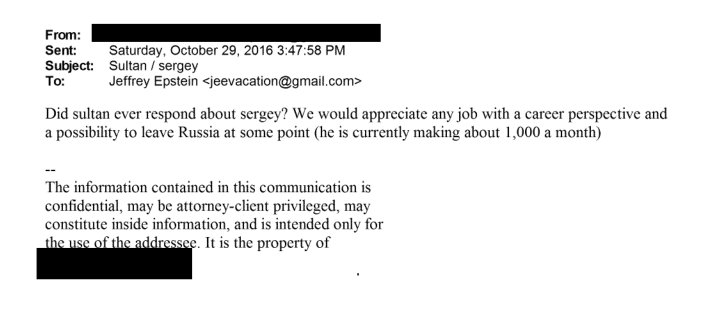
EFTA01739393 – An email exchange where Epstein asked Pozhidaeva about photos she posted on Facebook.
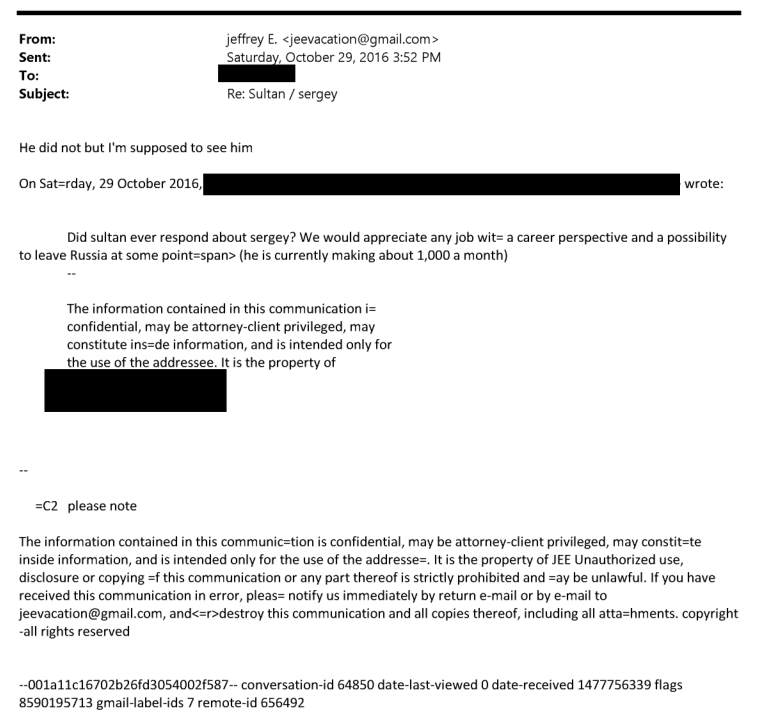
EFTA02447019 – An email exchange where Pozhidaeva asked Epstein about a job for her brother.
The recently released Epstein files have dredged up painful memories for Pozhidaeva. A January 2016 message showed Epstein interrogating her over photos she had posted of herself and other assistants on Facebook, which he blamed for drawing attention from the Daily Mail. Another email from October 2016 showed her asking Epstein to deliver on a promise to help her brother in Russia get a job. He never did.
Some emails showed Pozhidaeva suggesting other women to Epstein and forwarding photos and modeling profiles, something she said he repeatedly pressured her and other victims into doing. Dozens of emails show Epstein making such requests of other women.
Epstein also asked Pozhidaeva and other victims to vet prospective women, including flagging their ages to ostensibly confirm they were of legal age and wouldn’t cause trouble, and to meet women and relay his instructions to them.
“I feel ashamed and think about those other women all the time,” Pozhidaeva said. “That’s the hardest part of all of this—I was too consumed by my own abuse to see beyond it. I had to appear happy, to keep smiling, while privately I was battling eating disorders, depression, and insomnia.”
Bridgette Carr , a law professor at the University of Michigan who founded the school’s human-trafficking clinic in 2009, said she draws the line between perpetrator and victim like this: Someone who aids a trafficker after fully escaping their situation is a perpetrator, while someone who does so while still entrapped remains a victim.
“If a woman is still in that situation,” she said, “there’s no magic that happens on her birthday when she becomes a year older.”
Pozhidaeva was among dozens of victims who pursued claims against Epstein’s estate after his death. She was also deemed eligible to receive compensation from other victim suits. Each woman had to present evidence to a settlement administrator.
“I was bullied and controlled for more than 10 years by Jeffrey Epstein,” she said. “I have to learn to stand up for myself now. I am done being bullied by anyone.”
Russian ties
Since the Epstein files release, Pozhidaeva has been contending with social-media posts and blogs insinuating she is a Russian spy. Several other Russian women in Epstein’s orbit told the Journal they have faced similar accusations.
For Pozhidaeva, the suspicion traces back to her father, who told the Journal he worked for Russia’s armed forces until 1996, retiring during the Boris Yeltsin era. He later worked as a sales representative at coffee and wine companies, and then took jobs at state-run energy and railroad companies.
Her father denied that he or his daughter are Russian agents. “Unfortunately, in the current political climate, there is a tendency to label almost any Russian national with a background in government or a high-level education as a ‘spy’,” he wrote in an email.
His early employment history, compounded by Pozhidaeva’s college degree from the Moscow State Institute of International Relations, has been enough to fuel accusations. “I’m willing to take a polygraph test to make this stop,” she said. “Whatever is needed, I will do it, so I can move on.”
Several media outlets have grabbed emails before the Justice Department removed them and published articles using her name. Pozhidaeva has since been contacting journalists asking to have her name removed from their articles. She said most reputable publications have agreed to withhold the names of sex-trafficking victims, but some haven’t responded.
Penza, the former Nxivm prosecutor, said sex-crime victims expect their confidentiality will be protected by law enforcement and when that expectation isn’t met, it “can feel re-traumatizing.” She said that exposing sex-crime victims “can also have a chilling effect on other people being willing to come forward.”
The redaction failures have given ammunition to bloggers and online commentators who have portrayed women trapped in Epstein’s orbit as willing participants. Some have gone further, citing emails in which women expressed gratitude or warmth toward Epstein as evidence of complicity or consent.
“People see a few emails and think they understand what happened,” Pozhidaeva said. “The Justice Department made mistakes, and even when they fix them, we’re left to live with the consequences.”