TEL AVIV—For two minutes on Monday, Dalia Cusnir allowed herself to hope for the first time in months.
Negotiators, including President Trump’s envoys Jared Kushner and Steve Witkoff, were trickling into Egypt this week to try to seal a deal that would end the war in Gaza and bring home Israeli hostages still held there by Hamas. One of them is her brother-in-law, Eitan Horn.
Cusnir shut the door behind her, sat on her bed, closed her eyes and imagined that she held him in her arms, she recalled. Then she opened her eyes again to a world without him.
“We just need to bring them back,” Cusnir said. “The resilience of Israeli society won’t hold any longer.”
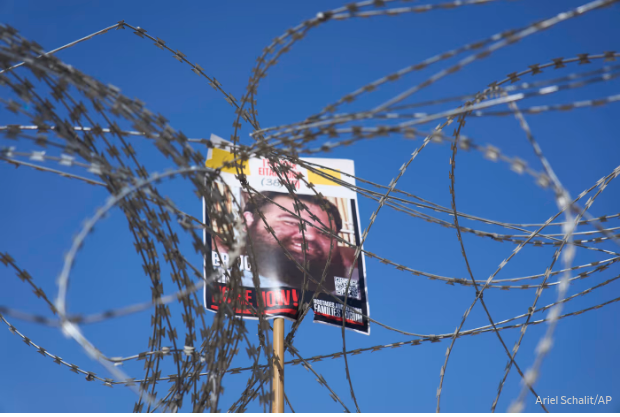
A deal can’t come fast enough for the families of the remaining hostages taken when Hamas invaded southern Israel on Oct. 7, 2023, and sparked the war in Gaza. Israel and Hamas have agreed in principle to the contours of a 20-point peace plan proposed by Trump , but are still at odds on the details.
Indirect talks this week in the Red Sea resort town of Sharm El Sheikh, Egypt, are aimed at hammering out an initial phase that would free around 20 or so hostages still believed to be alive from the roughly 250 seized two years ago, along with the return of bodies of around 28 others. In exchange, Israel would release hundreds of Palestinian prisoners.
If a deal can be made, it would kick-start a staged withdrawal of Israeli forces and pave the way for an end to the war .
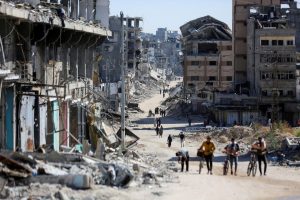
The war in Gaza has left the enclave in ruins and killed more than 67,000 Palestinians, according to local health authorities, who don’t say how many are combatants. The fighting has displaced almost all of Gaza’s more than two million people and caused a humanitarian crisis. The human toll of the war, and Israel’s defiant response to international criticism, has turned some of its traditional Western allies against it.
Some hostages were freed in earlier exchanges, first under a cease-fire deal in November 2023 and another that started in January but fell apart in March.
Families like Cusnir’s never thought their agony would run this deep or last this long—two whole years—and say they want their government to do whatever it takes to close this chapter.
Both of her husband’s brothers were kidnapped by Hamas in the Oct. 7 attack. Eitan, now 39 years old, remains in captivity while his older sibling, Iair, was freed during the cease-fire in February. Just hours after Iair returned to Israel, while he was still in the hospital, Cusnir said he called her into his room and told her he would never be free until all of the hostages return.
“He told me, ‘You think I’m here, but I will still be a hostage until the last one is free’,” Cusnir said.
Udi Goren lost his cousin, Tal Haimi, in the Oct. 7 fighting. Goren is one of the many hostage family members who are eager to see a deal that will bring home the remains of their loved ones for burial.
Haimi, who was part of a local emergency response group, was killed in a battle with Hamas militants as they tried to breach the front gates of his Kibbutz Nir Yitzhak, Goren said. Israeli authorities told the family they believed Haimi’s body, along with others who died beside him, was taken into Gaza.
“We can’t move past it because there’s no evidence, no proof, no body,” Goren said. “There’s even a term for it—delayed grief—and this itself is very, very hurtful.”
The relatives of hostages have become like family to each other since the attack, finding comfort in their shared trauma and joining to advocate for their loved ones. They have traveled the world to plead with leaders, including Trump, to throw their weight behind the cause.
A large majority of the hostage families have been critical of Israeli Prime Minister Benjamin Netanyahu, accusing him of prolonging the war in Gaza for his political survival, which he denies. This week, to mark the Oct. 7 anniversary, hostage relatives convened outside Netanyahu’s home in Jerusalem for meals and prayers, coinciding with the Jewish holiday Sukkot this year.
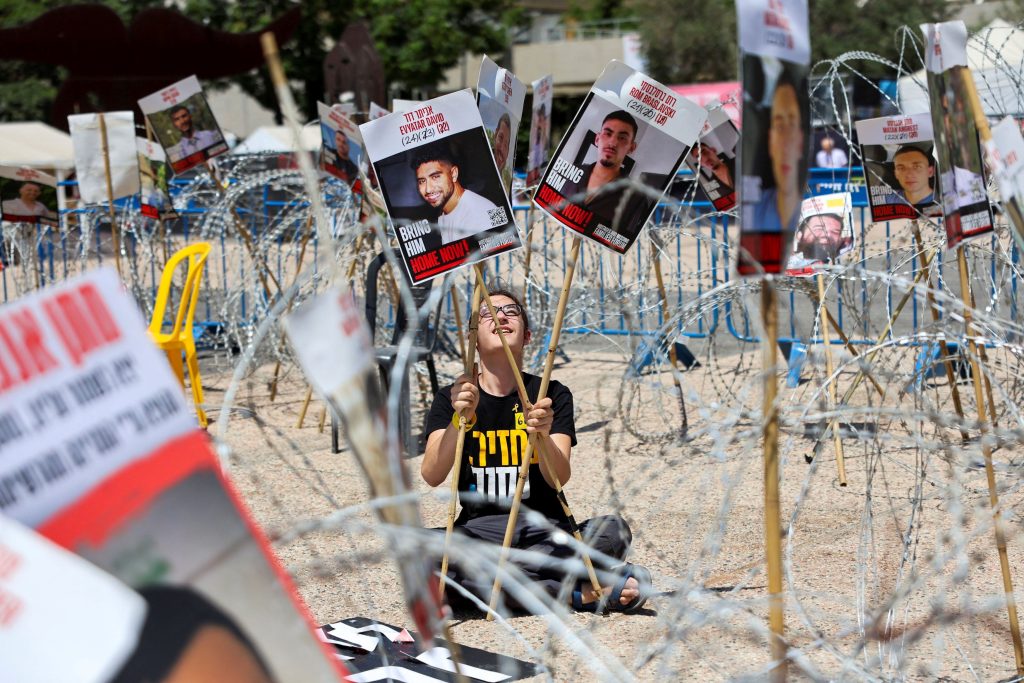
On Tuesday night, thousands joined their call to gather at sites across the country to commemorate Oct. 7. In Tel Aviv, crowds overflowed from a courtyard that has become known as Hostage Square, wearing T-shirts reading “Bring Them Home” and others that simply said: “NOW!”
As often happens at the site, located outside the city’s main art museum and decorated with sculptures honoring the victims, many attendees stood silently in tears.
Dana Shaikovitz, a 50-year-old teacher who came with two close friends, said she hoped a deal would be struck and this would be her last visit to Hostage Square.
“We need it, the people of Gaza need it, everybody is so tired, so sad and so devastated,” she said. “Whatever it takes, just do it.”