That Jeffrey Epstein preyed on adolescent girls while socializing with the uber rich is amply confirmed by three-million or so pages of investigative documents released by the Justice Department since December.
But did he eat babies? Or disable his victims with exotic drugs and destroy their bodies in vats of acid? For a growing number of online sleuths, there is a booming business in peddling outlandish answers to those and other sordid questions raised by the trove of newly released files.
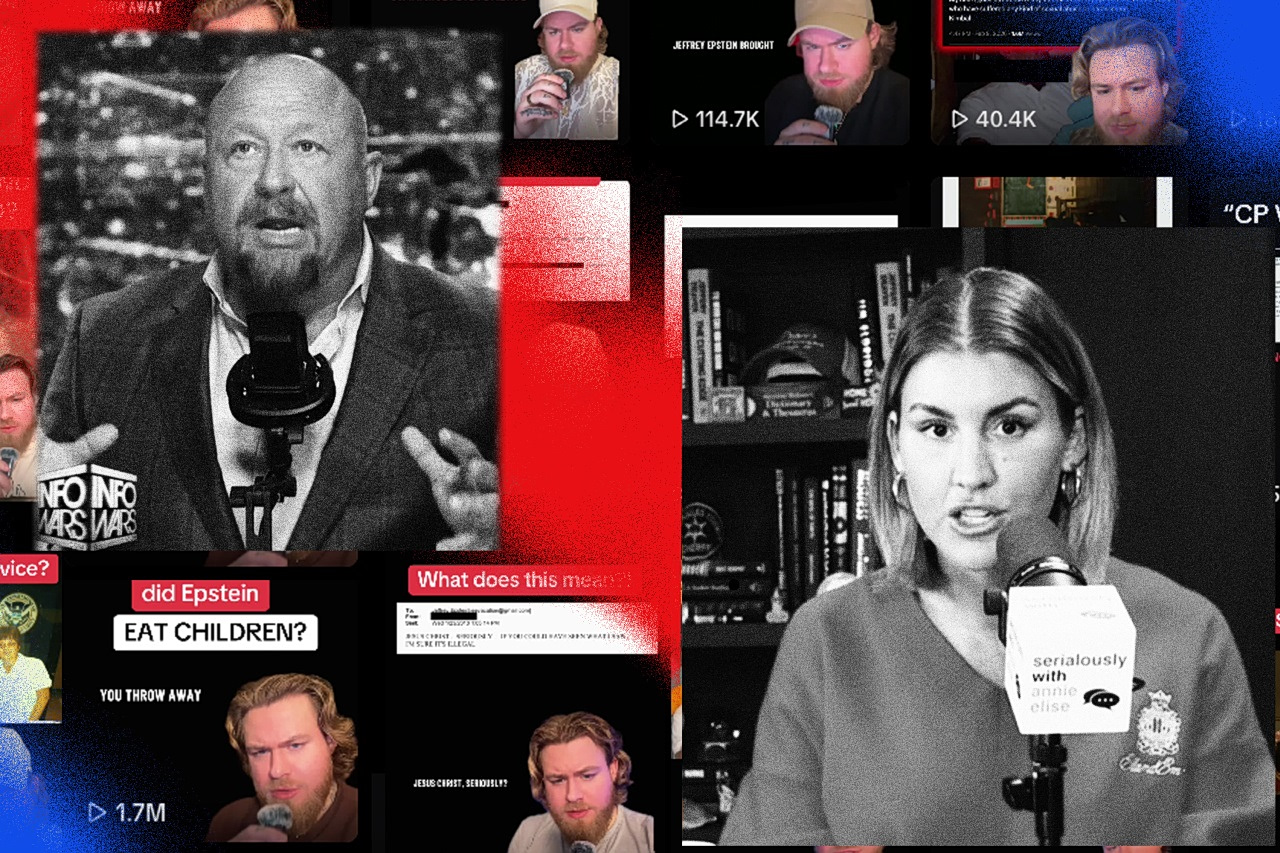
“It’s enough to make your head explode,” said Annie Elise on a recent Epstein-themed episode of “Serialously,” her true-crime podcast. “When you bring in the babies, the cannibalism, the terminations, the trapdoors…all the sulfuric acid. One or two of those could potentially be explained away. But where there is smoke, there is fire.”
Elise, who launched her podcast during the pandemic and now has 1.6 million subscribers, estimated that traffic roughly tripled for a recent Epstein episode, such was the public’s hunger for answers. “I had no plans to cover the files,” she said in an interview. “But then I was just inundated with so many requests from people.”
So Elise turned to Dr. Leslie Dobson, a forensic psychologist and self-proclaimed Epstein expert with her own robust social media following and a more than passing interest in cannibalism. “I’ve worked with cannibals,” Dobson said at one point in the episode. “I know cannibals.”
The highly anticipated release of the Epstein documents was supposed to shine sunlight on an inscrutable criminal saga and provide something like a final accounting. Yet it appears instead to have spawned a cottage industry spinning out fresh Epstein conspiracy theories.
Among them is the claim that Epstein and fellow elites were eating babies on his private island. There is no evidence that it ever happened, but the notion has been aired on platforms ranging from the “ Joe Rogan Experience”—the world’s most popular podcast, with more than 20 million subscribers on YouTube alone—and Serialously to relative minnows on TikTok with just a few thousand followers.
Reviving Pizzagate
The Epstein files are so potent that they have breathed fresh life into the moribund Pizzagate conspiracy from 2016, in which powerful Washington, D.C., Democrats were supposedly operating a pedophilia ring that involved pizza parlors.
“These emails validate all that other stuff is true, too,” Liz Crokin declared on Alex Jones’s InfoWars podcast, which described her as a “top child-trafficking expert.” In the files, Crokin said she saw proof of “child sacrifice, murder. Cloning. The Dr. Mengele-type experiments.”
Whatever their differences, one thing these various podcasters and platforms share is a fascination with Epstein that is driving traffic their way—which can translate into revenue from advertising, subscriptions and in some cases, merchandise. (Serialously, which has been covering true-crime stories for years, sells a “Be Nice Don’t Kill People” sweatshirt on its website for $35). In such a crowded online market, the more lurid the claims the better: Often, they are preceded by “trigger warnings” of graphic content.
“This is one of the most disturbing things I’ve ever read in my life,” content creator Colin Browen says in one TikTok video about “Epstein’s Baby Farm” that has racked up nearly 10 million views since it was posted in February.
It’s difficult to know just how much online personalities have earned from peddling Epstein-related rumors. The research firm Edison estimates that around 90 million Americans are interested in conspiracy-related content, including podcasts. The most popular individual podcasts, including Rogan’s, regularly garner millions of views and listens per episode. And those viewers and listeners are exposed to thousands of ads per show over the course of a year, including from big spenders like Squarespace, BetterHelp and ZipRecruiter , according to data from Podscribe. Across the industry, podcast advertising revenue is expected to approach $2.6 billion this year.
Browen, who hosts a web series called “The Paranormal Files,” said in a statement that his posts on Epstein involve “sharing documented information and raising questions about the evidence, and while they have reached large audiences, they have generated very little revenue and have even resulted in demonetization and strikes across platforms.”
The thin line between conspiracy and cash was straddled by InfoWars’ Jones on a recent Epstein-themed episode in which he pivoted from explaining the finer points of child cannibalism—“it’s not just eating children and stuff; it’s their blood product”—to hawking his own methylene blue health supplements. “Believe me!” he urged listeners. “You are going to want to reorder it again!”
Jones, a pillar of the conspiracy world, gained notoriety for claiming in 2012 that the school shooting at Sandy Hook Elementary School in Newtown, Conn., was a ruse involving child actors—a claim for which he was ordered to pay $1.4 billion to families of victims and a Federal Bureau of Investigation agent he defamed. In the last year, Epstein has come up hundreds of times on InfoWars, according to a Wall Street Journal analysis of episode transcripts.
A unique bonanza
To Joseph Uscinski, a political-science professor at the University of Miami who studies conspiracy theories, the current frenzy was to be expected. Since the Middle Ages, at least, he noted, a subset of people have been drawn to the belief that evil forces—often elites—have been conspiring to abuse children.
The 1980s, during his own youth, was the heyday for conspiracy theories about satanic cults sacrificing children, Uscinski noted. More recently, these same theories have re-emerged through the QAnon conspiracy and then Pizzagate, as well as some of the more far-out interpretations of the Epstein files.
“It’s not the conspiracy—it’s the people,” Uscinski said. “They’re the same people prone to the same beliefs.”
Still, the Epstein files might represent a unique bonanza as conspiracy fodder goes. For one thing, what once seemed fantastical—that an evil man and his posh British girlfriend were abusing dozens of girls on a James Bond-style private island and chumming around with a prince and a former U.S. president—has now been proved true. (Many who mixed with Epstein, including former President Bill Clinton, say they didn’t participate in or know about his abuse).
Similarly, there also appeared to be some high-level intervention that allowed Epstein to escape punishment for years and continue his abuse. Even mainstream Epstein chroniclers, including the Miami Herald’s Julie K. Brown, no longer trust the official claim that he killed himself in his jail cell in 2019.
Then there is the bewildering volume of files now available for the conspiracy-minded to peruse in search of clues and secret codes. Back in 2016, for example, Pizzagate adherents became convinced that mentions of “pizza” in hacked Democratic emails was code for “children” and that the size of various pies—7-inch, 9-inch, 11-inch—referred to their ages.
Mystery jerky
The Epstein files also feature pizza—and plenty of beef jerky.
In one of hundreds of mentions, an Epstein associate asks a friend in a 2012 email: “JE is asking to bring him more beef jerky on Fri. Are you also flying on Fri? If not, I would like to collect it from you and take with me on the plane. Please let me know, thanks.”
The friend replies: “I’m flying on Friday. I will bring jerky.”
In another, someone writes to a chef: “JE has asked me to email you and ask you whether you would be able to teach me to make the beef jerky.”
“People have said online that means human flesh,” Aaron Parnas, the son of former Rudy Giuliani associate Lev Parnas—and himself now a minor online authority on the Epstein scandal—explained. He did so as a guest on “Life Uncut,” a top-ranked Spotify podcast that features two Australian hosts, Brittany Hockley and Laura Byrne, who were former contestants on “The Bachelor Australia” reality show. Then Parnas added: “It could also just mean ‘jerky’.”
Rogan is hard to pin down on the jerky question. On a Feb. 19 episode of his podcast, he expressed skepticism about the cannibalism theory but affirmed that “it certainly is a code.” Then he jumped into back-to-back ads for two of his sponsors: Squarespace, an online tool to build websites; and ShipStation, an e-commerce software.
Meanwhile, at “The Paranormal Files,” Browen was recently grappling with this riddle in an email Epstein sent to a friend, a seemingly misogynistic reference to a group of girls lounging by his pool: “Some are like shrimp, you throw away the head and keep the body.”
“Is this actually Epstein and this guy talking about decapitating a woman and keeping the body?” Browen asked in a TikTok clip that garnered 1.6 million views and more than 84,000 “likes.” Then, said the stricken host: “This is some really deeply disturbing shit to me.”
Write to Joshua Chaffin at joshua.chaffin@wsj.com and Jaclyn Jeffrey-Wilensky at jjw@wsj.com