At North Korea’s new beach resort, the white sand glistened against the crystal-clear waters. Ten minutes of Wi-Fi cost $1.70. Food arrived in abundance, albeit with the same three beverage choices: water, tea or beer.
The weeklong trip cost roughly $2,000. The catch? All travelers had to be Russian .
Welcome to North Korea’s Wonsan Kalma coastal complex, a megaresort built by the regime to portray the country as modern and affluent. It is opening to foreign vacationers for the first time, as part of North Korean leader Kim Jong Un’s drive to attract more tourism to his cash-strapped country and show his people they can experience some of the finer things in life despite international sanctions .
Anastasia Samsonova, a 33-year-old from Moscow, was looking for something offbeat for her summer vacation. Having never been to North Korea, she chose a group tour that would spend several days in Pyongyang before arriving in Wonsan.
But as she took her first steps on the sand, Samsonova—who, along with 12 other Russians, was part of the first group of foreign vacationers allowed to visit the resort several weeks ago—faced an unsettling sight. “The entire beach was empty,” she said. “In fact, we seemed to be the only guests in the entire resort.”
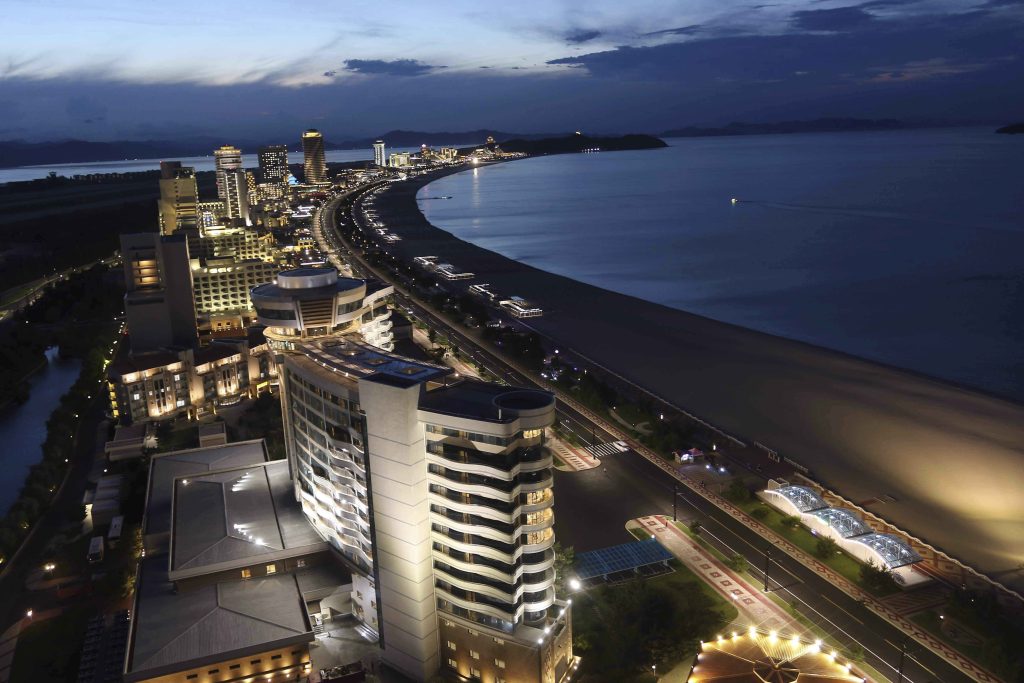
A night view of the the Wonsan-Kalma resort is seen in Wonsan, Kangwon Province, North Korea, Tuesday, July 1, 2025. (AP Photo/Jon Chol Jin)
One upside: The lack of fellow travelers meant the service was excellent, said Samsonova, a human-resources specialist. When the group asked for porridge and brioche buns, staff quickly produced them. Portable music speakers were hand-delivered on the beach upon request. Patio chairs for the balcony came instantly.
“We really felt like the most important people on Earth,” said Samsonova. She went home with a souvenir statuette shaped like a nuclear warhead.
Kim’s beach stroll
North Korea once welcomed hundreds of thousands of foreign tourists a year—mostly from China —before slamming its borders shut in January 2020 during the Covid-19 pandemic. The country reopened to tourism in February 2024 exclusively to Russian travelers . Last year, roughly 1,500 vacationers actually went, according to a Russian official from Vladivostok, a far-eastern city that has direct flights to Pyongyang.
Starting this February, North Korea allowed certain Western tourists to visit a special economic zone near the Chinese border. But after several weeks, the tours were halted without explanation. That leaves very few nationalities able to enter North Korea. The U.S. State Department since 2017 has barred American citizens from entering the country.
Kim began touting the Wonsan Kalma resort in his New Year’s address in 2018. He pored through thousands of blueprints before settling on a final design, Pyongyang’s state-run media reported. The sprawling seaside complex, with plans for high-rise hotels, a casino and shopping malls, took inspiration from the Spanish holiday mecca of Benidorm.
The opening of Wonsan was hailed in state media as an achievement of North Korea’s “people-first politics,” reinforcing the regime’s narrative stressing big investments for the well-being of the population, said Eric Ballbach, the Korea Foundation fellow at the German Institute for International and Security Affairs.
North Korea’s major construction projects “often have an ideological angle to them,” said Ballbach, a German who has previously visited the Wonsan region. Trips to the resort for regular North Koreans are likely to be dangled as rewards for special loyalty, he added.
At Wonsan’s opening ceremony in late June, Kim, cigarette in hand, lounged next to a waterslide. He later strolled down the beach with his young daughter . The complex can accommodate roughly 20,000 visitors, although satellite imagery shows much of it remains unfinished.
That didn’t stop Kim last month from hosting Russian Foreign Minister Sergei Lavrov, who flew directly to Wonsan and stayed at the locale’s best hotel. The two met aboard Kim’s luxury yacht anchored nearby, where the North Korean leader pledged to “unconditionally support” Russia’s war efforts against Ukraine.
Lavrov, during his trip, said the North Koreans have shown interest in welcoming more Russian visitors to the resort, state news agency TASS reported. A second batch of Russian tourists is expected to arrive next week.
But it will be a challenge to attract a real boom in foreign tourism to Wonsan since travelers headed to North Korea aren’t typically looking to lounge on the beach, said Rowan Beard, co-founder of Young Pioneer Tours, a China-based travel agency specializing in North Korea tours.
“Most people going to North Korea want to see Pyongyang, the military sites, the monuments, the Communism-related landmarks,” said Beard, an Australian who visited the Wonsan area multiple times before the pandemic.
Free jet-ski rides
The 13 Russian tourists—whose trip to Wonsan overlapped with Lavrov’s visit—needed to pay North Korea $1,400, in addition to around 35,000 rubles, or about $435, to a Russian tourist agency, to make the trip. The meals, flights and other travel were covered; snacks, other incidentals and extra leisure activities weren’t.
There were several couples among the group, including one who had previously traveled to North Korea. Most were well-traveled and affluent, several of the attendees say. There were no children.
According to interviews and their social-media posts, they spent three days in Pyongyang, then were supposed to fly to Wonsan. But the Russians were abruptly told they had to journey there by train—which several of them attributed to Lavrov’s pending arrival.
It took around 10 hours to traverse roughly 120 miles to North Korea’s east coast, slowed by the country’s aged railroad tracks .
Daria Zubkova, a 35-year-old veterinarian from St. Petersburg, enjoyed peering into North Korean villages and observing the country’s rural landscape. “We got to see a lot from the train window,” she said.
Zubkova said she encountered almost no restrictions on what she could photograph or film. On her Instagram page, she has since uploaded videos of Heineken beer, Lego-style toy tanks and a bus painted with the slogan, “We work for the people!”
In Wonsan, the visitors were told there were separate beaches for locals and foreigners. The water park, with pools, hot tubs, saunas and slides, was off-limits. To buy things, the Russians tapped electronic payment bracelets at the checkout, needing U.S. dollars, euros or Chinese yuan to add prepaid funds. Rubles weren’t accepted.
A bottle of beer cost about 60 cents, while a face massage ran $15. A plastic model of North Korea’s Hwasong-17 intercontinental ballistic missile, atop its launch vehicle, fetched $465. The nuclear-capable weapon —the largest of its kind ever seen at its 2020 debut —has the potential range to strike the U.S. mainland and has been flight-tested at least three times.
At one point, Zubkova asked how much it would cost to rent a jet ski and quad bike. The North Korean worker didn’t know how much to charge, so it was free. She said she has a long list of friends now eager to go to North Korea.
“Everything was brand new,” Zubkova said. “It all smelled brand new, too.”
Growing pains
The Wonsan Kalma complex has experienced some growing pains, too, said Alexander Spevak, marketing manager of the Russian tourist group that organized the recent trip to Wonsan. He was among the first batch of 13 Russian travelers.
For instance, the hotel cleaning staff didn’t seem to acknowledge the “Do Not Disturb” sign hanging from his door handle. Spevak had set the water boiler to a higher temperature because he planned to take a shower. But the staff repeatedly entered his room and turned his boiler down to the minimum level.
When Lavrov visited, the resort became packed with North Korean visitors. Spevak, contrasting with what he saw days earlier in Pyongyang, assumed they were elites, based on their smartphones and nicer clothes. “The people we saw at the resort were the first chunky North Koreans we’d seen,” he said.
Then, for unclear reasons, the North Korean visitors were handed swimsuits, goggles and hats. They waded into the waters en masse. That included Spevak’s tour guide, who clung to one of the Russian tourists for hours in the water.
“Our guide couldn’t swim!” Spevak said. “She was so scared.”
The unpredictable nature of the trip did end on a positive note. The canceled round-trip flight to Wonsan prompted the North Koreans to issue each Russian traveler a refund.
The amount: 200 U.S. dollars, paid in cash.
Write to Timothy W. Martin at Timothy.Martin@wsj.com