In the hours after the U.S. secured its first victory in a World Cup knockout match in more than 20 years last Wednesday, the mood inside the White House was anything but celebratory.
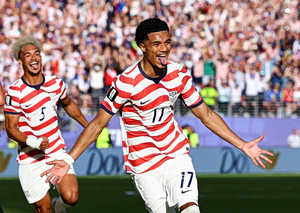
The game, held 2,400 miles away in Santa Clara, Calif., had been marred by a controversial red card for the Americans’ top scorer at this tournament, striker Folarin Balogun—and it meant he would be automatically suspended for the next match.
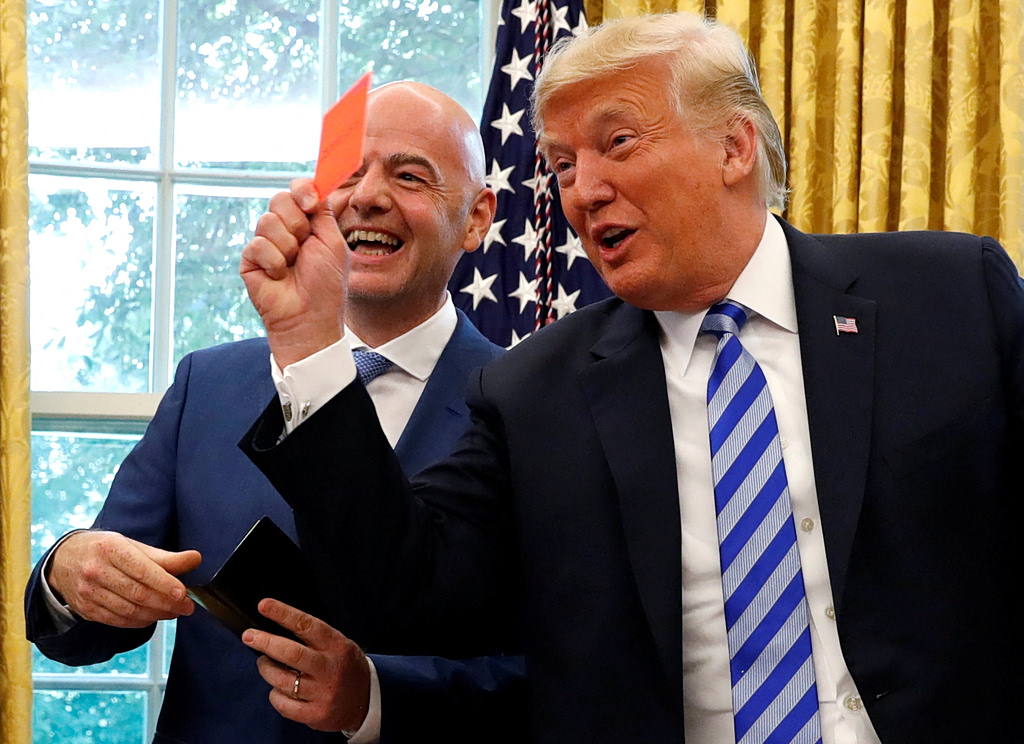
FILE PHOTO: U.S. President Donald Trump holds up a red card as he meets with FIFA President Gianni Infantino in the Oval Office of the White House in Washington, U.S., August 28, 2018. REUTERS/Leah Millis/File Photo
That’s when senior Trump administration officials hatched a plan that would go down as one of the most audacious in the 96-year history of the World Cup.
Never mind that soccer’s world governing body fiercely protects its role as the final arbiter of what happens within the white lines of the pitch, or routinely metes out draconian punishment for political interference. The White House was going to take it upon itself to turn a refereeing decision into a matter of state and reverse a call in a soccer match. And in FIFA president Gianni Infantino , the man Trump once called “the king of soccer,” officials knew they could count on a willing ally.
For Commerce Secretary Howard Lutnick and Andrew Giuliani, the executive director of the White House’s World Cup task force and son of Rudy Giuliani , the borderline call was an injustice that demanded executive intervention.
Starting that night, Lutnick and Giuliani organized several phone calls with Trump, according to people with knowledge of the matter. The suspension, they argued, wasn’t merely undeserved, it threatened to undermine the U.S. team’s chances when the Americans took on Belgium on Monday in Seattle for a place in the quarterfinals.
Trump, who was instrumental in bringing the World Cup to the U.S. and views its success as a matter of personal pride, didn’t want the ejection to cast a shadow over the tournament. So the president instructed his team to find a way to lift the suspension, the people said. Lutnick, Giuliani and other administration officials started recruiting high-powered, Trump-aligned lawyers to mount a legal challenge to the suspension. They discussed challenging FIFA’s use of slow-motion replay to decide whether Balogun’s stepping on an opponent’s ankle constituted a red-card offense.
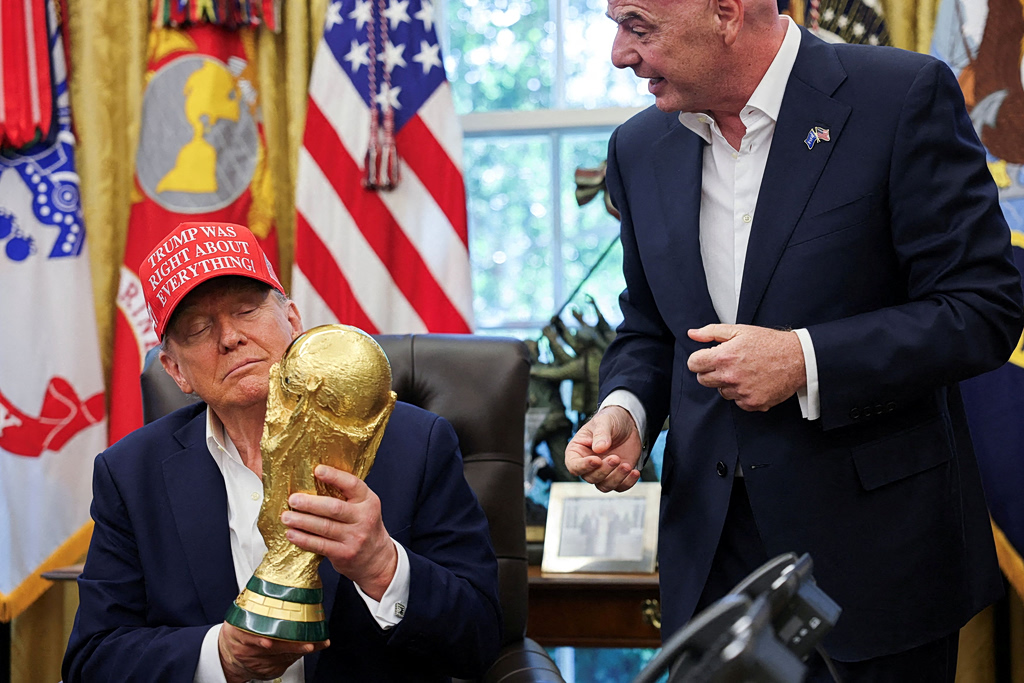
FILE PHOTO: U.S. President Donald Trump holds the FIFA World Cup Trophy, as he makes an announcement on the 2026 FIFA World Cup, as FIFA president Gianni Infantino stands next to him, in the Oval Office at the White House in Washington, D.C., U.S., August 22, 2025. REUTERS/Jonathan Ernst/File Photo
Administration officials didn’t take long to brief U.S. Soccer officials about their plan, the people said.
In the 24 hours after the game, as U.S. Soccer publicly bemoaned that it had no recourse to appeal the decision (and no obvious replacement for Balogun on the roster), Trump picked up the phone to the one person he knew had the power to put things right.
Infantino has ruled soccer’s governing body since 2016 and courted Trump for nearly as long. He has been a regular guest of the Oval Office and popped up alongside Trump at events ranging from a UFC fight in Miami to the Gaza peace summit in Egypt. And when the two men spoke, Trump urged Infantino to review the Balogun call.
The FIFA president agreed to look into it, but didn’t commit to overturning it, one of the people said.
By the time Trump and Infantino spoke again days later, however, Infantino was ready to tell him that the suspension was being lifted, some of the people said. FIFA had deployed a little known provision, known as Article 27, which it says allows its Disciplinary Committee to exercise its discretion when reviewing sanctions.
“Thank you to FIFA for doing what was right, and reversing a great injustice!” Trump wrote on social media Sunday afternoon.
Not everyone took such a generous view. Soccer fans across the rest of the world cried foul over what they saw as a head of state putting his thumb on the scale—and forever tarnishing the integrity of the World Cup.
FIFA declined to comment on the White House’s influence and insisted that its Disciplinary Committee was an independent body. The White House didn’t respond to a request for comment.
Belgium’s soccer federation said that it was “astonished” by the reversal and announced that it was reviewing its options. The team’s coach, Rudi Garcia, wondered if the whole affair was an April Fool’s prank played in July. Norway coach Stale Solbakken condemned the episode as a “Bad, bad, bad, bad, bad decision that will hurt the World Cup.”
“I feel also sorry for the United States,” Solbakken said, “because if they win, that will always hang in the balance for it.”
Even U.S. coach Mauricio Pochettino found himself in an awkward position. He had insisted after Balogun’s ejection, which came in the 64th minute of the 2-0 win over Bosnia and Herzegovina, that it was “never a red card.” The Americans had been forced to finish the game a man down, which he said was punishment enough. Yet he refused to address whether or not it was appropriate for the President of the United States to involve himself.
“In the end, it’s not that we’re victims,” Pochettino said in Spanish. “But we’re not the bad guys here.”