President Trump’s deal with Iran will allow the Islamic Republic to sell its crude and fuels like diesel on the open market for the first time since 2018.
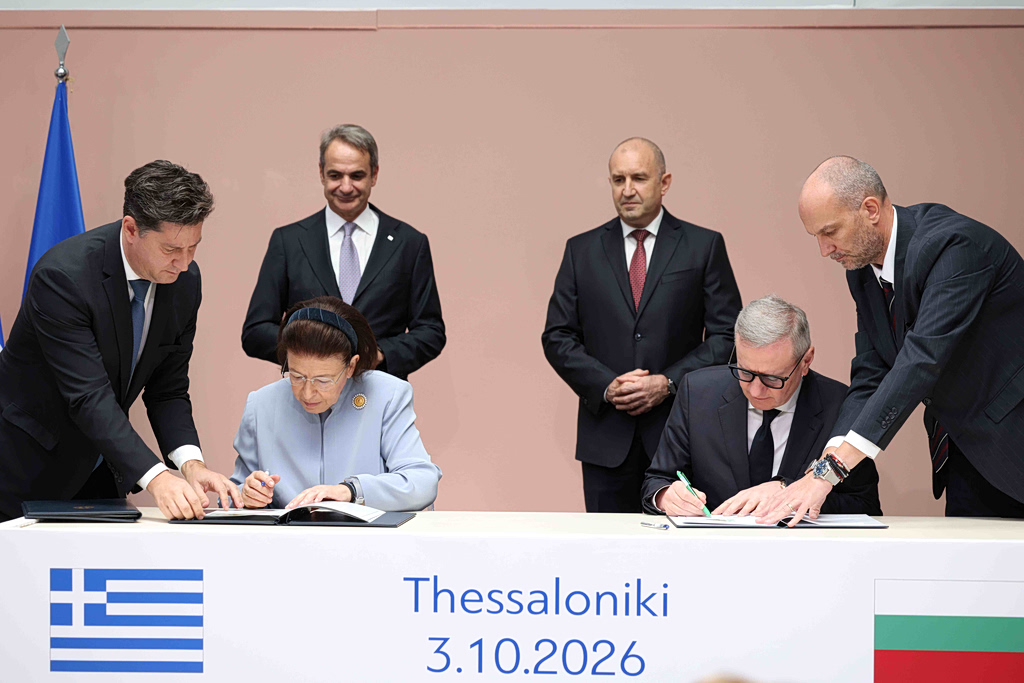
The pact—signed by Trump and by Iran’s President Masoud Pezeshkian this week—would let Iran immediately begin selling its oil, waiving sanctions and paving the way for services such as banking, transportation and insurance to facilitate transactions.
On Friday, talks in Switzerland between the U.S. and Iran were postponed following renewed fighting between Israel and Lebanon . Israel and Lebanon later Friday agreed to a ceasefire.
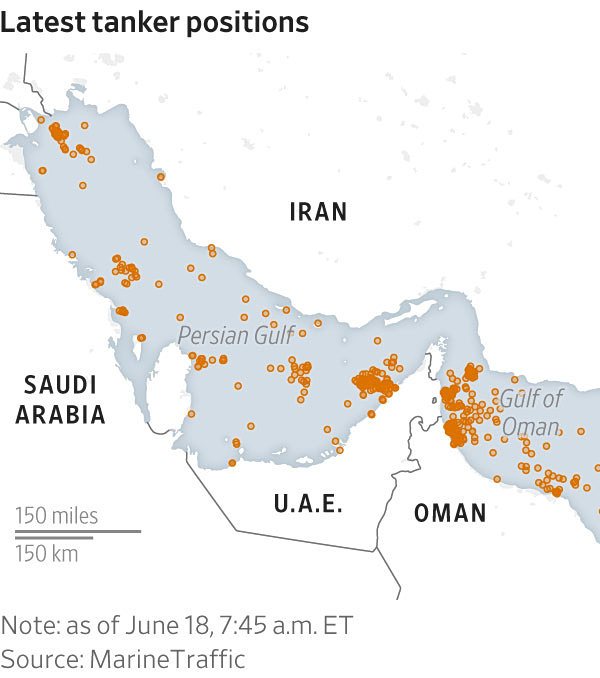
The U.S. military confirmed that it lifted a two-month blockade that brought Iran’s loadings down to a trickle, roughly 260,000 barrels a day last month, according to Kpler, a commodities and shipping data provider. In the prior three months that ended in April, Iran was about to load 1.85 million barrels a day on tankers, even if those vessels were trapped inside the Persian Gulf.
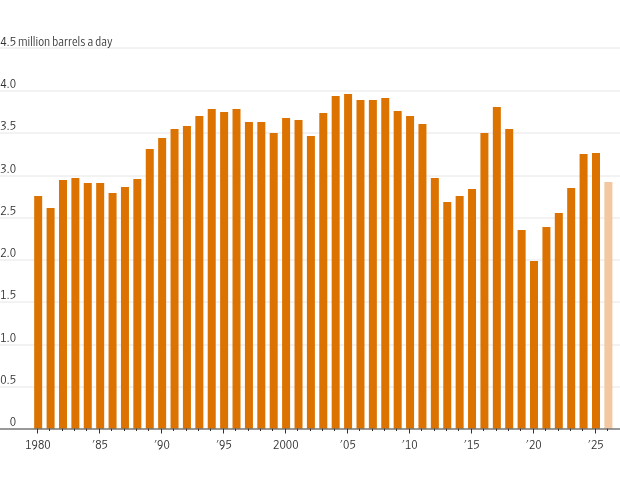
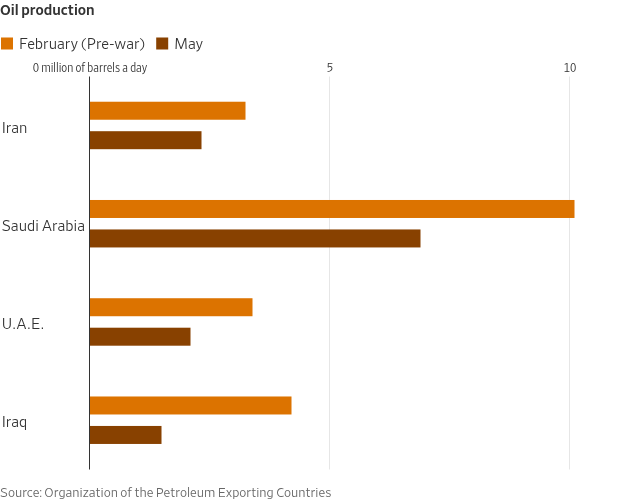
Iran has a long way to go to rebuilding its oil sector, parts of which were pounded by U.S. and Israeli forces. A decade ago, when a nuclear pact with the U.S. lifted restrictions on Iran’s oil sales, it was the world’s fifth-largest producer, pumping nearly 4 million barrels a day in 2016.
That level was well below what Iran pumped in its oil heyday, before the Islamic revolution in 1979. Crude output peaked at more than 6 million barrels a day for a few years in the 1970s when Western oil companies, including BP and Total, operated there.
Sanctions in the 1980s—and the ensuing brain drain from Iran—caused a long decline in its oil output that the industry has never fully recovered from.
Here is a look at what’s ahead:
The Coming Weeks
A few tankers filled with Iranian crude crossed the Strait of Hormuz this week, while others that had been hiding their location reactivated their radio signals, analysts and ship trackers said. Those moves came after the Trump administration said Tehran was free to market its oil.
Three Iranian-linked tankers carrying 5 million barrels between them sailed past the U.S. blockade this week, bearing for Southeast Asia, according to Vortexa, which tracks maritime movements.
Tehran clinched a deal to sell 10 million barrels—equivalent to 5 supertankers—to China, according to Hamid Hosseini , the spokesman for Iran’s oil exporters union. The sales are a first step to rebuilding its oil export flows, he said.
Over the next few weeks, if the peace deal holds, Iran will load tankers with oil currently stored on Kharg Island, where the country’s oil hub has over 30 million barrels in tanks.
The Near-Term Challenges
Iran can only substantially raise its oil production once storage tanks that are already brimming with crude get drained, according to analysts. In fact, empty onshore storage has fallen to 13.5 million barrels, meaning Iran has about a week of available capacity left at the country’s normal production rates, commodities-data provider Kpler said.
Finding tankers available to load Iranian oil could prove difficult, at least initially. Many of the Very Large Crude Carriers, or VLCCs, that ferry 2 million barrels at a time across oceans have been repurposed to the U.S. Gulf Coast to handle a surge in American oil exports. It could take weeks for those ships to get back to the Persian Gulf—and that’s if shippers are persuaded the conflict is truly over and it’s safe to transit the Strait of Hormuz.
Under the deal, Iran has 30 days to clear mines that it dropped into the strait.
“The strait is only open when the vessel owners say it is,” said Andy Lipow , president of Lipow Oil Associates in Houston.
A Year-End Partial Recovery
Analysts estimate it would take until the end of the year, or even into early 2027, for oil production and exports from Iran, Saudi Arabia and other Gulf producers to approach normal. Even then, how long it will take Iran to bring its oil fields back online is an open question. Oil fields largely skirted bombing damage, though pipelines, petrochemical plants and other infrastructure sustained hits.
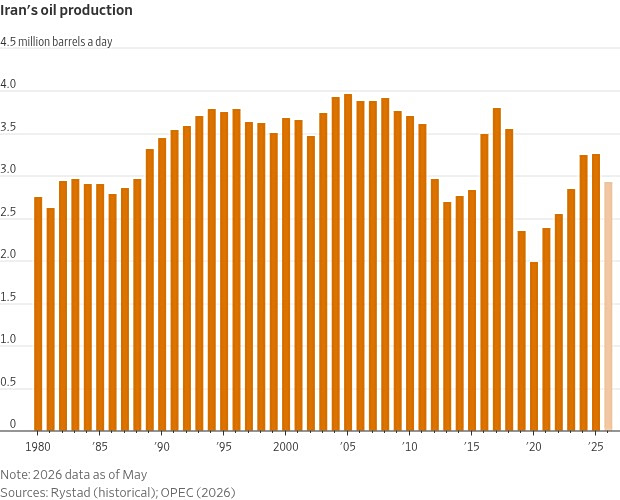
Iran’s production dropped to 2.3 million barrels a day in May, down from 3.2 million barrels a day prior to the war. Saudi Arabia’s crude output also sank, falling from 10 million barrels a day in the fourth quarter to 6.9 million barrels in May. Oil production in the United Arab Emirates and Iraq have dropped 38% and 52%, respectively, according to data from the Organization of the Petroleum Exporting Countries. Without a natural outlet for those barrels, those countries shut in vast numbers of wells as they ran out of storage space.
“If three or four months from now, we’re back up to 80% or 90% of production, then the revenue will be there” to repair damaged wells and oil facilities in the region, said Jim Burkhard , head of S&P Global Energy’s crude oil research. “I think we’ll get most of it back by the end of the year.”
Beyond 2026
Whether Iran can regain status as a long-term major player depends on geopolitical positioning of the U.S., China and Russia.
Iran will have to restart shut-in wells—a complicated task. It also needs to drill new ones to maintain supply levels, because many of its fields are old and have declining oil output, said Rahul Choudhary, an analyst at Rystad.
Since several international oil companies withdrew from Iran in 2018, the country has relied on local contractors that lack the money and technology to reverse the downward trend, Choudhary added.
It will need to attract outside investors, but most big oil companies won’t line up to invest, analysts said. For years, U.S. companies have been barred from doing business in Iran, and other Western companies are cautious about entering any country where strife could erupt suddenly and the rule of law is in question.
When the Trump administration urged U.S. oil companies to invest in Venezuela, they sought financial and security guarantees, and have pressed for an overhaul of regulations that govern how the country works with foreign oil companies.
Even so, the U.S.-Iran war proved that Tehran has more leverage on the global stage than previously believed.
“The biggest takeaway for the Iranians is that, prior to this, there was speculation that the Strait of Hormuz cannot be closed. But now they know that they can close it,” said Rohit Rathod, an analyst at Vortexa. “That’s the biggest win for the Iranians out of this.”
Write to Collin Eaton at collin.eaton@wsj.com , Benoit Faucon at benoit.faucon@wsj.com and Emma Brown at Emma.Brown@wsj.com