 Μake us preferred on Google
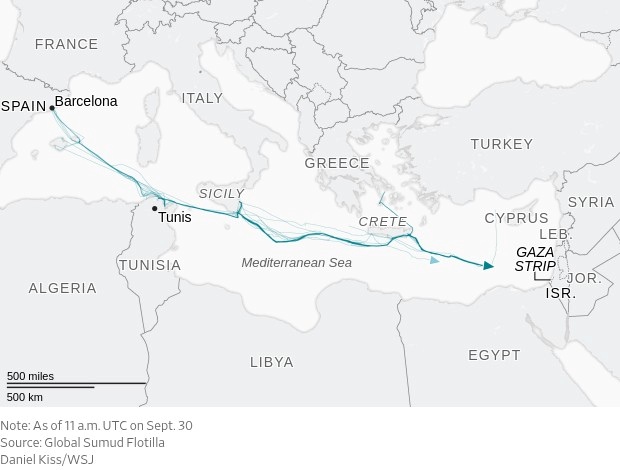
 The pro-Palestine activists and others aboard the flotilla of boats heading for Gaza were off the coast of Crete when their marine radios crackled to life in the night. Abba hits including “Dancing Queen” took over channel 16, the international frequency used by vessels for safety or distress calls.
“I thought it was a prank. Instead, it was the start of the operation,” said Italian lawmaker Arturo Scotto , who was on night duty on one of the boats. Suddenly the sky lighted up with flashes followed by loud bangs as low-flying drones hovered above. One of the boats suffered damage to its mast and had to abandon the voyage.
No one was injured in the incident last week, but to the around 500 activists, crew and others on board the more than 40 sailing and motor boats, the message seemed clear: Continue at your peril.
The passengers from around the world, carrying humanitarian aid for Gaza and hopes of breaking Israel’s naval blockade of the Palestinian enclave, strongly suspected Israel was behind the drone attack.
Israel’s government, which has neither confirmed nor denied its involvement, has vowed to stop the boats from reaching Gaza.
The flotilla and Israeli forces are heading ever closer to a confrontation off the coast of Gaza. Israel’s navy is preparing to intercept the activists soon, most likely on Wednesday.
The large number of boats, each carrying a small number of people, could make its interception time-consuming—but it could also make it easier for Israeli forces to detain the activists boat by boat. The hoped-for scenario, say people on both sides, is that no one uses force.
But all involved know there is a risk.
“Navies know how to act at sea,” said Eliezer Marom, a former commander of the Israeli Navy. But the waters are rough, tensions are high, and large groups of people are hard to control, Marom said. “There’s always the potential that people could be hurt.”
That is what happened in 2010, when a Turkish ferry carrying hundreds of pro-Palestine activists sought to break Israel’s blockade of Gaza. Around 70 nautical miles from the coast, Israeli navy commandos fast-roped from helicopters onto the deck, where they were met by a violent mob. Israeli forces opened fire. Eight Turkish citizens and a U.S. citizen were killed.
Marom oversaw that operation. He said Israeli authorities have no interest in a repeat.
David Adler , one of 24 Americans traveling on the flotilla, said the activists are practicing nonviolent resistance and de-escalation tactics, drawing inspiration from civil-rights icons such as Rosa Parks and Mahatma Gandhi.
“Those methods get rehearsed every single day in terms of where we’re gonna sit, how we’re gonna hold our hands up, our posture, how we communicate and talk,” said Adler, who is aboard Ohwayla, one of the lead vessels. “We’re trying to prepare for every potential scenario, and the main thing we always emphasize is never, ever escalate.”
For Israel, its already battered international reputation is on the line. Even historically friendly Western countries have become increasingly critical of Israel’s conduct of the two-year war in Gaza , where a famine is unfolding according to international hunger experts, and over 66,000 people have been killed according to Palestinian health authorities, which don’t say how many of them were combatants.
Israel says its naval blockade is legal, citing a United Nations report in 2011 that said it was a legitimate security measure to prevent weapons from reaching Gaza.
Israel has said the flotilla is backed by Hamas, the U.S.-designated terrorist group whose deadly attack on Israel in 2023 triggered the war in Gaza. The flotilla’s passengers have dismissed the accusation as baseless.
The flotilla’s goal is to pressure Israel to lift its naval blockade of Gaza, and open a sea corridor for aid workers and supplies.
The Global Sumud Flotilla set off in recent weeks from ports in Spain, Tunisia, Italy and Greece, converging in the Mediterranean. The group takes its name after the Arabic word sumud, meaning resilience, which is often associated with the Palestinian cause. It is a heterogeneous assortment of around 500 activists, politicians, public figures and ordinary citizens from 46 countries around the world. The largest groups by nationality are Italian, Spanish and Turkish. Passengers include Swedish climate campaigner Greta Thunberg and a grandson of Nelson Mandela.
Not all the participants see eye-to-eye. Some are determined to reach Gaza’s Israeli-controlled territorial waters, come what may. Others want to stop earlier. The divisions prompted some of the participants to leave the flotilla after the drone attack.
“My risk assessment changed, I could see land and the only option I had was to disembark,” said Niccolò Celesti , an Italian photojournalist, who went ashore in Crete. “I am in favor of dialogue, of finding whatever path is available to reach the goal of establishing a humanitarian corridor.”
Italy’s government has urged its citizens to turn back. Around 10 of the 50 or so Italians aboard the flotilla have quit the mission in recent days.
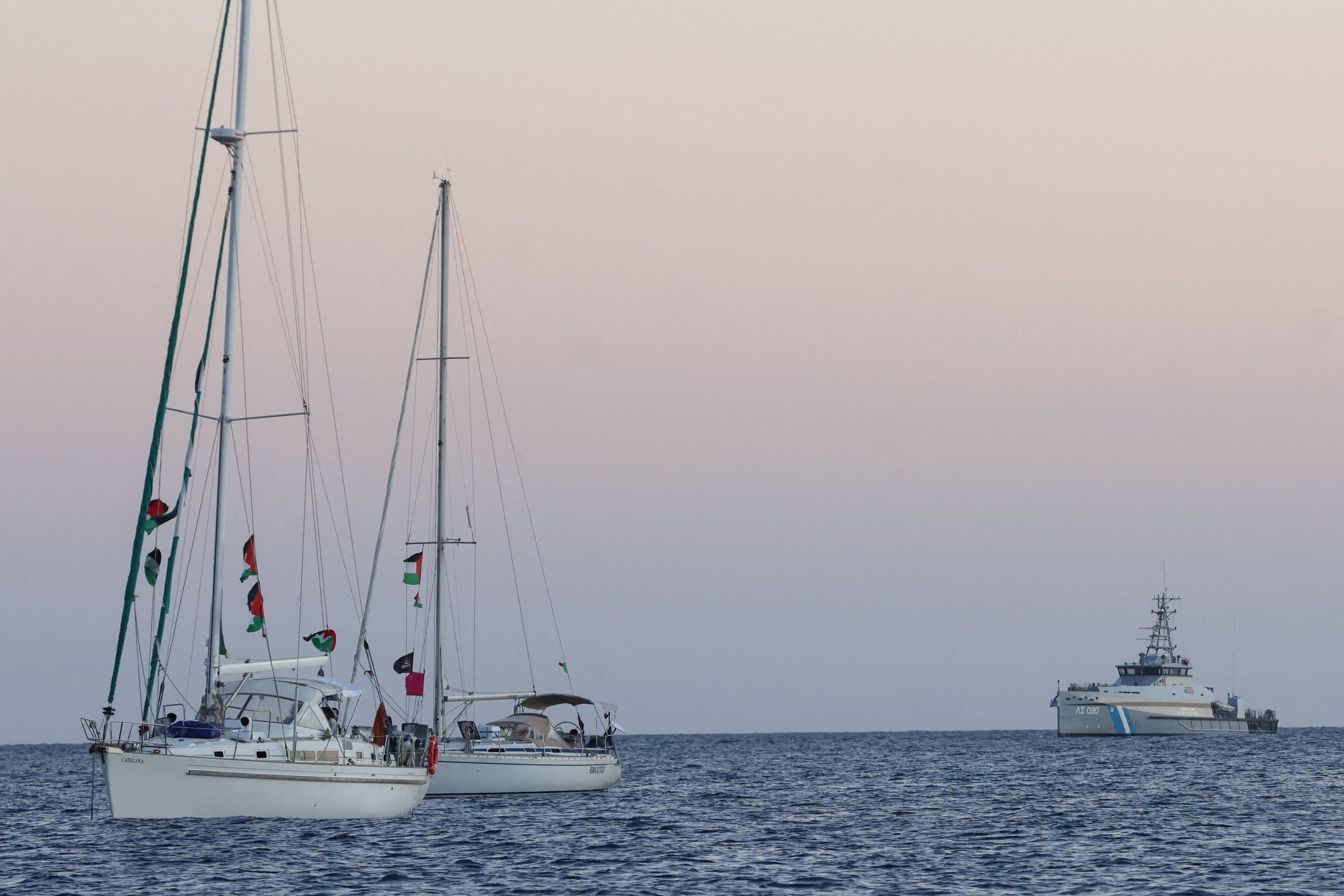
Italy and Spain have dispatched naval frigates to accompany the flotilla and rescue its passengers should things go wrong. The medical charity Emergency has also sent a rescue ship. Those vessels will stop before the area where the encounter with Israel’s navy is expected.
Rome has received assurances from Israel that its military won’t use lethal force against activists, according to an Italian official.
A spokesperson for the U.S. State Department said it has no higher priority than the safety and security of Americans, but called the flotilla “a deliberate and unnecessary provocation.”
Critics of the flotilla have called it a “selfie cruise” where activist-influencers pose for social-media posts against Mediterranean sunsets.
That couldn’t be further from the truth, said Kleoniki Alexopoulou , a Greek academic who is on the flotilla’s steering committee. She said participants work around the clock and follow strict rules, such as no sex or alcohol, to avoid tensions and show respect toward different cultures.
“Life on the boat is quite demanding, this isn’t like being on a yacht, but it’s still nothing compared to the difficulties faced by Palestinians,” she said.
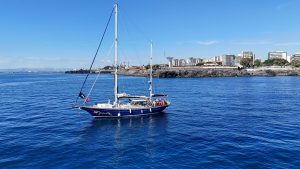
Many of the vessels are small, sometimes rickety sailboats. Mechanical failures are common. Below-deck areas can get uncomfortably hot. Some participants have been seasick for days.
On one day, waves reached up to 10 feet, said Yassine Lafram , who heads an association of Muslim residents of Italy. “They were higher than the boat. I said ‘OK, we’re done for.’”
Now anxiety is rising. After sunset in recent days, surveillance drones have hovered in the sky over the boats. “We’re entering the most critical phase,” said Lafram. “There is fear. But it’s nothing compared to what the population of Gaza is going through.”