Two years after New York City cracked down on Airbnb and other short-term rentals, it is harder than ever to find an apartment to rent in the city.
Lawmakers made two pledges in advocating for a law to enforce the city’s longstanding prohibition on short-term rentals, which finally went into effect in 2023.
The first was that a crackdown would remove noisy, disruptive tourists from residential buildings that had turned into de facto hotels. The second was that curtailing Airbnb and other short-term rental companies’ operations would protect the city’s tight housing supply.
The problem of the partying tourists upstairs is largely resolved, and New York City hotels have benefited from the sharp decline in short-term rentals. But the city’s housing crisis looks as bad as ever.
Apartment rents are at all-time highs, while the vacancy rate is next to nothing. The new legislation removed tens of thousands of short-term rentals from New York City apartment buildings, but it is unclear how many of those units are now occupied by year-round tenants.
“The law doesn’t seem to have a material impact in making rents more affordable,” said Jonathan Miller , chief executive of real-estate-appraisal firm Miller Samuel.
Short-term rentals took up only a tiny fraction of housing in New York City. There were an estimated 38,500 Airbnb units at the start of 2023, out of more than a million open-market residential units. While that number might seem too small to move the needle on housing availability or affordability, city officials point out that it does make a difference when there are only around 40,000 apartment vacancies.
“We can’t afford to lose a single unit of housing when there’s a huge vacancy problem in New York City,” said Christian Klossner , executive director of the city’s Office of Special Enforcement.
The 2023 enforcement did reverse the proliferation of tens of thousands of illegal short-term rentals. Those hosts violated the city’s rules by renting units for less than 30 days, among other infractions.
Many factors affect the price of rent, including demand and lack of construction.
Not all apartments or homes that previously operated as short-term rentals are now occupied by tenants with 12-month leases. Some property owners switched to renting for 30 days or longer, said Jamie Lane , chief economist for short-term rental-analytics firm AirDNA. Maybe they like to have the apartment available for several weeks or months a year when family or adult children come to stay, he said.
Manhattan’s residential-rental vacancy rate was 2.45% in July, near all-time low levels, according to Miller. The median rent has climbed to an all-time high, at $4,700 a month, though a number of factors have contributed to this rise, including a lack of new construction.
The new law, known as Local Law 18, “has become a compounding factor in the affordability crisis that the city is facing,” said Nathan Rotman , Airbnb’s North American director of policy strategy. He says many Airbnb hosts relied on short-term rentals to supplement their incomes.
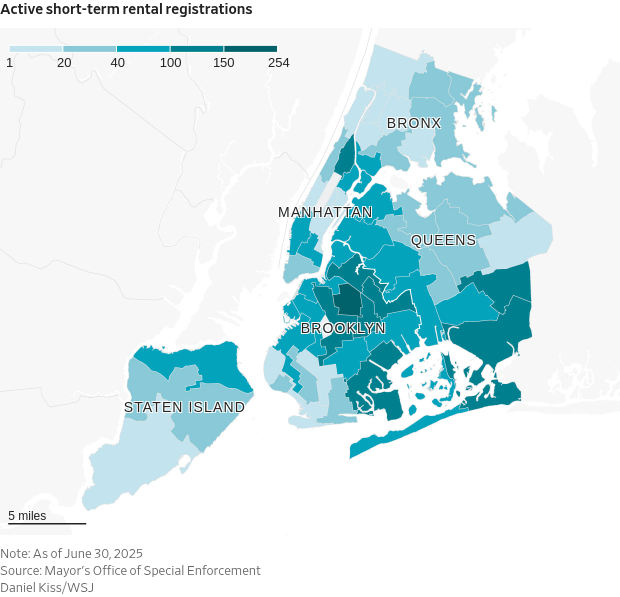
Under New York City’s stricter enforcement levels, there are now about 3,000 short-term rentals operating legally, according to the Office of Special Enforcement. Hosts can’t have more than two guests in a unit or lock off rooms and must be present during the stay. Local Law 18 requires short-term rental hosts who list on booking platforms to register with the city, and fines those platforms for processing transactions from unregistered hosts.
Airbnb sees an opportunity to seize on higher rents and is throwing its weight behind a City Council bill that would loosen some of the existing short-term rental regulations. The bill, which would allow owners of one- and two-family homes to rent for fewer than 30 days, was introduced a year ago but hasn’t progressed through the City Council.
The San Francisco-based company has become one of the biggest spenders in New York City’s November elections, seeking to support candidates who endorse a rollback of the short-term rental restrictions ahead of next summer’s World Cup finals in nearby northern New Jersey, when a flood of visitors is expected to descend on the city. Airbnb’s PAC is the top spender in the 2025 citywide elections, aside from a super PAC established to support former Gov. Andrew Cuomo’s mayoral campaign.
Airbnb has been operating in New York City since 2008, even though much of its hosts’ activity was technically illegal from the start. City laws have long prohibited apartment owners or tenants from renting their entire apartment to guests for fewer than 30 days.
Before the 2023 law, New York City was one of the company’s biggest U.S. markets, though the company doesn’t break out numbers for individual cities.
Shortly after the city began enforcing the new law, Airbnb CEO Brian Chesky spoke at a travel conference and said he predicted the city would see both higher hotel prices and rents: “And the reason why is because a lot of New Yorkers were actually, it turns out, pretty regular ordinary people that were dependent on Airbnb to pay their rent or mortgage.” Some former short-term rental hosts said they rented their units when they traveled for work or vacation.
Airbnb’s PAC has spent more than $3.6 million between February and June. That includes paying for more than $400,000 of ads against Democratic mayoral candidate Zohran Mamdani , who has made affordable housing and a rent freeze on the city’s one million rent-regulated apartments a cornerstone of his campaign .
Dora Pekec , a spokesperson for Mamdani’s campaign, said, “Airbnb’s proposed changes to the city’s housing law would drain even more supply out of an already tight housing market.”
Some cities have contemplated total or near-total bans on short-term rentals, which major booking platforms have challenged in court.
Irvine, Calif., banned short-term rentals in 2018. Over a nearly two-year period that ended in June 2021, long-term rental rates decreased by about 3% on average, according to a study published in Real Estate Economics. (That enforcement period included the pandemic, which the authors controlled for.) Since then, however, rents have increased 8%, according to data firm CoStar .
Proponents of the new regulations, meanwhile, have spent heavily to preserve them. A coalition of affordable-housing groups and tenants unions has financial backing from the hotel industry, and specifically from the city’s powerful hotel union. The hotel union’s interest is twofold—to preserve jobs in the industry and ensure the city remains affordable to live in, union officials said. The union, the Hotel Trades Council, has spent nearly $2 million in local elections through its PAC.
Hotels tend to benefit from tighter Airbnb restrictions, especially in New York City. Significantly reducing the number of apartments that can be rented for less than 30 days undeniably boosts demand for hotel rooms in a city visited by tens of millions of tourists a year.
Without the law, “we would be in a catastrophic situation,” said hotelier Richard Born , who owns 24 hotels across the city.
The average rate for a New York City hotel room rose to $283 a night in July, a 7% jump from two years ago. Occupancy has outpaced 2023 levels every month this year except for July, according to CoStar. The city’s program of paying for tens of thousands of migrants to stay in hotels contributed to the higher occupancy.
The Hotel Association of New York City, which supports strict regulations on short-term rentals, says the primary driver of rising room rates is hotel owners’ rising costs.
Whitney Hu , a spokeswoman for the affordable-housing coalition fighting Airbnb, says it will take years for the market to settle into its new normal, and the first step is returning units back to the long-term market. “I think the majority of people on the streets don’t necessarily have the most sympathy for somebody trying to protect investment property when they’re trying to find a home themselves,” she said.
Others say the 2023 legislation is a success because it gave the city tools to enforce its existing laws around short-term rentals. It helped reduce quality-of-life complaints from residents who had been sharing their buildings with illegal short-term rentals, Council Member Gale Brewer said. Before the increased enforcement, Brewer said her office often received calls about apartments being used by an endless stream of short-term rental guests who were “partying and throwing up.”
“Since the law passed I never heard another word about that,” Brewer said, “because people are going to get caught.”
Write to Allison Pohle at allison.pohle@wsj.com and Kate King at kate.king@wsj.com