Oil markets are waking up to a new reality: Disruption to the Gulf’s prodigious energy supplies isn’t ending anytime soon.
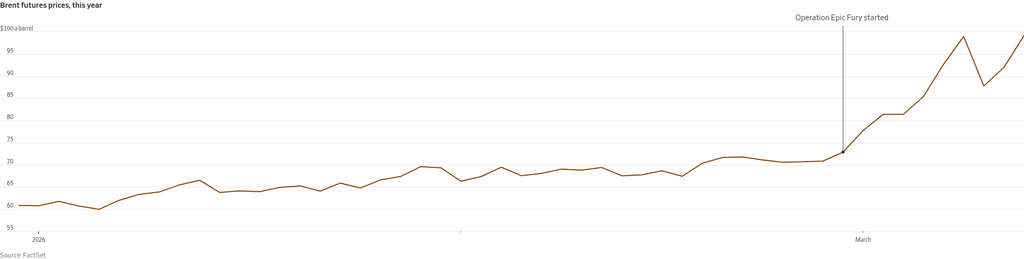
When the U.S. and Israel first attacked Iran, some traders initially expected days of disorder. Now they are expecting the turmoil to last weeks or even months. On Thursday, Brent crude shot back above $100 a barrel amid growing concerns about a protracted period of disruption to the oil markets. Futures settled at $100.46, up more than 9% for the day.
Several tankers were attacked in the Strait of Hormuz on Thursday, with Iran’s new supreme leader vowing to keep the vital waterway closed . President Trump said stopping the Iranian regime from getting nuclear weapons was a higher priority than oil prices . Several analysts said crude could hit new multiyear highs if the conflict drags on.
“The market is getting more and more nervous,” said Neil Crosby of Sparta Commodities. “We see not only supply chain issues from the Hormuz closure, but also growing medium-term implications from all the attacks on infrastructure in the region.”
Traders and analysts are fixated on the Strait of Hormuz, the narrow passage between Iran and Oman through which 20% of the world’s oil typically flows.
Oil analysts are now forecasting longer-lasting upheaval . If the war continues, the strait will likely remain paralyzed. If the fighting quickly ends with the Iranian regime left in place, it could still be risky, potentially handing Tehran more control over the globally significant energy route.
Goldman Sachs this week raised its oil price forecasts, citing longer-than-expected disruption. Brent crude could hit an average of $145 in March and April in a more extreme scenario, it said. The bank now expects disruption to flows through the strait to last 21 days, up from its previous forecast of 10 days.
Goldman’s base case is for Brent futures to average $98 a barrel in March and April. A week ago, the bank said oil would trade in the $80s in March.
Macquarie Group is now predicting that crude prices could top $150 if the strait remains closed for a few weeks. Others say oil prices could go even higher.
“In our view, $200 a barrel is not outside the realms of possibility in 2026,” Simon Flowers , chairman and chief analyst at energy consultancy Wood Mackenzie said this week.
“When the conflict ends, cranking up the supply chain won’t be swift,” Flowers added, referring to damage to production facilities in the Middle East.
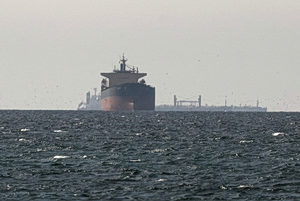
One reason for the changing outlook is a surge in attacks on tankers near the strait. Over the past 24 hours, at least seven vessels were hit in waters off the coast of Dubai and Iraq. One of the ships, a foreign tanker carrying Iraqi fuel oil, was ablaze in Iraqi waters. One crew member died.
U.S. officials said that Iran has also started to litter the strait with sea mines, simple but powerful weapons that could give the country outsize power to wreak havoc with the global economy. The U.S. Navy isn’t yet ready to start escorting tankers through the passage, Energy Secretary Chris Wright said Thursday.
Further complicating the global oil flow, Iranian-backed Houthis in Yemen and other groups are now threatening to shut the Bab el-Mandeb Strait. Some 12% of global seaborne oil passes through the strait at the southern tip of the Arabian Peninsula.
Choking off that waterway would mean that vessels could no longer access the Suez Canal via the Red Sea, effectively rendering one of the precious few ways of bypassing the Strait of Hormuz largely useless.
“The war in the Middle East is creating the largest supply disruption in the history of the global oil market,” the International Energy Agency said Thursday as it slashed its forecast for oil-supply growth this year.
IEA member countries on Wednesday sought to calm markets by launching the biggest-ever release of emergency oil reserves .
But the move to release some 400 million barrels of oil to alleviate supply pressures has largely failed to reduce anxiety. Nothing will fully offset the supply lost by the strait’s closure, traders and analysts said.
It isn’t yet clear how fast the 400 million barrels will be dispersed, but it is expected to take several months. Analysts at Dutch bank ING estimate about 3.3 million barrels a day will be released, far short of the supply losses of 15 million barrels a day from the Persian Gulf.
“As we have said repeatedly, the only way to see oil prices trade lower on a sustained basis is by getting oil flowing through the Strait of Hormuz. Failing to do so means that the market highs are still ahead of us,” the ING analysts said.
Further, some oil and liquefied natural gas producers in the Persian Gulf have turned off wells as storage space runs out. Oil and LNG facilities may take weeks to restart, meaning disruption to overall supplies will likely last even after oil starts moving again through Hormuz.
The realization of prolonged disruption has already dawned on the physical oil market .
Japan has said it would release 15 days’ worth of oil from private-sector stockpiles and an additional 30 days’ worth from government reserves to keep a lid on price increases .
Taiwan has placed coal-fired units at Hsinta Power Plant—the island’s oldest coal-fired power plant—on standby. Myanmar’s junta has started rationing fuel for private cars, while Thailand has suspended some fuel exports.
Meanwhile, Indian oil refiners—now armed with a waiver from the U.S. to start buying Russian crude again—have swooped in to scoop up Moscow’s exports.
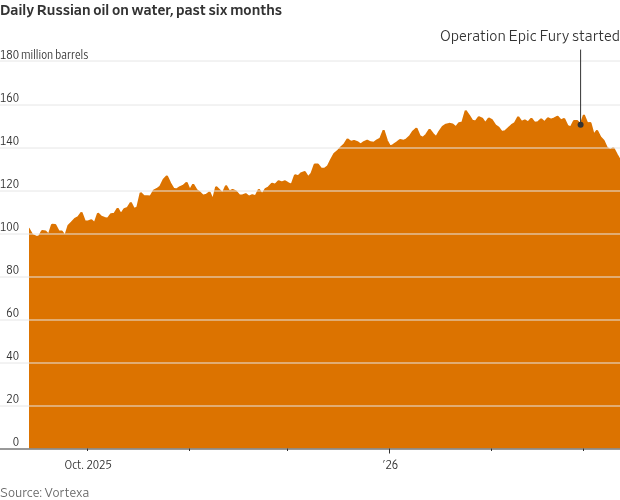
Before the war started, some 152 million barrels of Russian crude were on water, seeking buyers. That figure has since dropped 12% to 134 million barrels on Thursday, according to ship tracker Vortexa.
“Plummeting Russian crude on the water reflects these barrels all of a sudden selling and being delivered like hotcakes,” said David Wech , Vortexa’s chief economist.
For years Russian oil has traded at a discount to global crude prices. Now, some traders are starting to sell the once-shunned oil at a premium.
Write to Rebecca Feng at rebecca.feng@wsj.com