Μake us preferred on Google
 As crews battle California’s largest wildfire of the year—a 70,800-acre blaze that has forced evacuations and closed a highway—many homeowners are preparing for such emergencies by burning their own land ahead of time.
Last December, Paige Lettington set her property in the foothills of California’s Sierra Nevada mountains ablaze to protect it from the raging wildfires that have consumed 14.8 million acres in California since 2015.
The centuries-old technique, known today as a prescribed burn, is becoming increasingly popular among homeowners in fire-prone states hoping to rid their properties of the flammable brush that can send a wildfire racing across the landscape.
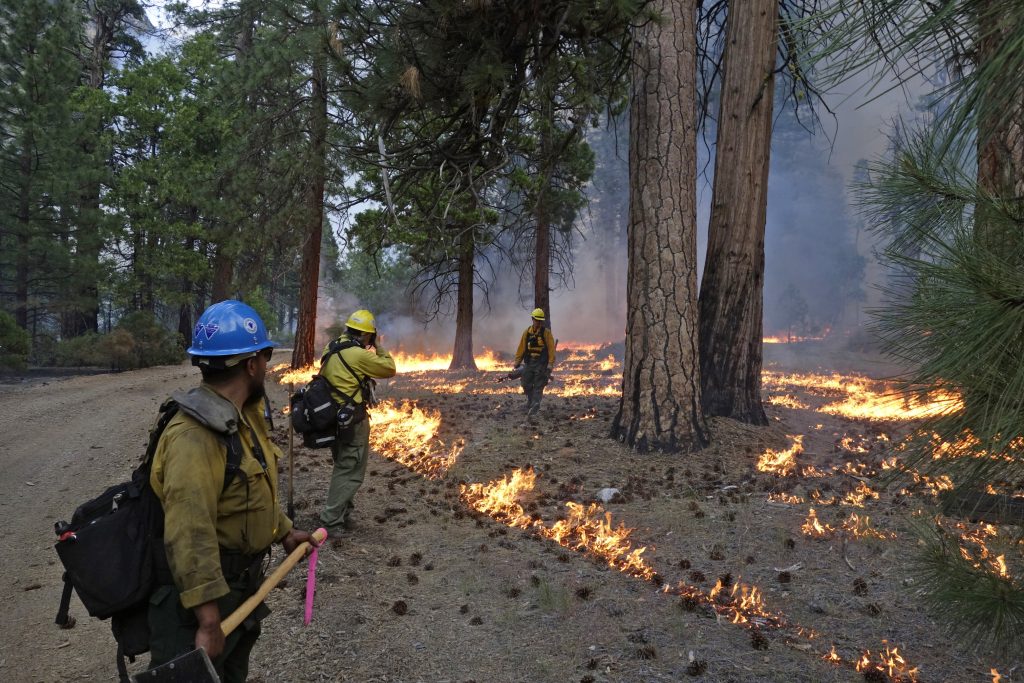
In this June 11, 2019 photo, firefighter Andrew Pettit, right, walks among the flames in Cedar Grove as fire ecologist Tony Caprio, center, take a photo and firefighter Julio Campos looks on during a prescribed fire in Kings Canyon National Park, Calif. The prescribed burn, a low-intensity, closely managed fire, was intended to clear out undergrowth and protect the heart of Kings Canyon National Park from a future threatening wildfire. The tactic is considered one of the best ways to prevent the kind of catastrophic destruction that has become common, but its use falls woefully short of goals in the West. (AP Photo/Brian Melley)
California is among several states that actively supports the approach.
In 2022, it set a goal of conducting 400,000 acres of prescribed burns annually. It established a $20 million prescribed-burn claims fund to encourage what it calls beneficial fires. And last year, more than 104,000 acres of prescribed burns were conducted there on federal, state and private lands .
Landowners who want to participate must get a permit from the California Department of Forestry and Fire Protection, or Cal Fire, and approval from local air-pollution authorities. To get liability protection from the state fund, landowners must have the burn supervised by a Cal Fire-certified “burn boss” at a cost of $2,000 to $5,000 a day.
California’s five biggest wildfires have all occurred since 2018, including the historic 2020 season that cost the state $1.23 billion to fight blazes that scorched 4.3 million acres. Forest ecologists attribute the bigger, more intense fires to climate warming and decades of forestry-management practices that allowed fuel to accumulate in some areas.
“When we moved up here, we knew we had to pay attention,” Lettington said. “These forests have been growing for years, and the wildfires have been getting worse.”
Last fall, after taking classes with local prescribed burn associations, and helping on several burns as a volunteer, Lettington decided she was ready to set her property on fire.
California has 31 prescribed burn associations—typically grassroots organizations formed by local communities, landowners, firefighters and conservationists—that help homeowners like Lettington with training, advice and equipment.
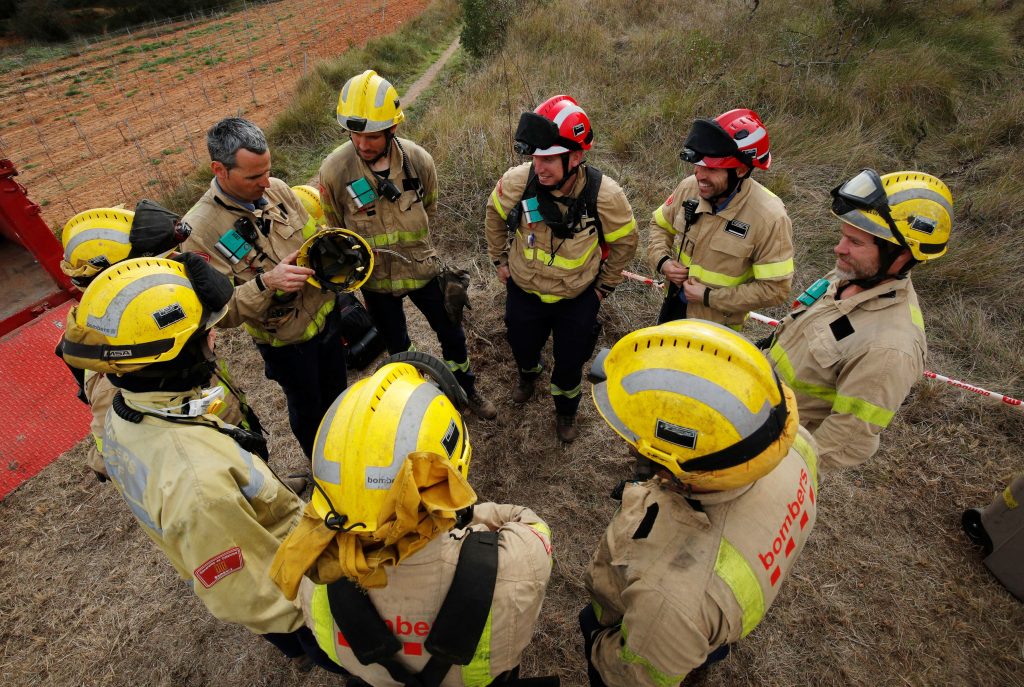
A group of firefighters do a meeting wearing a Prometeo monitoring device (by IBM) during prescribed burn of the forest in Olivella, south of Barcelona, Spain February 11, 2020. Picture taken February 11, 2020. REUTERS/Albert Gea
Lettington spent several days removing combustible material from a strip of ground to create a firebreak to prevent the flames from expanding beyond the half acre she intended to burn. She also dragged bigger brush piles outside the firebreak perimeter and notified the local fire department.
On the day of the burn, she and a dozen trained volunteers gathered with hoes, rakes and water-filled backpacks. Lettington lighted the ground with a hand-held propane torch. Soon, 2-foot-high flames burned dry grasses, leaves and manzanita shrubs within the perimeter.
“The whole thing took about three hours,” Lettington said.
Local burn associations hope small burns like Lettington’s will add up.
“We are working on the mission that we can burn a million acres of land in California by training a million landowners to burn 1 acre at a time,” said Cordi Craig , prescribed fire program manager for Placer County’s Resource Conservation District.
Forestry managers and ecologists say that without regular fire, many forests become unhealthy, trees are stressed by overcrowding, fire-dependent species disappear, and flammable fuels build up and become hazardous.
But there has been some pushback against the larger burns conducted by federal forestry officials. In recent years, in California and elsewhere, environmental groups have sued saying that the burns and tree thinning in some ecosystems damage habitat for endangered wildlife.
Fires can also “escape.”
The U.S. Forest Service conducts 4,500 prescribed burns annually, with about seven fires that escape controlled fire lines a year, according to a 2024 report from the Government Accountability Office. In 2022, two forest-service controlled burns in New Mexico escaped and merged, burning 341,000 acres and destroying hundreds of structures. It was the largest wildfire in the state’s history.
In California, there have been no escapes from private controlled burns, according to Cal Fire.
The use of prescribed burns is growing in other states as well, with more than 140 burn associations now operating in 21 states.
In Oklahoma, the number of prescribed burn associations has jumped from six in 2006 to 26 this year. Increasing amounts of flammable vegetation, changing grazing patterns, and extreme heat and drought have contributed to more and bigger wildfires in the state, according to John Weir , senior extension specialist for fire ecology at Oklahoma State University.
In Washington state’s Cascade range, Sarah Allaben , a fire adapted communities coordinator at the nonprofit Mt. Adams Resource Stewards, helped set up the Mount Adams Prescribed Burn Association to help landowners navigate regulatory issues that have prevented amateurs from conducting prescribed burns.
In North Carolina, Jesse Wimberley , who leads the Sandhills Prescribed Burn Association in southwestern North Carolina, and his colleagues have revived prescribed burns using techniques for managing land passed on from Wimberley’s ancestors.
“The antidote to wildfire is more fire,” Wimberley said. “We are working on how to get fire on the land at scale.”
Native Americans practiced prescribed burning for generations before the practice was opposed in the 19th century by forestry officials and conservationist John Muir, who wrote in 1869 that human-lit fires were the “master-scourge of forests.”
That view held until recent decades, when scientists began touting the benefits of regular low-intensity burning to reduce the risk of larger and more intense wildfires, while improving forest health.
Six months after Lettington burned a patch of her property, a soft carpet of green vegetation was returning to the landscape. She is preparing to burn another section once cooler weather arrives this fall.
“From a fire-safety and ecology point of view, this burn made a lot of sense to me,” Lettington said. “I’m hooked.”
Write to Eric Niiler at eric.niiler@wsj.com
Corrections & Amplifications undefined Paige Lettington took classes with local prescribed burn associations. An earlier version of this article incorrectly said only that she took a class with the Nevada Prescribed Burn Association. (Corrected on July 6)