Driving north from Melides toward the town of Comporta, through the western reaches of Portugal’s Alentejo region, I passed expansive rice fields, forests of umbrella pines and clusters of whitewashed homes.
Then came the billboards.
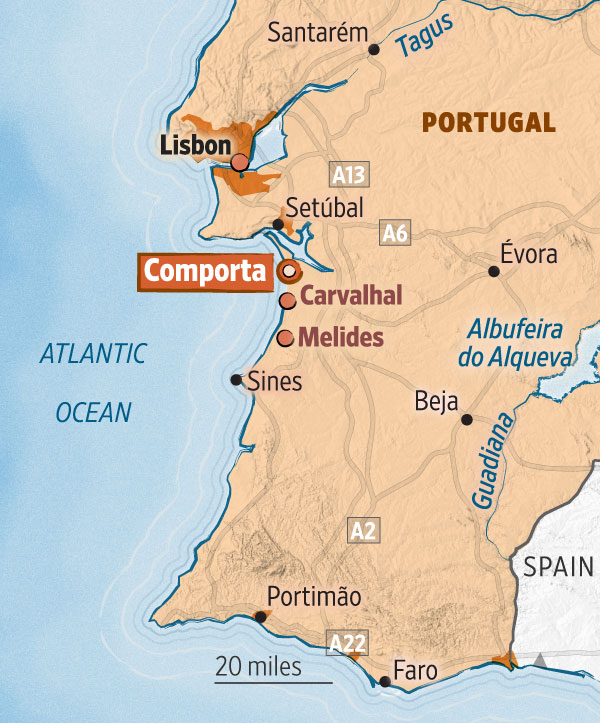
One after another advertised new luxury residential developments with promises that included, in English, the opportunity to build the “Comporta of your dreams.” Thatched-roof houses appeared in glossy renderings, selling an idealized vision of life along this stretch of the Atlantic coast, just over an hour south of Lisbon.
One left turn at a roundabout and the road gave way to wide stretches of beach.
The drive told two stories. One was of a place I’d been hearing about for years: a sleepy beach town surrounded by several others, an area beloved by fashion insiders, artists and nature lovers alike.
The other was of a place in the midst of transformation, as new luxury hotels, buzzy restaurants and vacation-home developments draw the next generation of travelers.
A coast in transition
One of my first stops was the village of Carvalhal, where sophisticated clothing and design shops sit alongside old-school cafes where locals linger over coffee. I met Helena Lunardelli, the co-owner of Caju, a colorful, quirky concept store selling funky international fashion and vintage Portuguese decor. Lunardelli first fell for Comporta seven years ago, while visiting from São Paulo, and now splits her time between Brazil and Portugal.
“There’s a real magic here,” Lunardelli said. “It’s a very easy way to live. People come here and feel they have time.” In her years living in the area, she has watched some longtime locals leave to make way for well-to-do transplants. “We miss some of the real soul of the place,” she said. “But for business, it’s very good.”
Lunardelli insisted my next stop must be Sal , an oceanfront restaurant overlooking Praia do Carvalhal beach. It was a Sunday and families gathered around large tables as waiters rushed between them. Outside, tables spilled across a terrace and onto the sand. In the middle of it all was the owner, Vasco Hipólito Raposo, holding court.
Upon introducing myself, Hipólito Raposo sat me down and ordered me tomato carpaccio, fish soup and a glass of house wine. Our conversation was interrupted by a steady parade of friends and guests, popping by to say hello.
“I think the biggest changes are still ahead,” said Hipólito Raposo, who grew up in Lisbon and bought his first home in Comporta 25 years ago. “The next five years will bring a lot of growth. But this is a protected area. You can’t build on the coastline.”
He was referring to the rules around the Sado Estuary Nature Reserve, a protected area around Comporta. It restricts where and how development can take place, particularly near the coast. As a result, even as new hotels and villas appear inland, much of the beachfront has remained quiet.
After lunch, I walked north along the beach. Restaurants and beach clubs were concentrated only around a handful of access points. Within minutes the crowds thinned, leaving long stretches of sand with barely another beachgoer in sight.
A new wave arrives
Just down the coast, at Praia do Pego, I got a glimpse of the Comporta that may be coming. At the three-year-old JNcQUOI Beach Club , you’re more likely to see people dressed in designer swimsuits holding expensive raffia totes than in the area’s usual uniform of linen shirts and flip-flops.
Where Sal, the restaurant, is colorful and eclectic, JNcQUOI Beach Club is outfitted in a sleek palette of navy, natural wood and cream.
Long before JNcQUOI brought its brand of luxury to Comporta, Gonçalo Pessoa saw its potential. The former TAP Air Portugal pilot first came to the area in 2001 after years of vacationing in the more developed Algarve in southern Portugal. As he watched in-the-know travelers trickle in, he noticed something missing: a chic place for them to stay. In 2014, he opened Sublime Comporta with just 14 rooms.
In May, he unveiled Sublime Sand, a village-like extension across the road, this time with 43 villas. He added restaurants, including the steakhouse Beefbar , as well as a spa, wine tastings with the property’s sommelier, horseback rides along the dunes and bike excursions through rice fields. Prices start at $1,400 a night.
Sublime Sand’s two- to four-bedroom villas are scattered through the forest and made of wood, glass and zinc, to blend into the landscape. “We should be truthful to the places where we settle, and the architecture needs to respect that,” Pessoa said.
Putting down roots
During my time around Comporta, I noticed a pattern. Many of the people I met had arrived as visitors and then found reasons to keep coming back before settling in for good. Atlantic Club Comporta , a new 24-villa residential community, could be a response to that pull. The brainchild of French interior designer Jacques Grange, an area regular for 30 years, the development spans 35 hillside acres overlooking the Atlantic and Carvalhal’s rice fields.
Its four- to eight-bedroom villas are scattered among fig and pomegranate trees and gardens designed by landscape architect Madison Cox. Inside, Portuguese tile, raffia and colorful linens fill airy living spaces that open onto private pools. They can be purchased for prices ranging from around $4.6 million to $13.8 million. Rentals start at around $15,000 per week.
Anna Jorge, who grew up in the area, has watched the money pour in. I met her at Cavalariça , a restaurant in Comporta carved out of a former horse stable. The stalls now frame the dining room. “Everything around us has exploded in terms of investment, which creates jobs and opportunities we wouldn’t otherwise have,” Jorge said. “But we’re always a little afraid when people talk about development because we don’t know where it’s going to stop.”
At a tense time for locals, what surprised me was how easily the old-school Comporta I’d heard about, with its artisanal shops and cafes, could still be found. How long it can maintain that balance is another question.
For now, it seems to still offer something increasingly difficult to find on Europe’s most coveted coastlines: room to breathe.
What to book before you arrive in Comporta
Some of the region’s most memorable experiences require a bit of advance planning. Here’s what to reserve before you go.
Horseback ride through the dunes
Book a ride with Cavalos na Areia , whose guided excursions also traverse pine forests and rice fields before arriving at the beach. (From around $80 per person)
Private wine tasting
Arrange a private tasting at Quinta Brejinho da Costa , a family-run winery near Melides known for its small-production wines and personalized visits.
Boat trip through the Sado Estuary
Head out with Sado Emotion in search of the Sado’s resident bottlenose dolphins, with a cruise along the Arrábida coast. Private trips are also available. (From around $52 per adult)
Dinner at Xtian
Visit the restaurant inside Vermelho Hotel , Christian Louboutin’s 13-room jewel-box of an inn in Melides, and order one of the region’s signature rice dishes. Arrive early for an aperitif at the bar and to wander the art-filled interiors and mazelike gardens.
Private sunset buggy tour
Explore Comporta’s fields, forests and dunes on a private off-road buggy tour with Feel Comporta . Upgrade the experience with a picnic and wine pairing. (From around $345 per person)