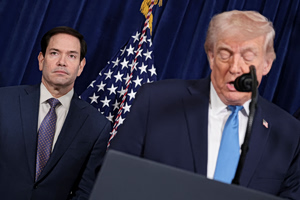
MUNICH—Secretary of State Marco Rubio made an unapologetic defense for American might and pursuit of national interests Saturday while seeking to recast President Trump’s sharp disputes with Europe as a form of tough love with the U.S.’s closest allies.
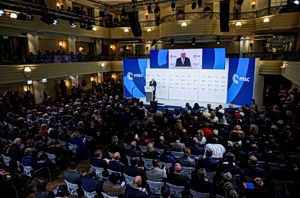
In a speech at the Munich Security Conference, an annual trans-Atlantic gathering, Rubio said that the current global order, with its free-trade regimes and minimization of national identities, was a “foolish idea” that the U.S. and its allies must work to reshape.
“We want allies who can defend themselves so that no adversary will ever be tempted to test our collective strength,” Rubio said. “We do not want allies to rationalize the broken status quo rather than reckon with what is necessary to fix it. For we in America have no interest in being polite and orderly caretakers of the West’s managed decline.”
Rubio sought to address Trump’s approach to U.S. allies, which has fueled mounting anxiety in Europe over trans-Atlantic ties including tariffs and his overtures to Russian President Vladimir Putin in his bid to end the war in Ukraine.
“This is why we Americans may sometimes come off as a little direct and urgent in our counsel,” Rubio said. “This is why President Trump demands seriousness and reciprocity from our friends here in Europe. The reason why, my friends, is because we care deeply.”
Rubio made no mention of Greenland after Trump’s repeated efforts to annex the Arctic island from close ally Denmark triggered a diplomatic crisis between the U.S. and Europe.
Rubio, the highest-ranking U.S. official at the conference, touched upon similar conservative themes that Vice President JD Vance discussed in his address to the conference last year, including deriding mass migration as a threat to Western civilization. But Rubio couched those remarks within a broader message: The U.S. would always remain Europe’s ally.
“Our destiny will always be intertwined with yours,” he said to applause from an audience of global national security elites. “We know that the fate of Europe will never be irrelevant to our own.”
Rubio’s remarks received a standing ovation from the audience of European dignitaries. Wolfgang Ischinger , a former senior German diplomat, immediately told Rubio on stage, “Mr. Secretary, I am not sure you heard the sigh of relief through this hall when we heard what I would interpret as a message of reassurance and partnership.”
Yet, several senior European officials said the speech didn’t allay all their concerns about the alliance, which has been deeply shaken by Trump’s efforts to acquire Greenland and the prospect of the U.S. brokering a peace deal in Ukraine that could favor Russia.
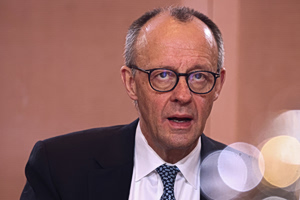
Rubio at the conference skipped a high-level meeting with European allies over future support for the war in Ukraine but held separate meetings on Ukraine with German Chancellor Friedrich Merz and other senior European officials, including a brief meeting with the prime ministers of Denmark and Greenland. Rubio is also slated to meet with Ukrainian President Volodymyr Zelensky on Saturday.
Trump is steadily continuing his efforts to end the war in Ukraine, Rubio said. The president boasted before entering office that he could solve the war on “day one.” “We don’t know if the Russians are serious about ending the war, they say they are,” Rubio said. “But we’re going to continue to test it.”
“I don’t think anybody in this room would be against a negotiated settlement to this war, so long as the conditions are just and sustainable, and that’s what we aim to achieve,” Rubio added.
Rubio’s remarks provided a contrast to Vance’s keynote address last year that roiled relations between the Trump administration and Europe. The vice president accused European governments of suppressing free speech and the will of voters on migration before meeting with the leader of Germany’s far-right party, Alternative for Germany.
That speech confirmed what many European officials then feared: The U.S. under Trump would be a different kind of ally, one that would reduce its military presence on the continent, impose new tariffs and force Ukraine to make an unsavory peace deal with Russia. Trump’s quest to own Greenland—seizing it from longtime ally Denmark—reaffirmed concerns that the U.S. was willing to risk severing trans-Atlantic ties, as did Washington’s insistence that its priority would be the Western Hemisphere.
But Rubio framed those pursuits as signs of a stronger U.S. acting in its own interests, not a heralding of “the end of the trans-Atlantic era.”
“Let it be known and clear to all that this is neither our goal nor our wish, because for us Americans, our home may be in the Western Hemisphere, but we will always be a child of Europe,” Rubio said.
Write to Alexander Ward at alex.ward@wsj.com and Robbie Gramer at robbie.gramer@wsj.com