
 Μake us preferred on Google
 WASHINGTON—The U.S. Supreme Court on Monday loosened restrictions on immigration raids in Los Angeles that a judge put in place after finding that federal authorities were likely using illegal racial-profiling tactics.
The court, in a brief unsigned order, granted an emergency request by the Trump administration to remove the limits while litigation continues. Government lawyers had argued the lower court had improperly interfered with agents’ ability to conduct immigration enforcement in a high-priority metropolitan area that harbors a large population of immigrants who are in the U.S. without permission.
The majority didn’t provide its rationale, as is typical in emergency orders, but Justice Brett Kavanaugh wrote a concurrence to explain his view that the administration had made strong arguments. He said it was “common sense” and consistent with court precedent for federal officers to conduct immigration checks in parts of Los Angeles where violations were most likely, such as where day laborers gather looking for work.
“If the person is a U.S. citizen or otherwise lawfully in the United States, that individual will be free to go after the brief encounter,” Kavanaugh wrote.
The court’s three liberal justices dissented.
“We should not have to live in a country where the Government can seize anyone who looks Latino, speaks Spanish, and appears to work a low wage job,” Justice Sonia Sotomayor wrote, joined by Justices Elena Kagan and Ketanji Brown Jackson.
The case is one of several prompted by the Trump administration’s crackdown in Los Angeles. In a separate lawsuit, California Gov. Gavin Newsom, a Democrat, challenged President Trump’s federalization of California National Guard units to assist in the immigration operations.
Last week, a federal judge in San Francisco found that some soldiers had engaged in civilian law enforcement operations such as traffic control, violating the 19th century Posse Comitatus Act which limits the domestic use of U.S. military forces. That decision, which forbids future violations, is on hold while the administration appeals.
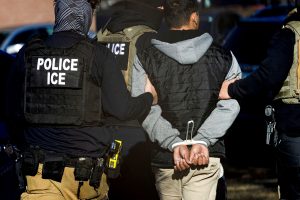
Monday’s case has put a focus on the administration’s strategies to increase immigration sweeps and deportations. The plaintiffs include immigrant-rights organizations and Latino individuals who said they were stopped because of their appearance during federal patrols that descended upon carwashes, bus stops, parking lots and other places with a large Latino presence.
On social media, Attorney General Pam Bondi noted the administration’s winning record before the justices, who have greenlighted a range of Trump policies, including mass layoffs of federal employees, termination of education and research grants, and removal of Senate-confirmed independent commissioners before their terms end.
“Another massive victory at the Supreme Court,” Bondi wrote. “Now, ICE [Immigration and Customs Enforcement] can continue carrying out roving patrols in California without judicial micromanagement.”
Attorneys for the plaintiffs said they would continue to pursue litigation.
The high court order allows federal agents to “target individuals because of their race, how they speak, the jobs they work, or just being at a bus stop or the car wash when ICE agents decide to raid a place,” said Cecillia Wang, national legal director of the American Civil Liberties Union, which represents the plaintiffs. “For anyone perceived as Latino by an ICE agent, this means living in a fearful ‘papers please’ regime.”
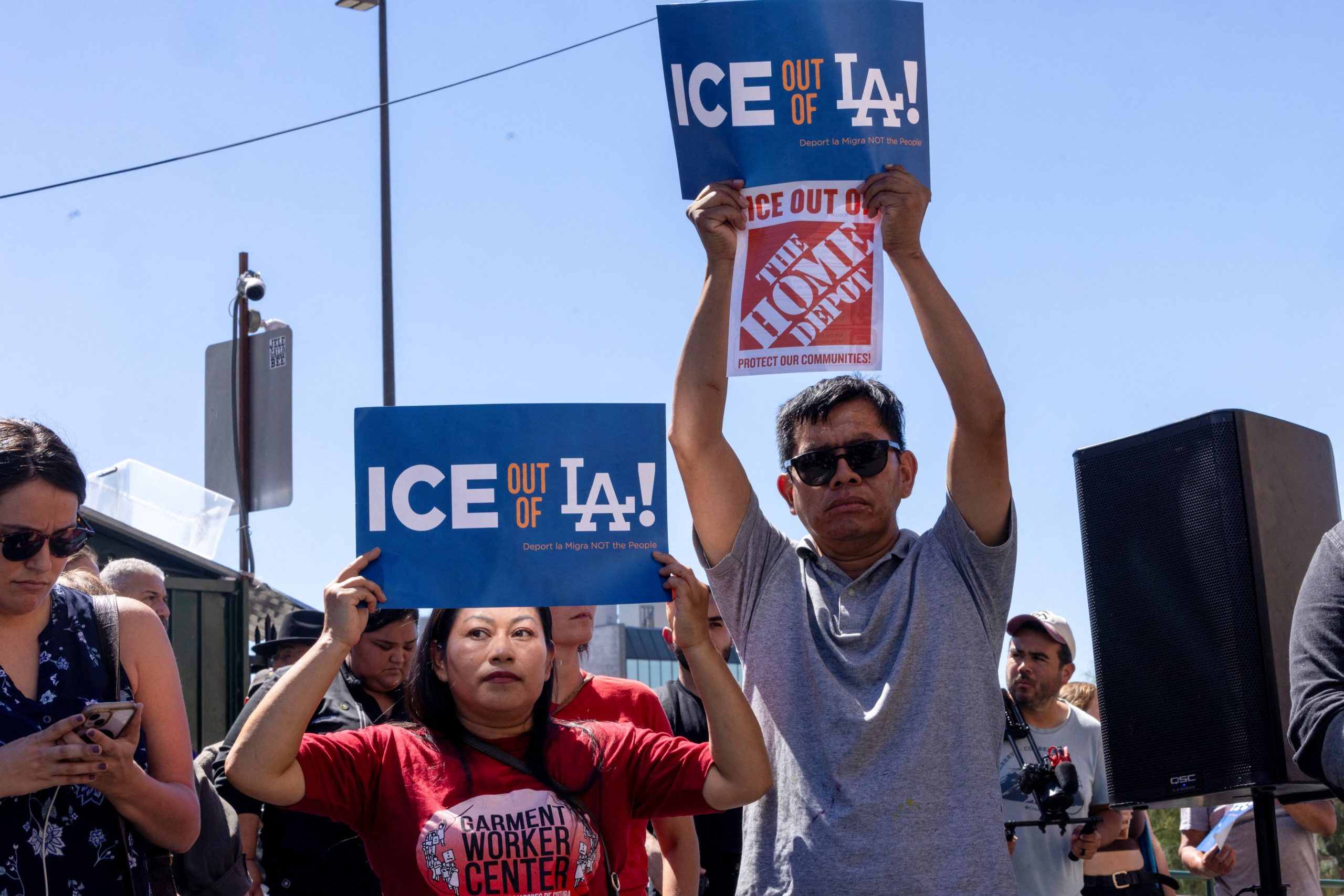
The Trump administration targeted the Los Angeles area in June for its mass-deportation campaign, with ICE agents focusing on heavily Latino communities and places where day laborers congregate, such as Home Depot stores.
Several individuals and groups affected by the raids filed suit, alleging that federal agents were violating constitutional guardrails including the Fourth Amendment protection against unreasonable searches and seizures. One of the plaintiffs, a U.S. citizen named Jason Gavidia, alleged that he was stopped by agents who pushed him up against a fence, twisted his arms behind his back and asked which hospital he was born in. They took his ID and never returned it, he alleged.
In July, a federal judge in Los Angeles ordered ICE to cease stopping people without reasonable suspicion they had violated immigration law—the normal standard under the constitutional protection from unreasonable searches and seizures. U.S. District Judge Maame Ewusi-Mensah Frimpong, an appointee of President Joe Biden, said agents couldn’t rely solely on an individual’s race or ethnicity, use of the Spanish language or accented English, presence at particular locations or the type of work the person does.
Last month, a federal appeals court in San Francisco rejected the government’s appeal, prompting U.S. Solicitor General John Sauer to ask the Supreme Court for an emergency order allowing its roving patrols to resume.
Sauer said in papers submitted to the Supreme Court that it makes sense for federal agents to consider these types of factors, given that many unauthorized immigrants speak Spanish and work as day laborers or in jobs such as landscaping and construction.
“No one thinks that speaking Spanish or working in construction always creates reasonable suspicion. Nor does anyone suggest those are the only factors federal agents ever consider,” Sauer wrote. “But in many situations, such factors—alone or in combination—can heighten the likelihood that someone is unlawfully present in the United States,” he wrote, and ICE agents “are entitled to rely on these factors when ramping up enforcement.”
Additional proceedings in the lower court are scheduled for September.