MEXICO CITY—The building was intimidating enough. Over 15 stories of steep concrete, towering into the smoggy air of Mexico City, designed to contain the noise from the stands and funnel it to the pitch, directly into the ear canals of the 22 men running around in cleats.
But for the Mexican national team, the mind games were just beginning. During the heyday of the Estadio Azteca, the idea was for Mexico to beat their rivals before they ever kicked off. Their favorite tactic was stretching somewhere deep inside the stadium while visitors warmed up on the field, exposed to the whistles, jeers and occasional flying bottles and beer cans from a heaving wall of ferocious home fans.
The first time opponents would even see the Mexican team was on the stairs inside the tunnel, when they stood shoulder to shoulder with a green army, noise echoing around them, before emerging into the Mexican sunshine.
“It feels like you’re entering a Colosseum,” says Javier “Chicharito” Hernandez, who made 109 appearances for Mexico’s national team over his 20-year career. “Having almost 100,000 fans, singing your anthem, supporting you, whistling when you’re not doing good…It’s hard to describe something so deep and so intangible.”
But you don’t need to be from Mexico to understand the significance, reverence, and trepidation that surround this hulking pile nicknamed El Coloso de Santa Úrsula . The 60-year-old Azteca, which hosts the opening game of the 2026 World Cup on Thursday, is a hallowed name across the soccer universe.
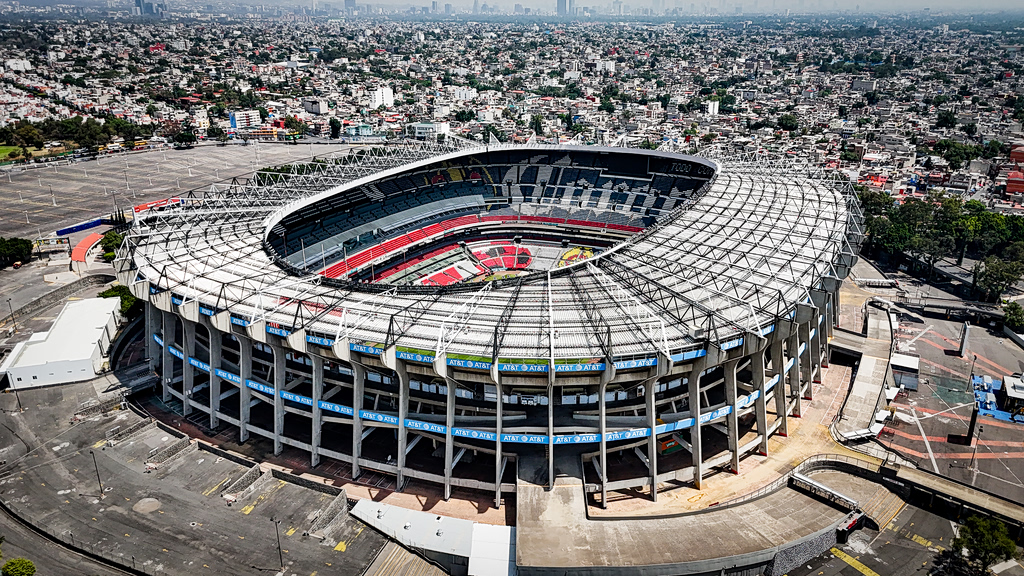
Images of Estadio Azteca obtained with a drone. Tlalpan, Mexico City, Mexico.
There have been not one, but two World Cup finals played on its pitch, in 1970 and 1986. The seemingly endless stands have witnessed electric performances by Pelé and Carlos Alberto, Michael Jackson and Paul McCartney. The Azteca has served as a place of worship for both a man of God (Pope John Paul II ) and the Hand of God (Diego Maradona’s left fist).
“This stadium is the cathedral of my life in football,” Maradona once said.
The Argentine soccer genius had a closer relationship with the Azteca than most. That’s where, in a quarterfinal match against England at the 1986 World Cup, Maradona pulled off two of the most inexplicable moments in soccer history. The first came when the 5-foot-5 Maradona jumped alongside the England goalkeeper and punched the ball in the net. The goal stood and Argentina had a 1-0 lead.
The English players were still stewing four minutes later when Maradona proved that he could also be divine. After he picked up the ball in his own half, Maradona danced past two England defenders, then two more, before slaloming around the goalkeeper to score Argentina’s second.
“From what planet are you visiting?” the Uruguayan radio announcer asked that day.
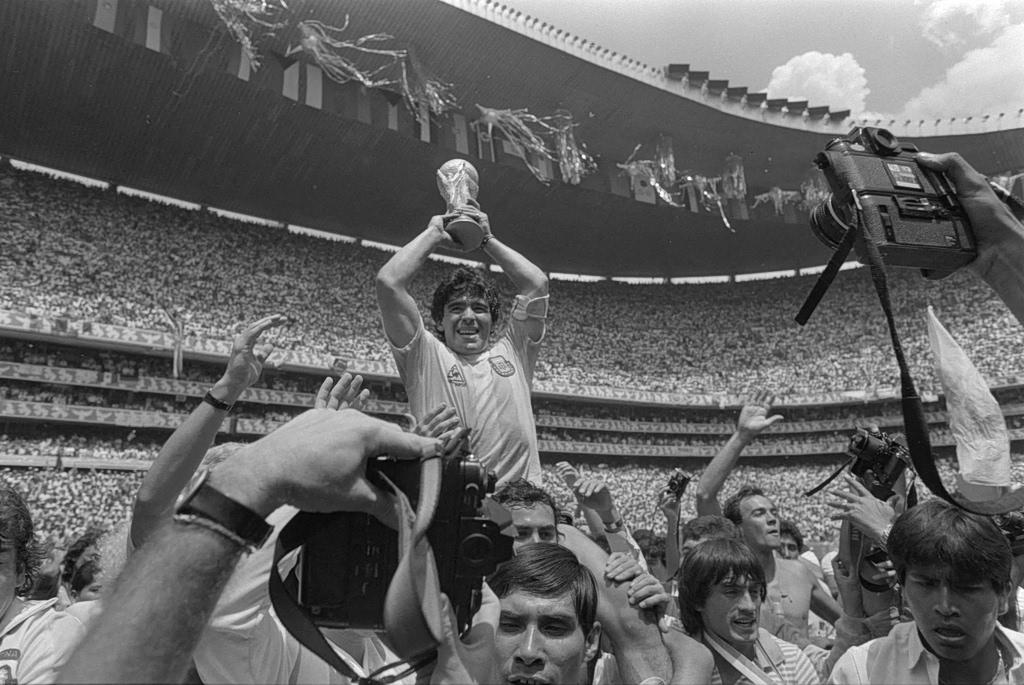
REUTERS PICTURES 40th ANNIVERSARY COLLECTION: Argentina’s Diego Maradona celebrates holding the World Cup trophy aloft as he is carried off the field after Argentina won the World Cup Final between Argentina and West Germany at the Estadio Azteca in Mexico City, Mexico. June 29, 1986 REUTERS/Gary Hershorn
Anyone who witnessed it on Planet Earth instantly declared it the greatest goal in World Cup history. But there is another candidate for that distinction—and it happened to come at the Azteca, 16 years earlier.
Over 26 mesmerizing seconds of the 1970 World Cup final, nine different Brazilians stroked the ball around the field, until Pelé teed up Carlos Alberto to score the final goal in a 4-1 victory over Italy. If Maradona had been about individual virtuosity, this was a collective symphony.
But visitors in years to come would have a harder time coming up with such artistry—especially if they were members of the U.S. national team. No one has received a more hostile welcome in the high altitude of the Azteca than the Americans who have been regular visitors here in World Cup qualifying.
Any player unlucky enough to take a corner kick found himself pelted with cups, bottles, and a torrent of Spanish insults. Whenever they felt liquid spraying down from the stands, they could only hope it was beer. Even on the rare occasions when they scored, the Americans were drowned up by the earsplitting whistles from the crowd.
“It was so loud that, honestly, you couldn’t even hear your teammates celebrating,” says former U.S. midfielder Stu Holden, who played here in 2009.
Unsurprisingly, the Americans have never won a World Cup qualifier in those conditions. But the vibe at the Azteca may be shifting. Purists bemoan some of the recent renovations to bring it up to World Cup standards. They argue that lowering the capacity to around 83,000 and cleaning up the concourses has sanitized it.
And above all, they resent that the place they have always known as the Azteca was assigned a new official name by FIFA for this World Cup.