A Pentagon spaceplane called X-37B zoomed into orbit this week for its eighth mission. When it will come back is a secret.
The uncrewed vehicle can spend months or years in space before it re-enters the atmosphere and glides down to a runway. That combination of flexibility and endurance has made it a favorite tool for military officials looking to quickly deploy new technologies on the final frontier.
A SpaceX rocket is scheduled launched X-37B late Thursday from Florida’s Kennedy Space Center. While in space, X-37B has a range of objectives that include testing laser communications and a quantum inertial sensor, the Space Force said.
Government and commercial engineers have spent years experimenting with lasers that allow satellites to share large amounts of data in space. The Pentagon is also testing tools like the inertial sensor, which could help improve navigation in situations where Global Positioning System signals aren’t available.
Boeing developed an earlier spaceplane for the National Aeronautics and Space Administration. It transferred the program to the military in 2004. The aerospace giant has built two X-37Bs for the Pentagon, which has tasked the Space Force to operate them.
The spacecraft has spent the last five months on Earth after a 434-day mission that included tests of orbital maneuvers known as “aerobraking.” The move helps the vehicle use the drag from the planet’s atmosphere to change its orbit without using much fuel.
X-37B’s frequent trips reflect the U.S. military’s desire for space superiority. U.S. officials have in recent years revealed new details about the threats they say Chinese and Russian operations pose to Western commercial and military satellites.
China now fields more than 1,000 satellites and has developed a range of radio jammers, antisatellite missiles and other weapons capable of targeting Pentagon assets, according to a U.S. Air Force document released in May. It also operates a competing spaceplane, called Shenlong, that has flown several missions.
Military officials haven’t disclosed many details about the payloads that X-37B carries, but past missions included testing different materials in orbit and an experiment that transmitted solar energy to the ground. Its fifth flight released three small satellites that government officials didn’t acknowledge until they had fallen back to Earth.
“There’s a global strategic interest in saying what you’re putting in space,” said Jonathan McDowell, a researcher at the Harvard-Smithsonian Center for Astrophysics. If the U.S. hides its satellites, “then the Chinese are going to start doing it too, and that’s not in our interest.”
An Air Force spokeswoman said the department complies with international treaty obligations and follows best practices in space.
The X-37B is one of the few Boeing space and defense programs that have avoided delays and mishaps.
Boeing has been bogged down for years with Starliner, a crew capsule for NASA that returned to Earth empty after a thruster problem raised safety concerns. Its work on the Space Launch System, a powerful rocket designed for long-range NASA missions, is at risk of cancellation by the Trump administration. Closer to Earth, jet fighters and trainer aircraft assembled around St. Louis face potential delays after about 3,200 workers went on strike earlier this month .
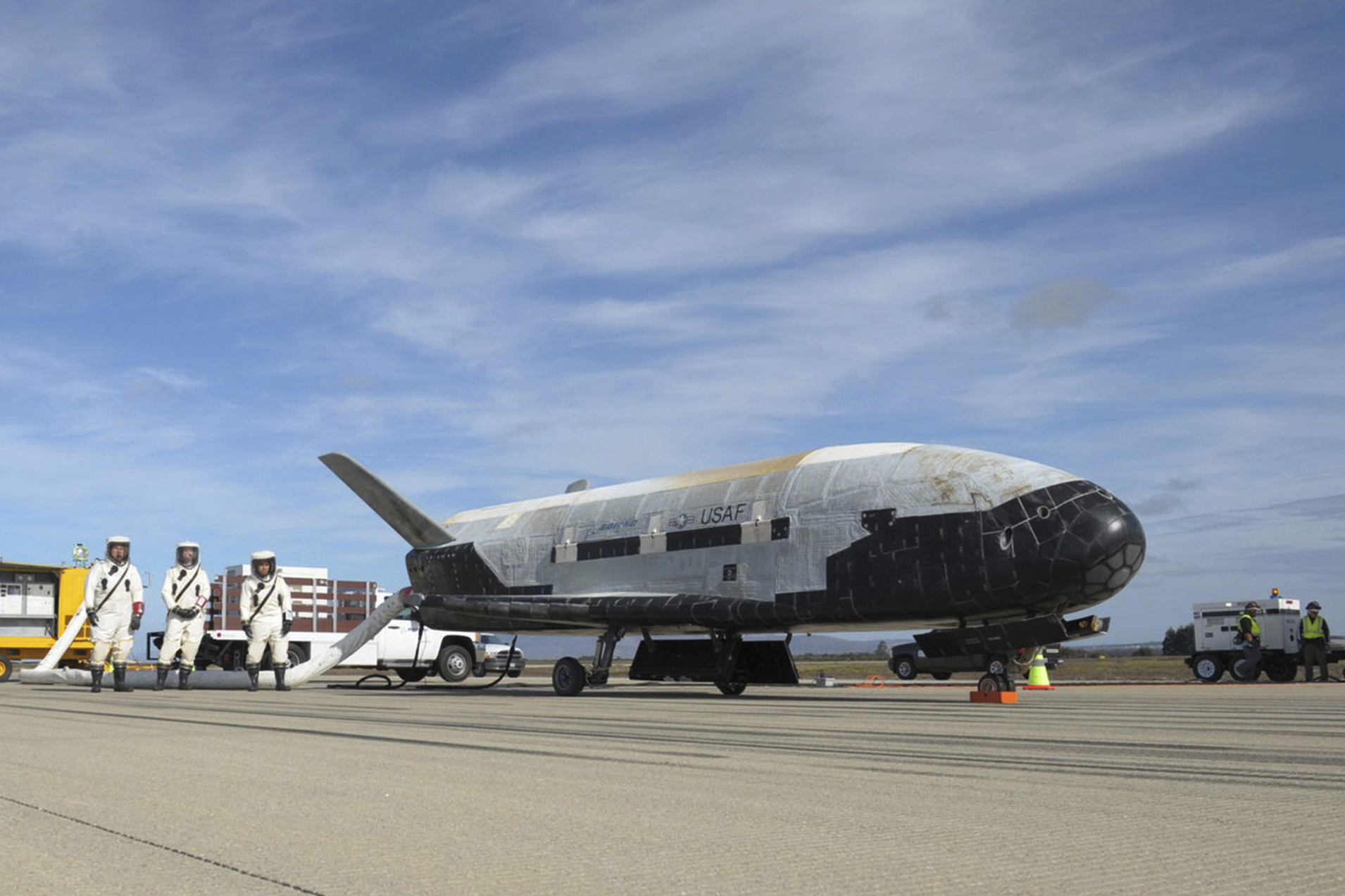
Snub-nosed with a 29-foot spine and a modest 15-foot wingspan, the X-37B looks like a quarter-size version of NASA’s Space Shuttle that carried astronauts to space for three decades. It can nest inside a capsule atop a rocket like the Atlas V or Falcon 9.
The resemblance is no accident. Boeing applied many of the lessons learned from the much larger shuttle orbiters to its smaller cousin. Like NASA’s retired spacecraft , the X-37B has a tiled shield that protects the vehicle from heat as it flies back to Earth, a key part of why the vehicle can be reused.
Unlike the shuttle, no one is on board the X-37B. That permits longer flights and more in-space tests, according to Randy Walden, a former Air Force official who worked on the spaceplane’s earlier missions.
Michelle Parker, vice president of Boeing’s Space Mission Systems unit, said the last X-37B mission broke new ground with autonomous spaceflight. In a statement, she predicted that ship maneuvers without human input will become more important because space is getting more congested.
Mobility in orbit is a growing area of focus for the Space Force, which envisions a future full of agile satellites, an upgrade over vehicles stuck in more static orbits.
“Maneuverability on orbit is just as important as maneuverability on the ground, in the sea, in the air,” said Jeff Thornburg, a longtime aerospace engineer who leads Portal Space Systems, a startup building mobile spacecraft.
How the Space Force will use the X-37B going forward isn’t fully clear. Congress allocated $1 billion toward the spacecraft in President Trump’s “one big, beautiful bill” that he signed into law in July.
A Space Force spokeswoman declined to discuss how the government will spend that funding or detail plans for future flights.
Write to Drew FitzGerald at andrew.fitzgerald@wsj.com and Micah Maidenberg at micah.maidenberg@wsj.com