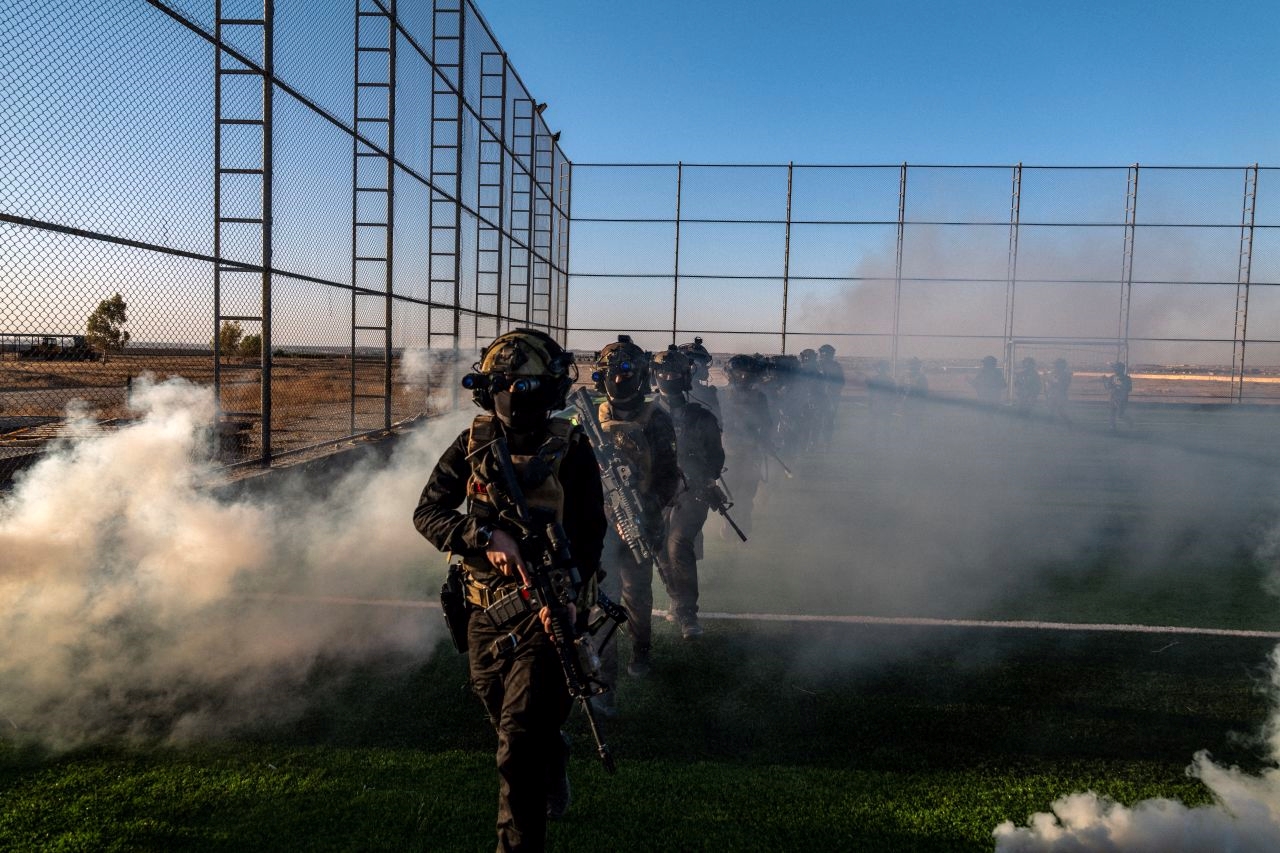
HASAKAH, Syria—Inside a sprawling facility in northern Syria this summer, a group of U.S.-backed Kurdish special forces trained a cadre of their next generation of fighters. All of them were women.
They are part of the Kurdish-led Syrian Democratic Forces, who with U.S. support helped defeat Islamic State six years ago and now control Syria’s northeast, about a third of the country. The women wore flak jackets and night-vision goggles, carried M4 rifles, and jumped out of American armored vehicles. A female commander issued orders to her male subordinates.
Their stature in the SDF is a sticking point in unifying the country under Syria’s new Islamist government.
“It’s very difficult for jihadists to accept a role for women as equals to men,” said Rohlat Afrin, who commands the female fighters of northeastern Syria’s Kurdish-led administration.
Afrin attended a meeting with Syria’s new governors early this year where the SDF signed an agreement to combine their administrations and armies . She was the senior woman, but President Ahmed al-Sharaa failed to shake her hand. It left her questioning whether the two sides could ever truly align.
“We have a completely different mentality,” she said.
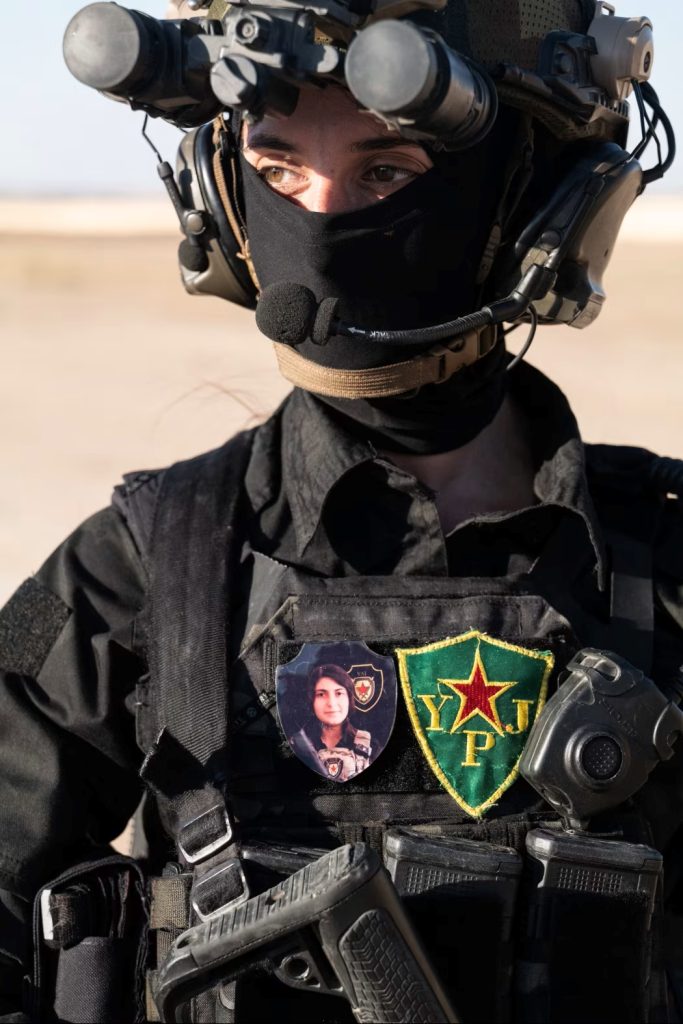
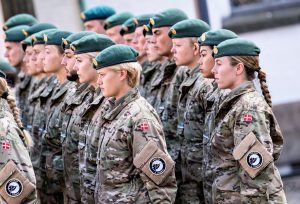
A member of the YPJ, an all-female unit in the Kurdish-led Syrian Democratic Forces.
Bridging the divide between their administration and the new government in Damascus is seen by the U.S. and European allies as vital to stabilizing the country as it emerges from a half-century of dictatorship under the Assad family’s regime . But the accord struck six months ago between Syria’s two most powerful political and military entities is already fraying amid clashes and mistrust.
Turkey is threatening to intervene if the SDF doesn’t dissolve itself into Syria’s new government and army. The U.S. is also applying pressure on both the SDF and Sharaa to mend fences.
“We value our allies, and we would like the United States to help convince these forces to reintegrate into the Syrian state,” Sharaa said last month at a talk in New York.
A major sticking point is the SDF’s demand that its forces be integrated into a national army as a bloc, not as individuals. That would preserve its current structures and keep women in positions of command.
The new government’s Sunni Muslim forces, once affiliated with al Qaeda, diminished women’s rights and freedoms in areas they controlled before they led a rebel alliance that ousted the Assad regime in December . Since then, some members of Sharaa’s government have declared women to be unfit for certain roles in the military and judiciary.
In contrast, women hold important positions in the areas controlled by the SDF. A social contract established in 2013 calls for women to account for at least 40% of the representatives in Kurdish-led government bodies and other institutions. Government and local municipal committees by law are jointly led by a man and a woman.
“This is one of the red lines that no one will accept to change,” said Siymend Ali, a spokesman for the YPG, or People’s Defense Units, the main group within the SDF alliance.
The Syrian Ministry of Information said every Syrian, regardless of previous militia affiliations, is welcome to join the new army—but with a caveat. “Women are able to apply to the police force, but military recruitment is strictly for men,” it said.
In the graveyards of Hasakah, a small city in northeastern Syria, well-kept tombstones are emblazoned with colorful images of female fighters killed in a decade of battles against Islamic State and other enemies.
The center of the city features a mural of a youthful, smiling fighter called Arin Mirkan. A decade ago, she found herself surrounded on a strategic hill as she fought against Islamic State in the town of Kobane, roughly 200 miles west of here. Instead of surrendering, she blew herself up, killing several militants in her last act.
A few months after Mirkan’s death, Arin Jonda joined the SDF’s Women’s Protection Units, known by its Kurdish abbreviation YPJ, renaming herself Arin after her hero. Renaming is a ritual for all the SDF’s female fighters, many of whom take the names of comrades who died or towns where significant battles took place.
“She inspired me,” said Jonda, 28, a fighter from Kobane. “I was very touched by her bravery.”
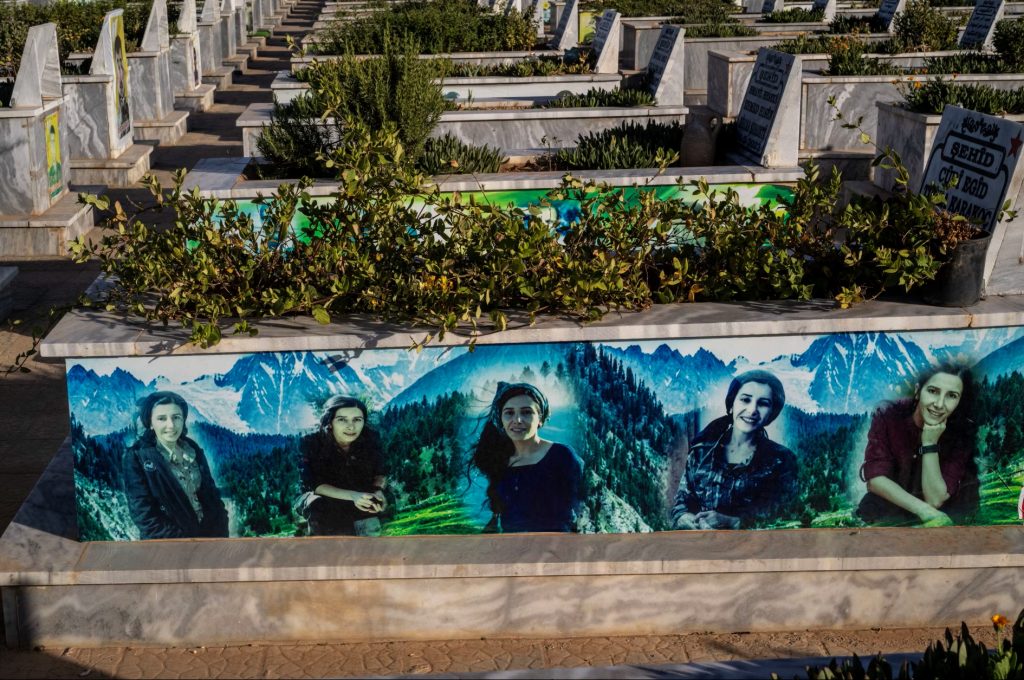
Images of fallen female fighters at a cemetery in northeastern Syria. Photography by Moises Saman for WSJ
Like most female fighters, she never married or had children. Her life, she said, is the military. She received a few months of training, mostly learning how to shoot an AK-47. When Turkey and its allied militias invaded the Kurdish-majority town of Afrin in northwestern Syria in 2018, she was on the front lines. The following year, she fought the militias in Sari Kani in northeastern Syria. The rest of her battles were against Islamic State.
The Women’s Protection Units aim to liberate women from traditional roles. Their main slogan is “Jin, Jiyan, Azadi”—“Women, Life, Freedom.”
The SDF declined to provide current numbers of its female fighters, saying the information was classified. In June, the Middle East Institute estimated the SDF has 50,000 fighters. Afrin, the top commander, said 20% of those forces are women.
Kurdistan Kobane, 28, joined in 2015 after Islamic State massacred more than 150 people including many members of her tribe in Kobane. She adopted the name of her town and ethnic region and became adept at urban warfare.
Her unit fought the group house to house in the town of Tal Abyad. She and a few male comrades once got trapped on the first floor of a building by Islamic State fighters one floor up. The militants fired down at them, forcing Kobane and her unit to flee the building and return through a back entrance to kill their enemies.
“It was difficult,” she said. “They had a better position on us.”
Many of the female fighters see echoes of Islamic State’s ideology in Syria’s new leaders. Sharaa, the president, was affiliated with Islamic State before splitting and realigning with al Qaeda, later repudiating extremism altogether .
As women were becoming more empowered in northeastern Syria, Sharaa was severely restricting women’s rights in the northwestern city of Idlib, where his troops enforced a strict interpretation of Islamic sharia law.
Women had no role in government. They had to be accompanied by male guardians in public places and were required to wear head-to-toe garments, the U.N. Human Rights Council said in a 2022 report.
“We must find a mechanism to convince them to change their mentality,” said Zaryan Asmin, a 30-year-old female fighter who supervises training of the female special forces. “We don’t want a divided Syria.”
Sharaa has pledged to respect Syria’s minority groups and women. Three days after the March unification meeting with the SDF, his government announced an interim constitution that guaranteed women’s rights and freedom of expression during a five-year transitional period.
Critics said the document didn’t do enough. When the government announced its interim cabinet two weeks later, the 23 ministers included only one woman.
The Sharaa government did appoint a woman to head Syria’s central bank and a female governor of Sweida, a restive southern province. It also created a new Women’s Affairs Office, though its director, Aisha al-Dibs, sparked a storm of criticism in January for suggesting that women aren’t capable of leadership and needed training.
In May, the Sharaa government appointed Ahmad Ihsan Fayyad al-Hayes, also known as Abu Hatem Shaqra, as commander of the Syrian Army’s 86th division, which oversees Hasakah and other parts of the northeast, areas mostly under SDF control. The U.S. sanctioned Shaqra in 2021 for the assassination of a female Kurdish politician and his ties to Islamic State.
“These are all bad signs,” Afrin said. “Having this person in this position is a message that the SDF doesn’t exist, the female fighters don’t exist.”
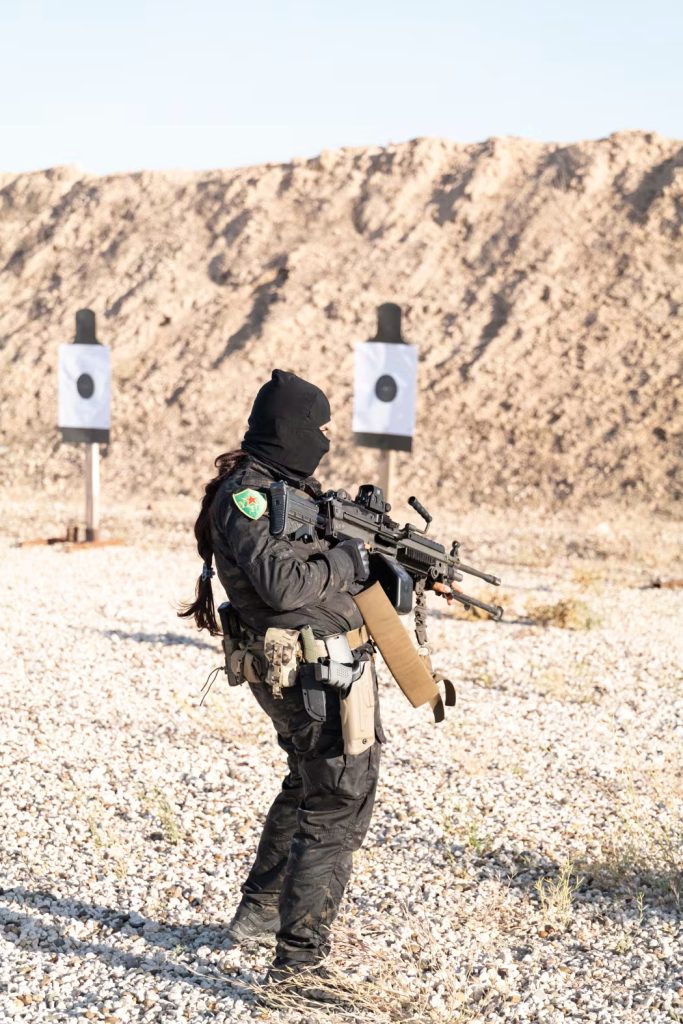
A female SDF soldier in a training exercise this year.
Meanwhile, the SDF continues to train its female troops to fend off enemies, including a resurgent Islamic State. At the session this summer, one of the fighters, struggling to lift a heavy machine gun, wobbled and dropped the weapon. She raised the barrel up again only to teeter once more. She picked it up a third time and steadied herself.
Then she fired a burst of bullets, as her female comrades cheered.
“Women, Life, Freedom!” she yelled, clenching her fists.
Write to Sudarsan Raghavan at sudarsan.raghavan@wsj.com