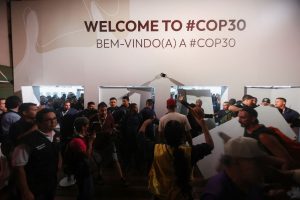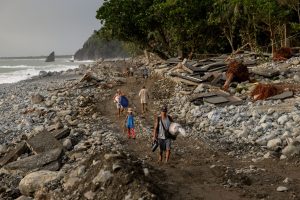
Holding a climate summit in the tropics would seem to be a good idea. Scientists say the world’s hot zones are bearing the brunt of a warming climate.
“The high temperatures do help frame conversation on the reality of what we’re dealing with,” said Alex Bath , a communications director with the Global Renewables Alliance who traveled to the Amazon rainforest for the latest edition of the annual United Nations climate conference.
What the organizers of this month’s conference didn’t account for was, well, the rain.
Heavy rain is a routine occurrence in Belém , considered the gateway to the Amazon, with some 10 inches falling on average each month. Even November, supposedly the driest month, typically sees around 5 inches, which is more than the average rainfall in any month in New York City. The first day of talks at the two-week conference, known as COP30, was marked by a deluge so huge it caught the organizers by surprise.
The delegation from the U.K. fled their pavilion, abandoning coffee and snacks after a hole appeared in the tent roof, lightning crackling in the sky.
Elsewhere, leaks in the vast canopy, some 77 football fields in size, meant water was seeping through vents in the air conditioning or dripping onto the delegates who had come to negotiate what to do about climate change.
During the rainstorms, attendees struggled to make their points over the din of a tropical downpour, pausing talks between countries trying to figure out the finer details of where billions of dollars of funding should flow.
“Parties couldn’t hear themselves,” said Injy Johnstone , a researcher on carbon markets who has been advising on negotiations. “You only had a short time to speak so there’s a pressure to talk even if no one can hear you,” she added, saying that some delegates were shouting into microphones just to be heard.
“There were real concerns whether the tent would even withstand the rain,” Johnstone said. “Mother Nature reigns supreme, both literally and figuratively.”
A spokesperson for the U.N. conference said organizers have taken steps to respond to the weather. “Swift actions have been taken to address issues as they arise, and the COP is proceeding well,” said the spokesperson. “The overwhelming majority of participants are focused on the substantive issues, as climate-driven disasters hit every economy, jobs, businesses, vital infrastructure and the global supply chains that all nations rely on for low-inflationary growth.”
The Italian delegation built a floating stage to sit on the river which surrounds Belém, delivered from Venice. It appeared well-adapted, at first. It was designed to flow with the river and was open to the elements. But on the Italians’ opening night, the torrents of rain short-circuited TV monitors and panelists struggled to give their presentations.
Organizers had to run out to buy 100 umbrellas to keep speakers dry.
Felix Harteneck runs InPlanet, a startup that aims to use rain to capture greenhouse gases through rock powder spread on soil. He might have been among the few people pleased with the cloudburst at the Italian event.
“While most people were trying to dodge the downpour—TV screens giving up one by one, umbrellas suddenly becoming the hottest commodity in the room—we at InPlanet were secretly thrilled,” he said. “We were probably the only team quietly cheering for the storm.”
Most of the conference’s discussions focused on how to tackle rising temperatures, a theme that was all too real to participants, as daytime temperatures soared past 95 degrees Fahrenheit. Organizers had warned those coming that the talks could get sticky. “The Government of Brazil wishes to inform all participants that, due to the high temperatures and humidity in Belém, formal business attire will not be required for the upcoming sessions,” an email from the hosts read.
In one wing, where the Global Renewables Alliance had a stand, there wasn’t any air conditioning. Two people in the area fainted as thermometers showed the temperature hitting 97 degrees.
“Hosting an event in the Amazon is a new experience for a lot of delegates,” Bath said.
Yet other parts of the site were positively frigid. Some sections developed their own microclimates due to the flow of air conditioning, forcing delegates to rummage around for jackets to keep warm.
Other issues have plagued the conference. Some stalls weren’t ready on the first day of the conference, on Nov. 10. Toilets lacked basic items such as soap, while water gushing from the faucets was tinged brown.
On Thursday, a fire broke out in a wing of the venue, forcing the evacuation of the entire site. No injuries were reported and it was quickly brought under control, the organizers said. Still, it left a gaping hole in the venue, with footage on social media showing delegates escaping the flames, some ripping off shirts to cover their mouths and noses.
As is usual at COP summits, protests provided another headache for the organizers. On the Wednesday of the first week, a protest led by indigenous peoples broke through a security cordon, though they didn’t go any farther than the main entrance as military and U.N. security teams tried to restore order.
Security was subsequently tightened, with a bigger military presence.
Still, it was the heat and humidity that proved the most disruptive elements.
Johnstone said that in some of the hottest areas of the venue, fans and mobile air conditioners had been stolen. Others at the venue were fanning themselves with hand-held paper fans handed out by delegations from various countries. Water itself had become a hot commodity, with fridges filled with cans of water being emptied as soon as they had been filled. It was a fitting way to illustrate what the negotiations were all about, Johnstone said.
“It’s really a microcosm for climate change,” she said. “Here where it’s hot, there’s resource competition.”
Write to Yusuf Khan at yusuf.khan@wsj.com