
For thousands of manufacturers across China, it’s déjà vu—with implications for the country’s fragile economy.
Earlier this year, after President Trump raised tariffs on Chinese goods to 145% in April, American customers of Alan Chau’s toy factory in southern China abruptly froze orders, sparking a cash crunch that brought his business to the brink. So it came as a relief when the U.S. and China reached a trade truce weeks later in mid-May, rolling back most of their tariffs on one another—and allowing Chau to resume shipping his products again.
Now, less than six months later, prohibitively high tariffs could be the reality again for Chau and tens of thousands of other factory owners that make China a global manufacturing powerhouse. Trump said Friday that he would impose a 100% additional tariff on all Chinese goods, effective Nov. 1.
“That is literally an embargo,” said Chau. “Who is going to do business with China?”
After months of trade talks in which U.S. officials expressed cautious optimism about a breakthrough, the White House was caught off guard when Beijing in recent days unleashed a barrage of measures, showing off an array of tools in its trade-war arsenal, including tightened export restrictions on rare-earth materials that could hurt U.S. industries and an antitrust probe targeting American chip company Qualcomm .
On Sunday, Beijing blamed Washington for having first introduced new restrictions against China after the latest round of trade talks in September.
“Frequently threatening high tariffs is not the right approach to engaging with China,” Beijing’s Commerce Ministry said in a statement. The ministry said its new rare-earth restrictions would have only a limited impact on global supply chains, and that relevant countries had been informed ahead of the Thursday announcement. It also said the new rules weren’t an export ban but rather a set of requirements for export licenses.
So far this year, strong exports have helped China’s economy defy expectations of a deeper slump, as manufacturers made up for higher hurdles on trade with the U.S. by increasing shipments to the rest of the world. For the first nine months of the year, China’s exports to the U.S. fell nearly 17% from the same period a year ago, while overall exports grew about 6%, according to Chinese customs data.
But governments around the world have complained about cheap Chinese goods flooding their markets and China’s year-over-year export growth slowed to 4.4% in August , before picking up to 8.3% in September. Meanwhile, momentum in other parts of China’s economy, such as consumer spending and investments, has softened in recent months . Beijing has launched a campaign to rein in production and head off spiraling price wars, weighing on near-term economic growth.
“The strength of China’s overall exports despite U.S. tariff barriers may have emboldened Xi to take the risk of an escalation in the trade war with the U.S.,” said Eswar Prasad , professor of trade policy at Cornell University and a former International Monetary Fund official.
“This approach could backfire given China’s persistently weak domestic consumption demand as well as rising concerns in other countries about being swamped by Chinese exports,” he added.
Tariffs on Chinese goods are paid for by U.S. importers but can hurt China’s factories by raising the cost of made-in-China products for Americans. That in turn can prompt U.S. buyers to shift purchases outside of China and cause Chinese manufacturers to lose business.
If the trade standoff worsens significantly, it could endanger China’s prospects of hitting its official target of around 5% growth in gross domestic product this year. Officials don’t appear to be worried yet, offering little sign that the government is preparing to launch more forceful stimulus measures.
Chau, whose toy manufacturing company is called GSNMC, said his customers were shocked by the latest turn and monitoring developments to see if production will need to be paused. He has one order of Christmas-themed toys already on its way to the U.S., which should arrive before the new tariff rate is set to take effect, but other contracts in the works are now at risk.
Losing future orders would be devastating to Chau’s business, which has already seen revenue shrink by about half this year compared with last year, even after tariffs for Chinese toys were lowered to roughly 30%. He may end up moving some manufacturing to Southeast Asia so his customers can avoid the higher tariffs on Chinese goods, something he had explored earlier this year but gave up on after the tariff truce made exporting from China feasible again.
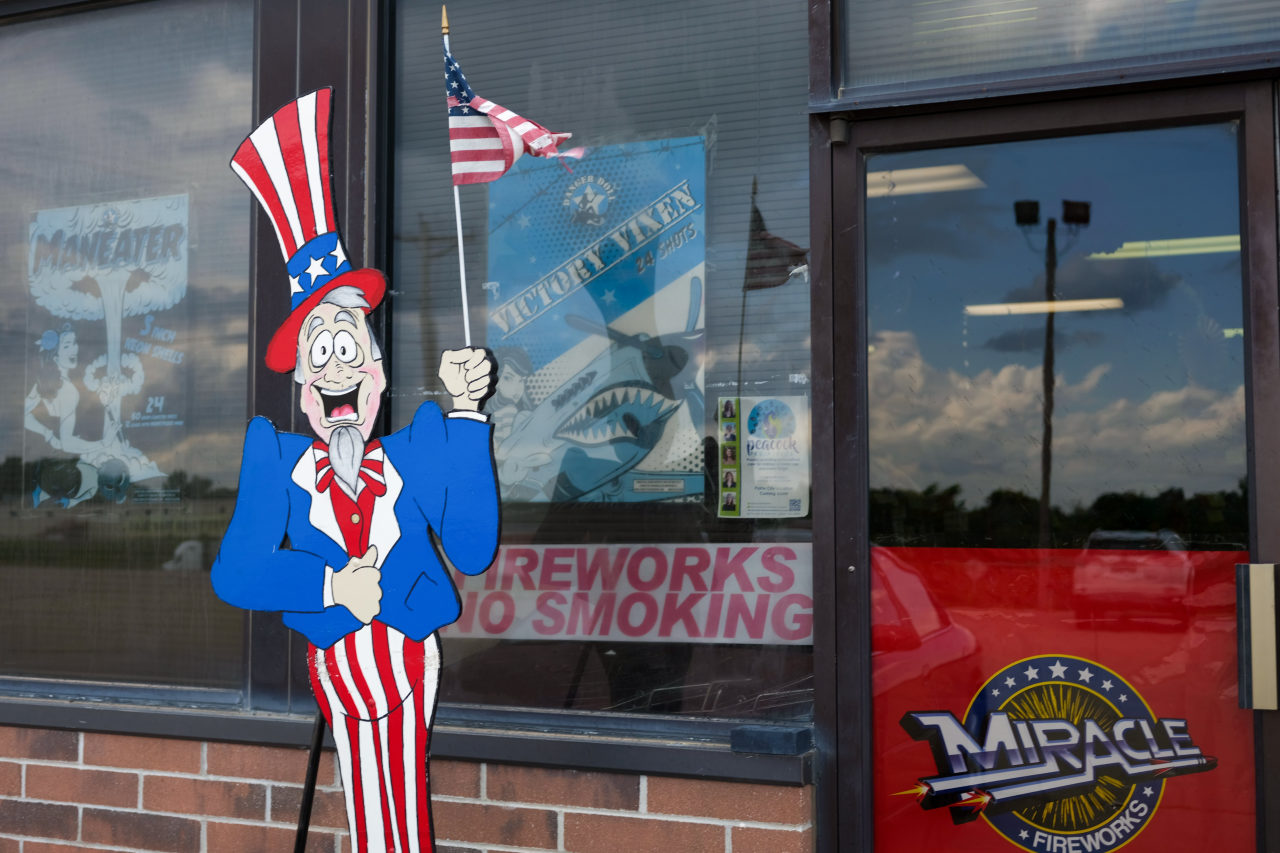
Adam Dai, founder of fireworks exporter Miracle Fireworks, based in the central Chinese province of Hunan, said a few American customers have already reached out and asked that their shipments be held. They are waiting several days to assess the situation before deciding how to proceed, he added.
If the additional tariff takes effect, Dai expects his business to be affected much as it was in April. The U.S. relies on China for its fireworks , with some 99% of its imported consumer supplies and 75% of its fireworks for shows coming from China, according to the American Pyrotechnics Association and the National Fireworks Association.
After many manufacturers grappled with the earlier round of high tariffs, a local fireworks-industry association has encouraged exporters to consider diversifying beyond the U.S. market, Dai said. But such shifts haven’t come easy.
“I am sure all the customers will hold off the shipment. Then there will be no shipment from China to the U.S.,” Dai said. “If this policy lasts long, then we will have to stop production and wait.”
Others aren’t counting on the 100% tariffs to last long—if they get enacted at all. Some analysts believe the U.S. and China could de-escalate tensions before the punitive measures go into effect. Trump and Chinese leader Xi Jinping were planning to meet at a regional gathering of leaders in South Korea at the end of the month.
“U.S.-China tensions are rising, but Trump’s threat of a 100% tariff is an empty gesture that is unenforceable,” said Dan Wang , a director on the China team at the political-risk consulting firm Eurasia Group, pointing to how tariffs were rolled back earlier this year amid market volatility and concerns from U.S. companies. “Judging by Trump’s track record, he wants a deal in which China will pay rent to enter the U.S. market, not prohibitively high tariffs on China that cause full decoupling.”
Jeffy Ma, who runs a hat manufacturer in Guangzhou called Ace Headwear, is monitoring the situation and waiting to hear whether his customers will put orders bound for the U.S. on hold for now.
His revenue hasn’t decreased this year despite the tariff hit. One client transferred some orders for the U.S. to other countries with lower tariff rates. But Ace Headwear offset the lost business with new customers from Europe, South Korea and elsewhere. Earlier this year, Ma’s company lowered prices by around 4% to offer some tariff relief to his customers, which include Fila, but couldn’t reduce prices any more because of already razor-thin profit margins.
Ma, for one, believes the 100% tariff is a negotiating tactic and will be rolled back by November. “Both sides are increasing their bargaining chips,” he said. “Such high tariffs cannot continue to exist.”
Write to Hannah Miao at hannah.miao@wsj.com and Yoko Kubota at yoko.kubota@wsj.com