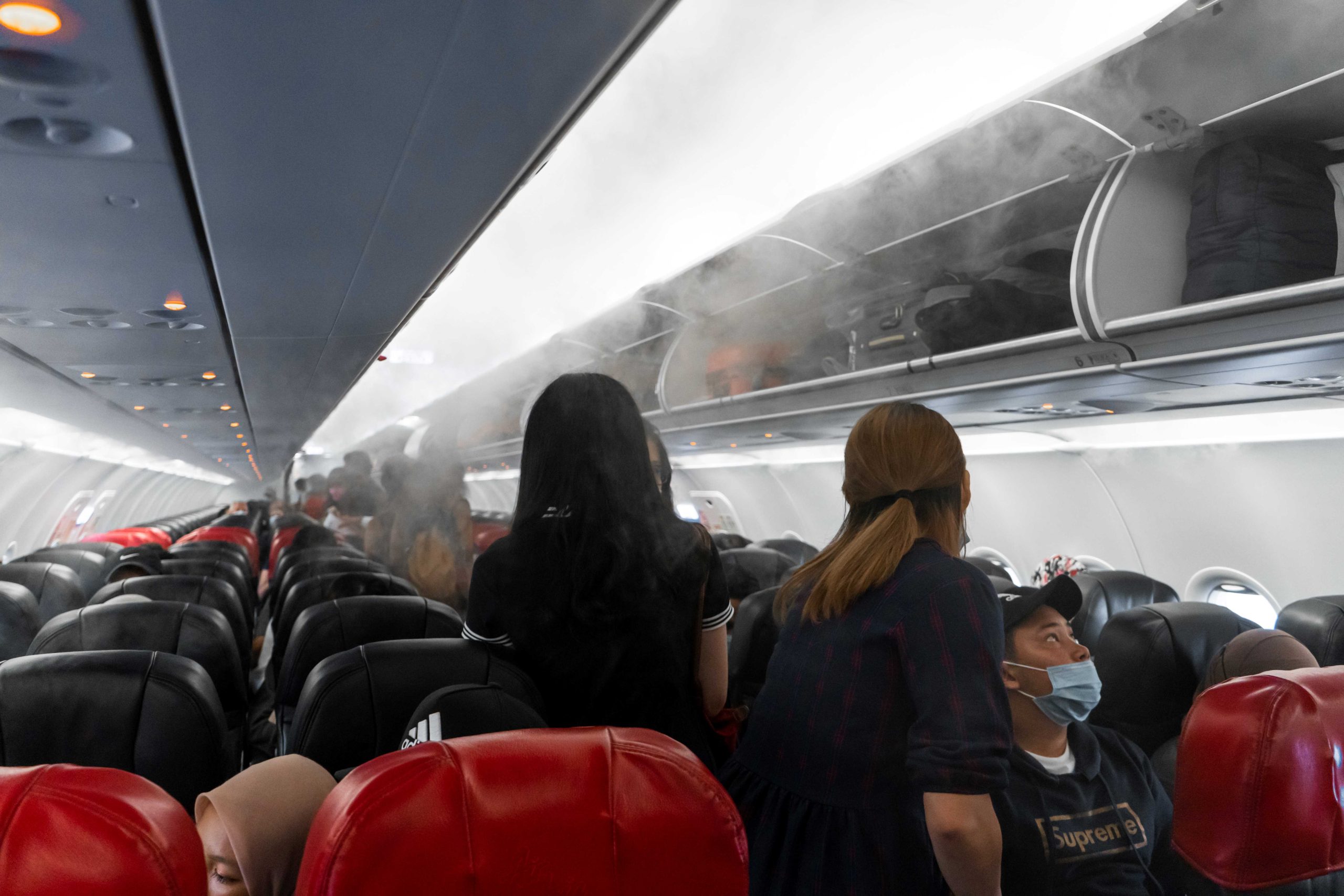
Due to a design element that has been a feature of almost every commercial jetliner since the 1950s, toxic fumes can leak from jet engines into the cabin or cockpit. The fumes have led to emergency landings, sickened passengers and crew members, and affected pilots’ vision and reaction times midflight, according to official reports .
The health effects are often mild but can also be severe, including brain injuries. Here’s what to know:
Where does the air on a flight come from?
On most planes, about half the air in the aircraft is recirculated. That refers to air that’s already on the plane that’s breathed in and exhaled by passengers with the remaining oxygen filtered and then pumped back inside the cabin. The other half is pulled from outside via the aircraft’s engines using a system known as “bleed air.” Engines are used for air supply on every modern aircraft, with the exception of Boeing’s 787.
Sorry, but why is my air pulled through an engine?
Good question! Because air at altitude is very thin and very cold, it has to be compressed and heated before it can be sent to us to breathe. Aircraft manufacturers realized in the 1950s that jet engines were already doing that work, and they decided to “bleed” the air from the engines’ compression chambers and then run it through air conditioners to get it back down to breathable temperatures. Fume events occur when engine oils and hydraulic fluids leak into that section of the engine.
Are all odors or vapors on a plane signs of toxic fumes?
Definitely not. In fact, most smells reported in Federal Aviation Administration service-difficulty reports didn’t qualify in The Wall Street Journal’s analysis as a “fume event.” Other odors ranged from muffins burning in the galley oven, to electronic equipment overheating. The same is true of vapors. One of the most common hazes in a cabin is condensation from the air-conditioning system, which is unrelated to vaporized engine oil or hydraulic fluids.
How worried should I be?
It doesn’t happen often. The rates we identified in 2024 showed an incident rate on top U.S. airlines of 108 per one million departures, or roughly twice a day. But we also know that fume events are massively underreported. Internal industry data reviewed by the Journal estimated a rate of 800 incidents per million flights in the U.S., or just about 22 a day. Still, as one researcher put it, it’s highly unlikely you’ll be exposed, but almost guaranteed it’ll happen on an aircraft somewhere in the U.S. today.
We also don’t know how toxic an actual fume event is, because it can depend on the size of the leak and the temperature of the engine. The industry doesn’t know what a “typical” leak looks like, and it can range from small droplets slowly dripping into the air supply to, in extreme cases, liters dumped in a matter of seconds. Toxicity levels of any specific event can only be confirmed by sensors and measuring devices, which the industry has lobbied against installing.
What should I do if this happens?
Fume events are usually noticeable and distinguishable from other odors that can enter the cabin. It might be worth informing your cabin crew if: a) the smell is permeating through a large portion of the cabin; b) others further away have noticed it; and c) you or others are not feeling right. After that, always defer to your flight attendant. They’re safety-trained and know the procedures, including when a flight might need to be diverted.
It is also important to understand that doctors and other researchers believe the scarier health effects are likely caused by repeated and prolonged exposure. Individuals often respond to chemicals differently and may be susceptible to effects at different levels. That means that while some might feel ill after an exposure, many won’t.
What about dropdown oxygen masks and existing air filters? Should I bring my own mask?
Because dropdown passenger oxygen masks aren’t sealed, they don’t provide proper protection. In one extreme fume event investigated by the FAA, passengers stood on their seats to break into the overhead compartments to access the masks—that’s a safety hazard that can cause other problems on a flight.
Cloth and even N95 masks also aren’t designed to filter vapors and gases. Until fume events have been addressed, often the best bet is to flag it to your cabin crew.
Why do cabin crew appear to be the most at risk?
There’s some evidence indicating that repeat exposures coalesce to cause more-severe damage. Cabin crew aren’t just flying more, but are also more active when they do. That means their breathing rates are typically higher than a seated and docile passenger.
While pilots have longer-lasting emergency oxygen supplies, cabin crew only have access to 15-minute oxygen tanks, which is often shorter than it takes for a pilot to divert and land the aircraft. Prolonged use of that oxygen supply is also dangerous.
Also, it’s possible we’re only more aware of affected crew because of the lack of awareness among passengers. Whereas crews have avenues to report their exposure, passengers don’t. Because symptoms can take time to fully manifest, the connection between exposure and symptoms becomes harder to make.
Write to Benjamin Katz at ben.katz@wsj.com