If a ground war is to be fought in Iran, the first shots could be fired in the country’s Kurdish areas, where militias say they are preparing to take on the government in Tehran—but only if they think they have a realistic chance of liberating themselves from regime forces.
They are not there yet.
A potential Kurdish uprising could mark a turning point in a war that has mostly been waged by air , paving the way for a more widespread popular revolt that could topple the Islamic Republic from below.
It is an approach fraught with risks. A Kurdish insurgency could fuel the separatist ambitions of other ethnic groups, raising the threat of civil war and disintegration—a fear shared by many Iranians, including many who oppose the Islamic Republic.
The most immediate danger would be to Iran’s Kurdish population itself, which could bear the brunt of a possible retaliation by Iran’s security forces.
“There is a big opportunity—an opportunity for greater autonomy and to set up democracy,” said Zagros Enderyarî, an official with the Kurdistan Freedom Life Party, also known as PJAK, one of several armed Iranian Kurdish groups based outside Iran. “But there is also a risk. The Iranian regime killed many people during the protests, and they could do that again—especially in Kurdistan.”
Israeli forces are working to create the conditions for a popular revolt. They have hit targets linked to Tehran’s repression apparatus. Many of the strikes have occurred in western Iran’s Kurdish provinces, where they hit military bases, border-guard posts, police stations and other regional security centers.
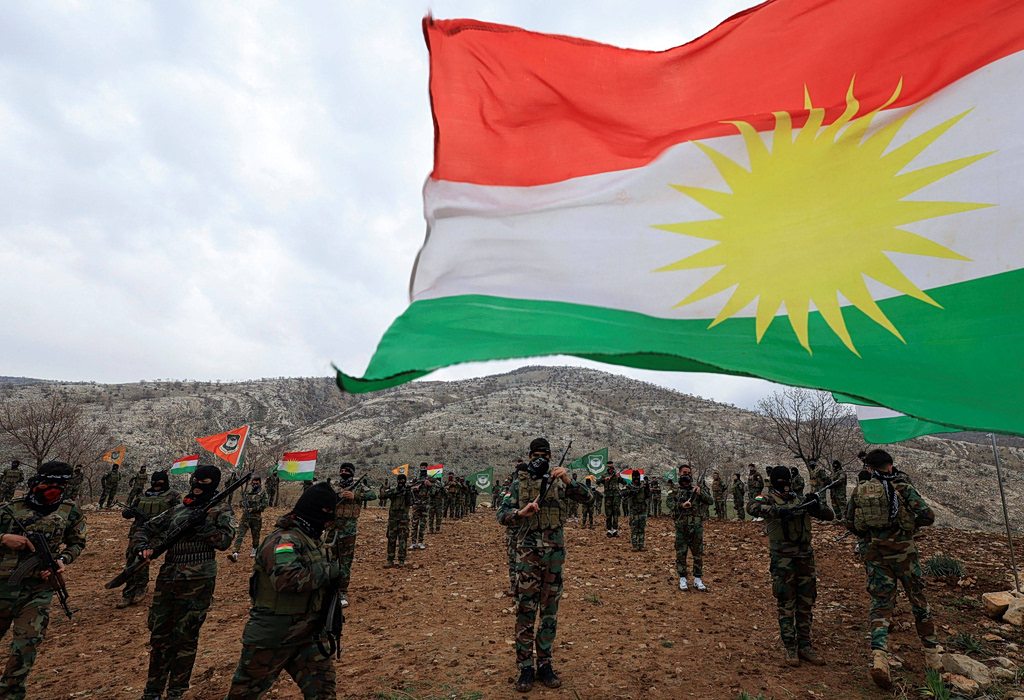
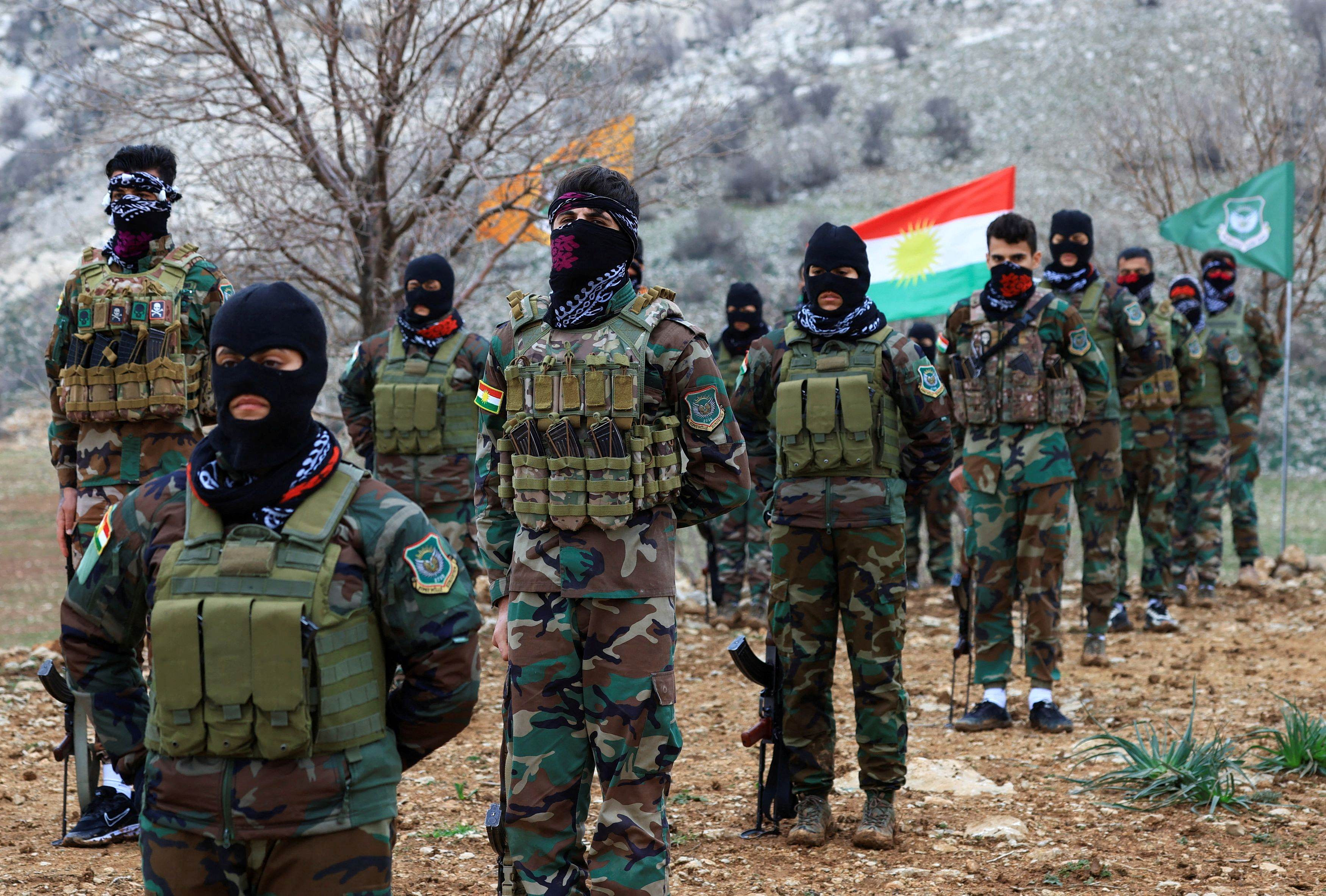
FILE PHOTO: Iranian Kurdish fighters from the Kurdistan Freedom Party (PAK) take part in a training session at a base on the outskirts of Erbil, Iraq February 12, 2026. REUTERS/Thaier Al-Sudani
Israel and the U.S. have been covertly supporting some Iranian Kurds inside Iran, seeing them as a useful auxiliary force to wear down and destabilize the regime, according to a person briefed on the war. Israel has been supplying Kurdish groups with weapons for months, the person said.
The idea behind the strategy is to open the way for a popular—and possibly armed—uprising in Kurdish-majority areas that have long bristled at the dominance of the Iranian government. An armed mobilization would rely on both Kurdish forces crossing into Iran from the border areas of Iraq, as well as on units that are already in the country, according to members of Iranian Kurdish groups.
There are also concerns that other ethnic groups such as the Azeri in the north and the Baloch to the east might join an uprising that could destabilize the regime in Tehran.
The prospect is already alarming some of Iran’s neighbors who worry that events could morph into secessionist movements that might cause problems for them. Pakistan has long worried that Baloch in eastern Iran might launch attacks on its territory to strengthen a Baloch separatist movement there. Turkey, which saw an influx of refugees from Syria over the years and has a large Kurdish population within its own borders, on Wednesday said Iran’s territorial integrity should be preserved.
Armed Iranian Kurdish groups, mostly based in Iraq’s semiautonomous Kurdish region and in border areas, say they are now preparing for armed action to defend their people and achieve a measure of self rule. At the same time, they said they are wary of getting involved in a battle they can’t win.
“We cannot move from here to there unless the airspace is cleared,” said Hana Yazdanpana, an official with the Kurdistan Freedom Party, or PAK, another armed Iranian Kurdish group based in Iraqi Kurdistan. “There needs to be a no-fly zone for us. We need to wait for the weakening of the regime and we don’t think it is going to happen over the next few days. It will be a suicide mission otherwise.”
Iran’s Kurdish community makes up an estimated 10% of Iran’s population and presents a unique threat to the Islamic Republic. They have a strong sense of identity that transcends national borders, and they are more organized than any other opposition group inside Iran. Many of them are armed.
Ethnic Kurds live in various countries in the Middle East. Kurdish groups in Syria and Iraq are a formidable fighting force, having played a pivotal role in defeating Islamic State.
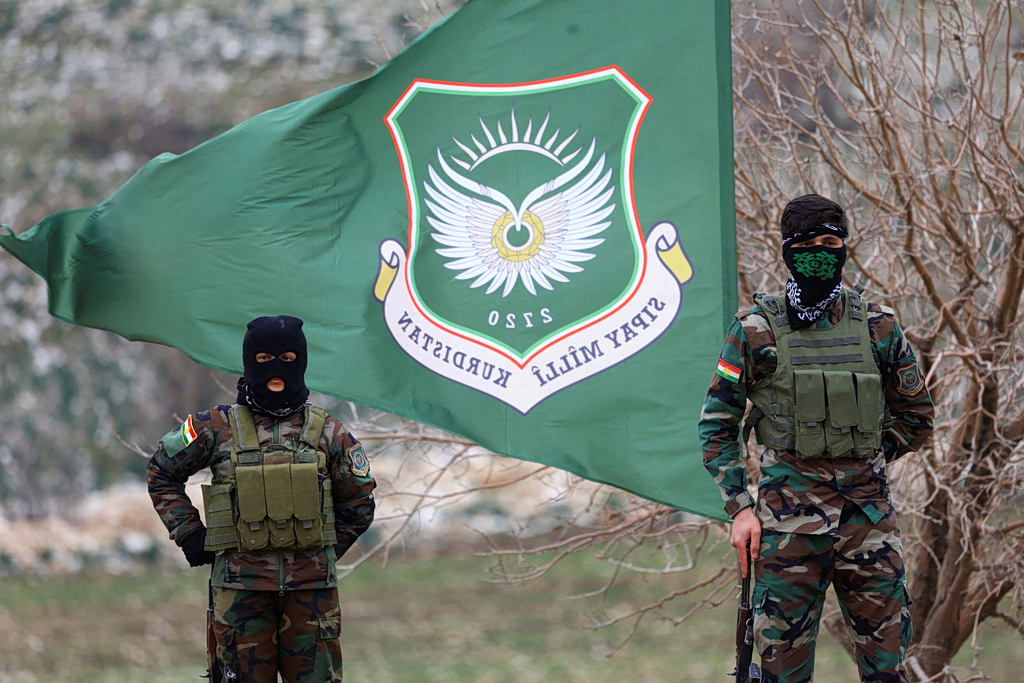
FILE PHOTO: Iranian Kurdish fighters from the Kurdistan Freedom Party (PAK) stand during a training session at a base on the outskirts of Erbil, Iraq February 12, 2026. REUTERS/Thaier Al-Sudani
Iranian Kurdish forces are less battle-hardened. Kurdish rebellions in the early years of the Islamic Republic were largely defeated, forcing Kurdish leaders into exile in neighboring Iraq. Since then, they have waged a low-level guerrilla struggle against the Iranian government, with occasional hit-and-run attacks against Iranian security forces.
They also have been preparing for this moment, cultivating networks inside Iran, procuring weapons and training in military bases in Iraq. Fighters from one group, PAK, took part in the four-year-war against Islamic State in Iraq.
“The war that is currently under way has little to do with our usual struggle, but the situation that has arisen may provide an opportunity for the Kurdish forces to take action,” said Kamal Karimi, a member of the Central Committee of the Democratic Party of Iranian Kurdistan, or KDPI, the leading Iranian Kurdish militant group, primarily based in Iraq’s semiautonomous Kurdish region. “If the conditions are suitable, the Kurdish forces have the necessary capabilities.”
President Trump has spoken with Iraqi and Iranian Kurdish leaders in recent days but hasn’t made a final decision on whether to support Iranian groups willing to take up arms against the regime, U.S. officials said, though he remains generally open to the idea .
The officials Trump spoke with include Mustafa Hijri, the leader of the KDPI, according to people familiar with the matter. Hijri also presides over a coalition established last month that brings together the leading Iranian Kurdish groups. The coalition, in its founding statement, said its goal was to overthrow the Islamic Republic and “to establish a national and democratic entity based on the political will” of Iranian Kurds.
The U.S. has a long and complicated history of supporting Kurdish groups in the region. The possible partnership between the U.S., Israel and Kurdish militants in Iran comes after the Trump administration ended a decadelong partnership with a Kurdish-led militia in Syria just a few weeks ago, bringing to a close a policy that stirred tensions with major ally Turkey.
Israel has covertly worked with Kurdish militias in Iraq as far back as the 1960s, and more recently with Kurdish groups in Syria, including provision of intelligence and weapons.
“It is a relationship that is kind of below the radar but it is a relationship that exists,” said Elizabeth Tsurkov, a nonresident fellow at the Washington-based New Lines Institute, who studies Kurdish groups.
Still, there are significant risks for the Kurdish groups if they decide to step into the breach.
Iranian forces are already targeting positions of Iranian Kurdish groups. Iran’s Islamic Revolutionary Guard Corps and the ministry of intelligence in a joint operation destroyed what they described as the headquarters and an ammunition depot belonging to Kurdish separatists in a border area, Iranian state-run media reported on Thursday.
“The separatist terrorist groups intended to enter the country’s western borders,” it said.
Iranian forces have launched drone and missile attacks against Iranian Kurdish bases inside Iraq in recent days, according to Iranian Kurdish officials and Iran’s state-run media.
While Iraq’s Kurdish leaders are sympathetic to the cause of Iranian Kurds—and have given their leaders safe haven—they are wary of the consequences a possible mobilization of Iranian Kurdish forces against the Iranian state could have in their own territory. Iran has proxy groups in Iraq it could mobilize against Iraqi Kurds after already striking the U.S. consulate in Iraqi Kurdistan, and a U.S. military base in Erbil.
Iraqi Kurdistan’s Deputy Prime Minister, Qubad Talabani, on Wednesday said his region “remains neutral and is not involved in the ongoing regional conflict.”