War has added impetus this year to a perennial call by vocal world leaders to loosen the grip over the United Nations held by the U.S., Russia and three other countries.
At the 193-member United Nations, power is highly concentrated between the five nations that hold veto authority on its governing Security Council, meaning any one of them can block international criticism of their activities. Increasingly, other big nations, including India, Brazil, Turkey and Nigeria, that represent growing shares of the global economy and population are voicing criticism of the so-called Security Council P5, which also includes China, France and the U.K.
The U.S. bombing of Iran this year and its military arrest of Venezuela’s president are widely seen by U.N. members as violations of the world body’s foundational charter that forbids attack on fellow members. Russia’s 2022 invasion of Ukraine is viewed in the same way, and part of a pattern toward might-makes-right led by countries that gained power as victors in World War II and led creation of the U.N. as avowed defenders of global peace.
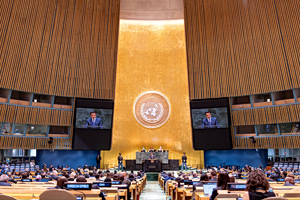
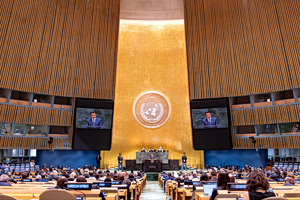
“Let’s recognize that a system in which the will of more than 190 countries is subject to the whims of five countries is neither fair nor capable of fully establishing trust,” Turkish President Recep Tayyip Erdoğan told the General Assembly on Tuesday. “The Security Council must absolutely be reformed in accordance with the principle that ‘the world is bigger than five,’” he said.
Calls to restructure the U.N. aren’t new.
But the issue is gaining new attention in this year’s race to succeed António Guterres as secretary-general of the institution. A former vice president of Costa Rica, Rebeca Grynspan Mayufis , has so far won two of three secret ballots, but her level of support among members of the P5 is unknown. Any one of them can veto a selection by the wider membership.
Guterres, a former Portuguese prime minister, repeatedly says the P5 has hamstrung the U.N. He says the group lacks legitimacy without any Latin American or African representation.
The lack of wider representation also makes it difficult for the U.N. to raise money from large economies that fear their voice isn’t heard; in fact, only the U.K. among the P5 this year paid its dues to the U.N. within the month they were owed.
“Strong, effective institutions that reflect the realities and the progressively changing relative weight of countries and economies in today’s world—not the power arrangements of 80 years ago,” Guterres told the assembly Tuesday.
The P5 nations tend to respond to world challenges in a predictable pattern of China and Russia versus the U.S., U.K. and France.
The concentration of power weakens the credibility of the U.N. because it has been unable to address the highest number of armed conflicts since World War II, said Luiz Inácio Lula da Silva, the president of Brazil. “We are all held hostage by the inaction of the Security Council failing to fulfill its role,” he told the body on Tuesday.
The Brazilian leader dubbed the P5 “lords of war” last year after the U.S., along with Israel, took aim at Iran with 12 days of bombing aimed at erasing its nuclear weapons capabilities.
While nearly all U.N. members call for reforming the organization, P5 nations show no interest in relinquishing their power. French President Emmanuel Macron nudged the power argument a different way in his address Tuesday, by highlighting the risks of concentrated control of artificial intelligence.
“There are some who wish to make us believe that only two powers, the U.S. and China, will be taking the decisions,” he said.
In his speech to the U.N. Tuesday, President Trump framed his decision to go to war with Iran as unavoidable in his bid to stop the Islamic government from getting a nuclear weapon.