 Μake us preferred on Google
Sinirlioğlu’s interactive dialogue at the UNSC on Nov. 6. Cyprus representative Maria Michael at 1:52:12; Greek representative Aglaia Balta 2:00:57; Turkey-Libya memorandum exchange at 2:00:57–2:05:13.
Sinirlioğlu held an informal dialogue with Security Council members on Monday, following his interactive session with the UN General Assembly on Friday. The next, a ninth informal straw poll is expected in the coming days, although its date has not been officially announced.
The eighth ballot, held last week, gave the Turkish candidate just three votes of encouragement from the Council’s 15 members, against eight votes of discouragement, while four members expressed no opinion. The results were not officially released.
The five permanent Security Council members – the United States, Russia, China, France and the UK – have the power to veto any recommendation for the post, making their positions particularly important as the selection process enters a more decisive stage.
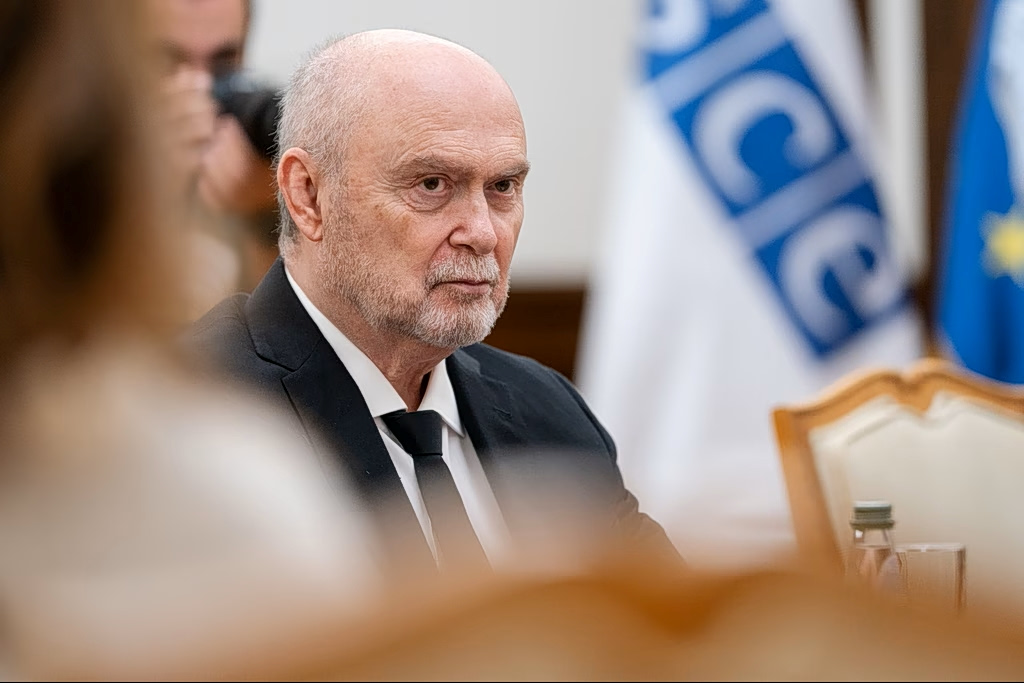
Sinirlioğlu, a former Turkish foreign minister and Turkey’s permanent representative to the UN from 2016 to 2023, currently serves as secretary-general of the Organization for Security and Co-operation in Europe (OSCE). He was nominated by Ankara on Nov. 1, following diplomatic contacts with the five permanent members of the Security Council and amid an effort to advance the succession process.
Guterres‘ second term expires on Dec. 31, with his successor due to take office on Jan. 1, 2027.
Questions over international law
During Friday’s General Assembly dialogue, Greece, Cyprus, the EU and Israel raised questions concerning Sinirlioğlu’s previous positions, focusing on his declared commitment to the UN Charter and international law.
Greece’s Permanent Representative to the UN, Aglaia Balta, focused on the 2019 Turkey-Libya maritime memorandum, which Ankara and the Tripoli-based Libyan authorities signed to delimit maritime jurisdiction areas in the eastern Mediterranean.
Recalling positions defended by Sinirlioğlu when he served as Turkey’s permanent representative to the UN, Balta highlighted what Athens considers a contradiction between his previous diplomatic actions and his stated commitment to international law.
She pointed out that Turkey and Libya have neither adjacent nor opposite coasts and therefore no common maritime boundaries. She also said the memorandum disregards Greek islands, including Crete and the Dodecanese, and their entitlement to generate maritime zones under the law of the sea, as reflected in the UN Convention on the Law of the Sea (UNCLOS).
Balta described the agreement as a “blatant refashioning of geography,” adding that its purported ratification by the Libyan House of Representatives could not confer legal effect on it.
She asked Sinirlioğlu how he reconciled his declared commitment to good faith, international law and the peaceful settlement of disputes with his previous defense of claims that, according to Athens, disregard geographical realities and violate international law.
In his response, Sinirlioğlu stressed that although he had been nominated by Turkey, he was not attending the dialogue as a representative of his country.
He recalled that Greece had supported his election as OSCE secretary-general through a joint Greek-Turkish candidacy, adding that he had repeatedly demonstrated his ability to serve as an impartial and independent international civil servant.
“I do have a national identity, of course, but I have also proven several times that I can be an impartial, independent international civil servant,” he said, without addressing the substance of the Turkey-Libya memorandum.
Cyprus issue and recognition of the Republic
Cyprus’ Permanent Representative to the UN, Maria Michael, put five questions to the Turkish candidate, focusing on the Republic of Cyprus, the buffer zone, the closed-off area of Varosha and human rights concerns in Turkey.
Referring to a letter dated May 19, 2022, in which Sinirlioğlu, writing in his national capacity, had argued that the Republic of Cyprus ceased to exist as a legal entity in 1963, Michael asked whether he now recognized its sovereignty, independence, territorial integrity and status as a UN member state.
She also asked him to condemn the August 2023 attacks against UN peacekeepers in the Pyla area, endorse the Security Council’s position on Varosha and commit to implementing relevant resolutions.
The remaining questions concerned allegations of widespread torture in Turkey, raised by the UN Committee against Torture in 2024, and restrictions on public demonstrations following the 2025 arrest of Istanbul Mayor Ekrem Imamoglu. Michael asked whether Sinirlioğlu supported independent investigations into the allegations and agreed with the UN human rights office’s assessment that blanket bans on demonstrations were unlawful.
The Turkish diplomat did not address the five questions individually. Instead, he said the UN Charter would guide his work if elected secretary-general, including on the Cyprus issue, while noting that changes in the international geopolitical environment inevitably affected international disputes.
He also cited former UN Secretary-General Dag Hammarskjöld, arguing that an individual could maintain personal convictions while nevertheless performing impartial duties with integrity.
EU and Israel raise further questions
The EU representative raised concerns over respect for international law and maritime security, asking how Sinirlioğlu would use the authority of the secretary-general’s office to promote compliance with UNCLOS and ensure accountability for violations.
The Turkish candidate responded that freedom and safety of navigation would be central priorities, describing attacks on commercial vessels, threats to civilian seafarers and unjustified restrictions on navigation as unacceptable, regardless of their origin or motivation. He did not explicitly refer to UNCLOS by name.
Israel’s Permanent Representative, Danny Danon, challenged Sinirlioğlu over his position on Hamas, recalling that in 2018, when he was Turkey’s permanent representative to the UN, he had urged the General Assembly to reject an amendment condemning the group and calling for an end to its violent activities.
Referring to the Oct. 7, 2023, attacks against Israel, Danon asked whether Sinirlioğlu, now seeking the UN’s top diplomatic post, could unequivocally condemn Hamas.
The Turkish candidate replied that he fully and unequivocally condemned terrorism in all its forms, adding that Hamas, like any other organization, should be held accountable if it violated international law.