
 Μake us preferred on Google
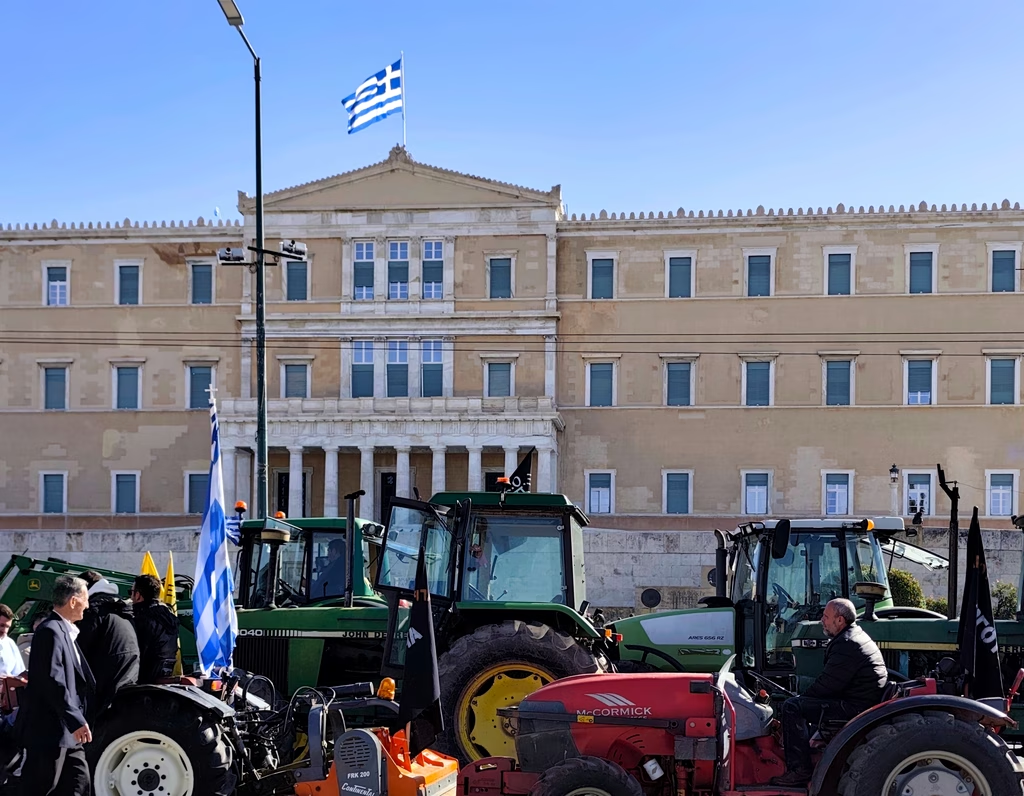
Prime Minister Kyriakos Mitsotakis’ government is facing growing discontent in Greece’s agricultural heartlands, where months of delayed subsidy payments have compounded the financial pressures on farmers and livestock breeders and eroded support for the governing New Democracy party.
The fallout from the OPEKEPE agricultural subsidy scandal, which exposed widespread irregularities in EU farm payments, has been aggravated by technical problems and bureaucratic delays following the transfer of payment responsibilities to Greece’s Independent Authority for Public Revenue (AADE). Farmers are also contending with rising production costs, persistent inflation and damage from natural disasters. An outbreak of sheep and goat pox has led to the culling of 500,000 animals, while foot-and-mouth disease has affected livestock on the island of Lesbos.
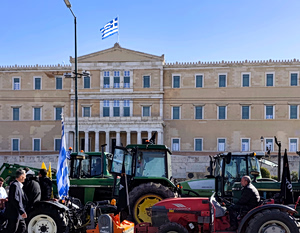
New Democracy lawmakers visiting their constituencies for the Oct. 28 national holiday were met with complaints and protests from farmers. The agricultural vote has traditionally been volatile, shaped to a considerable extent by government subsidies and agricultural policy.
From Electoral Stronghold to Political Liability
The governing party’s current troubles with farmers mark a sharp reversal of its earlier electoral gains among agricultural voters. According to combined exit poll data, New Democracy’s share of the vote among farmers, livestock breeders and fishermen rose from 32% in 2015 to 42% in 2019, reaching 48% in the 2023 general election.
The first warning came in the 2024 European Parliament elections, when the party’s share of the agricultural vote plunged to 28%. Then came the OPEKEPE scandal, involving widespread fraudulent claims and the illegal distribution of EU agricultural subsidies, which further damaged the party’s standing among farmers.
The government’s decision to transfer payment responsibilities to AADE was intended to overhaul the system. But the transition has been beset by technical failures, administrative bottlenecks and problems processing farmers’ annual declarations under the Integrated Administration and Control System, known as OSDE. As a result, many farmers have been left waiting for payments they depend on to finance their operations.
Subsidy Delays Leave Farmers Short of Cash for Planting
The government has pledged to pay advances on basic agricultural subsidies by Nov. 30, with a Nov. 10 deadline for submitting the necessary declarations. Previously, the bulk of these advance payments was made in October, coinciding with the start of the planting season, when farmers need money to purchase seeds, fertilizers and fuel.
So far, 260,114 OSDE declarations have been finalized, while another 167,920 remain provisional. Authorization requests submitted through the certified centers that assist farmers with their applications, have reached 485,000. Based on last year’s figures, an estimated 150,000 producers have yet to submit their declarations. Approximately 620,000 OSDE applications were filed in 2025. Meanwhile, advance payments totaling €7.8 million have been made to just 19,819 beneficiaries who submitted their applications by Sept. 25.
With the submission deadline approaching, the government is under pressure to resolve the outstanding problems as farmers threaten renewed road blockades. Farmers who make changes to their applications after Nov. 10 will not have those changes taken into account when their Nov. 30 advance payments are calculated, further complicating an already difficult situation.
Polls Show New Democracy Losing Ground in Rural Greece
The political consequences are already apparent in Thessaly, one of Greece’s most important agricultural regions.A recent Real Polls survey for regional broadcaster TRT showed New Democracy polling at 24.1% in Thessaly, rising to 27.3% when undecided voters are factored into the projected election result. The party won 41.7% of the vote in the region in the 2023 national election. A separate poll in Larissa, Thessaly’s largest regional unit, which has not been made public, suggests a similar decline in support for New Democracy. Its support in villages across the Larissa regional unit is even lower, falling below 20%. The party is also recording double-digit losses in northern Greece, where voters appear to be shifting toward parties to its right.
In Crete, a region prominently featured in the OPEKEPE scandal, livestock breeders have expressed anger and uncertainty over the future of their subsidies. A New Democracy lawmaker and former minister, describing the atmosphere on the island, acknowledged the political damage. “We’re taking a real beating,” he said.
Can New Democracy Win Back Farmers?
Maximos Charakopoulos, a New Democracy lawmaker for Larissa, former deputy agriculture minister and secretary-general of the party’s parliamentary group, acknowledged that the OPEKEPE subsidy scandal has damaged a longstanding political relationship. “Farmers have always been the backbone of New Democracy’s popular base,” he said. “That relationship of trust was shaken by the OPEKEPE scandal and the delays it caused in subsidy payments.”
Charakopoulos defended Mitsotakis’ decision to move responsibility for EU agricultural payments to AADE, arguing that the change could establish a more transparent system free from the shadows and suspicions surrounding its predecessor. For now, however, he acknowledged that the government is bearing the political cost of introducing the new arrangements while payments are still being processed. “We are paying the price for the problems caused by the transition to the new system while it is still being rolled out,” he said.
Charakopoulos believes the government must now turn its attention to the longer-term future of rural Greece. Mitsotakis has pledged to make the revitalization of the agricultural sector one of New Democracy’s three priorities if the party wins another mandate. But Charakopoulos said those commitments must soon be translated into specific proposals. He pointed to the findings of a recently completed cross-party parliamentary committee on agriculture as a starting point for the next steps. The need to attract younger people into farming is particularly pressing, he argued, given the aging population working in the sector. “Personally, I believe the biggest challenge is renewing our aging farming population through an ambitious program for young farmers,” Charakopoulos said. “And this is a challenge we must overcome.”
He recently accompanied a delegation of farmers from Larissa to a meeting with Agriculture Minister Margaritis Schinas, where they raised the continuing difficulties of rebuilding farms devastated by Storm Daniel three years ago. At the meeting, an agreement was reached to extend by six months the deadline for restoring plant production capacity destroyed by the disaster.