The world’s greatest repository of Greek antiquities to shut down for five years at least for expansion, restructuring museological approach
Easter often revives debate about animal rights—yet sadly, not all animals are included
Nationwide increases in cases are being recorded for several diseases included in the Ministry of Health’s “lists” of rare conditions. How is life with a rare disease, how is diagnosis made, and what role does genetics play?
As Hungary heads to the polls, Europe holds its breath. Paolo Gentiloni, former Italian Prime Minister and European Commissioner, breaks down why the import of this “small” country for the EU belies its small size.
The increase in water reserves does not remove the risk of water shortage in Attica, as safety levels remain below those of previous years. The need to implement critical interventions to secure the water supply remains urgent.
The digitization of the Diplomatic and Historical Archive of the Ministry of Foreign Affairs opens new horizons. Tens of thousands of files relating to the dictatorship period and the 1955–1960 five-year span are being catalogued. These are expected to shed light on unknown aspects of the Cyprus issue.
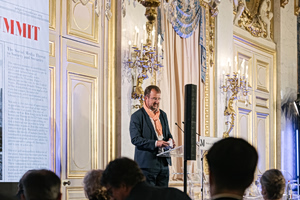
Florian Knauss, director of the Glyptothek in Munich—a museum often described as an “ark” of classical and Roman antiquity—speaks about the ever-living, constantly evolving story of ancient artifacts, as well as the modern role of museums.
An Orthodox celebration on the Isar River brings Greeks and Germans together, revealing how shared rituals, dialogue, and tradition foster connection, identity, and mutual understanding far from home.
A survey of Greek high school students in Munich reveals a generation torn between emotional ties to Greece and the practical realities of building a life abroad, as they navigate identity, opportunity, and belonging.
The poem “Little Souls Shine Forever” earned the school an Honorable Mention in the Gabriel Pentzikis Competition 2025.
The Greek Lyceum of Munich “Konstantinos Carathéodory” is a living organism that preserves strong ties with the motherland and shapes the next generation of the Greek diaspora.
He was one of the most important figures in mathematics in the 20th century. With roots in the Hellenism of the Ottoman Empire and an academic path that led him to Europe’s leading universities, Konstantinos Carathéodory devoted his life to science, leaving a profound mark both on global mathematical thought and on the intellectual history of Hellenism.
Greek history and culture have left a vivid mark on the Bavarian capital. From the imposing Königsplatz to the Orthodox Church of the Transfiguration of the Saviour, the city reveals a deep and enduring relationship with Greece—rooted largely in the Ottoman empire.
Maria Toursidou delivers a haunting short story about what so often happens behind closed doors. Her work was awarded First Prize at the Marilena Laskaridi 2024 Literary Competition for Greek high schools abroad.
An initiative of TO BHMA, under the auspices of the General Secretariat for Greeks Abroad and Public Diplomacy, concerning schools of the Greek diaspora in every corner of the world.
In this revealing interview with To BHMA International Edition, Chief White House Correspondent for the New York Times Peter Baker offers a candid look at how the Trump presidency has reshaped the relationship between power and the press.
An independent group of specialists reviewed newly released and pre-existing evidence of the Nirvana singer's suicide. Their findings call into question the legitimacy of the official police investigation.
In a home in Munich filled with images and stories, Eleni Tsakmaki unfolds her life: from childhood loss and exile to writing, which became the chronicle of an entire generation of people who sought survival and found a second homeland.
The poem “Lost on the Railway Tracks”, inspired by the Tempi tragedy, captures the innocence and pain of the victims. It was set to music and performed by female students of the Greek Lyceum at a protest gathering in Munich, showing how poetry can become the voice of the youth.
Educator and researcher Vassilia Triarchi-Hermann has dedicated her life and work to the education of children of the Greek diaspora in Germany. She speaks about her career and her vision for Greek-language education.