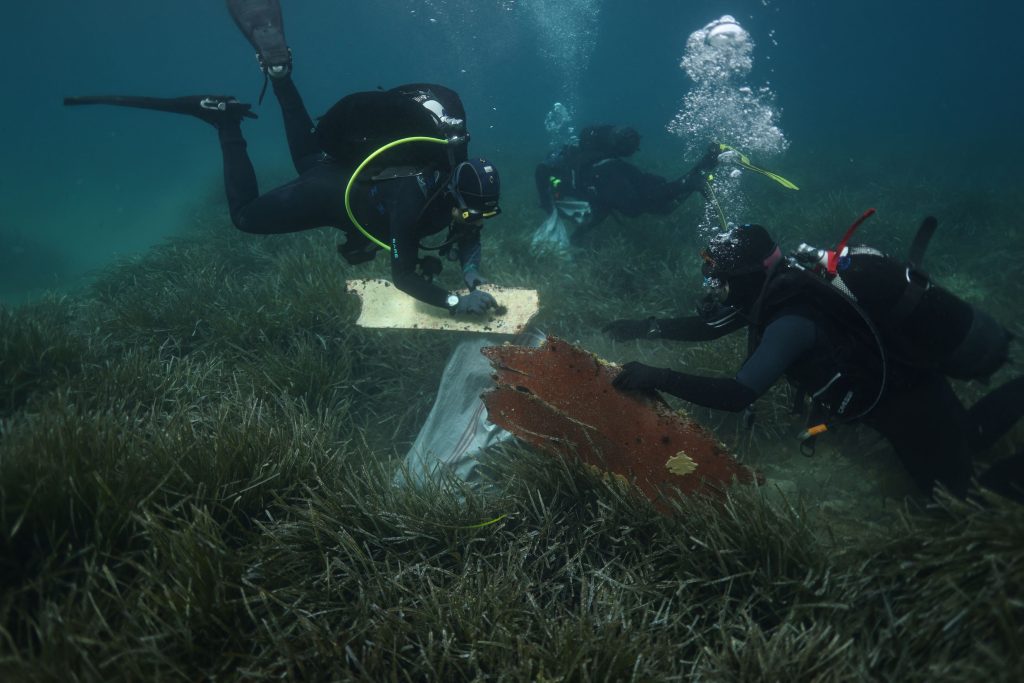
For as long as she can remember, Dr. Maria Salomidi has lived with the sea. “My father used to go spearfishing. We would visit areas with small Posidonia meadows. Where you saw only sand, suddenly a lush green forest would rise before you, and then you knew you might encounter anything—from tiny fish and crabs to sea turtles. We used to see pen shells too, which have now disappeared, of course. But you always knew you would see something beautiful.”
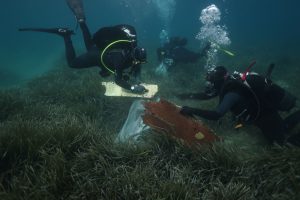
For the past 25 years, Ms. Salomidi’s relationship with the seabed has also had a scientific dimension, as she works as a researcher and scientific diver at the Institute of Oceanography of the Hellenic Centre for Marine Research (HCMR).
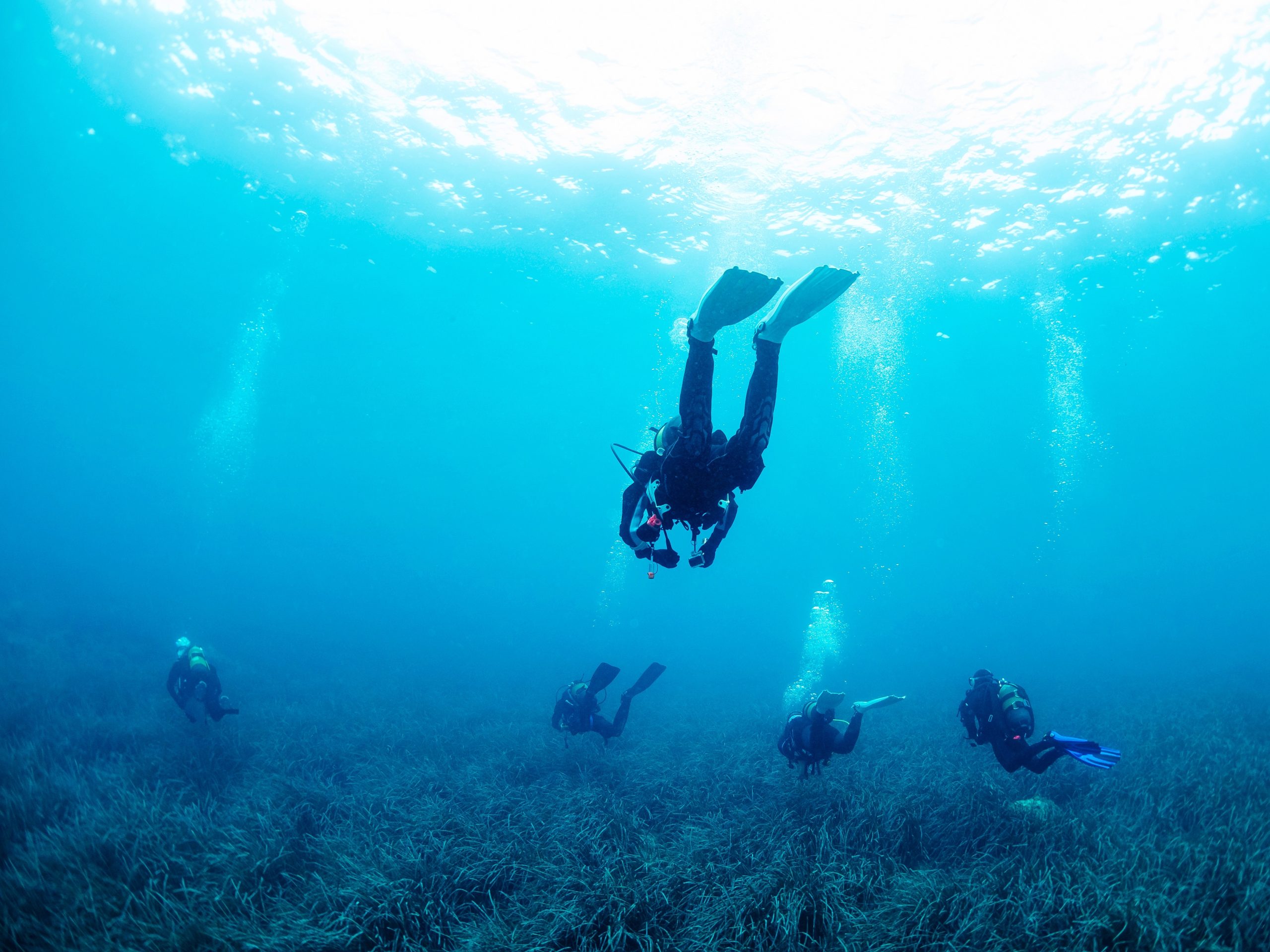
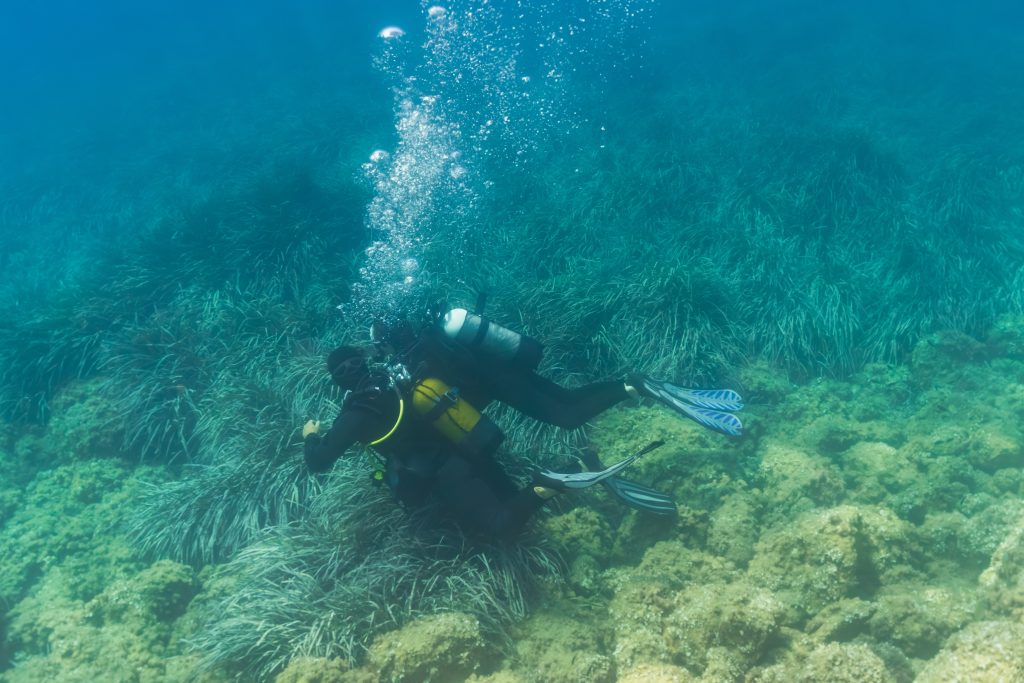
Posidonia oceanica is not a “seaweed” but a marine flowering plant, an angiosperm endemic to the Mediterranean. In Greece, it is the dominant species, forming meadows that stretch from the coastline down to about 25–30 meters deep. It calms the waters, keeps the sand in place, and serves as a “nursery” for countless marine species.
The most recent mapping, published in 2022 in the scientific journal Botanica Marina, showed that seagrass meadows are found along about 70% of the Greek coastline, covering a total area exceeding 2,749 square kilometers, with Posidonia being by far the most extensive. It is mainly absent near river mouths or in closed, turbid bays. Wherever we “see grass,” the ecosystem offers us natural coastal protection from erosion, cleaner water, food, and shelter for marine life—hence it is considered both a priority habitat and a key indicator of coastal health.
Threats from Climate and Human Activity
The central responsibility for safeguarding and protecting the marine meadows lies with the Ministry of Environment and Energy, as Greece must comply with its relevant European obligations.
As Ms. Salomidi explains to To Vima, Posidonia is sensitive to changes in salinity and water temperature, which are linked to the climate crisis. However, the problem is further aggravated by human recklessness and ignorance. “Anchors dropped everywhere without control, fish farms established directly over meadows, bulldozers loading sand onto trucks and dumping it into landfills,” she summarizes, emphasizing that the washed-up Posidonia leaves we mistakenly see as “dirt” on beaches are in fact the natural shield of our coasts.
Filling this gap in knowledge and action is precisely the aim of the ‘Hellenic Alliance for the Marine Meadows’, a five-year collaborative project announced two weeks ago in Athens. Its ambition is to “make the invisible visible,” uniting island communities, scientists, institutions, and citizens around the protection of Posidonia and all valuable marine plants found along Greece’s coastal zone.
The program is designed and coordinated by the Cyclades Preservation Fund, together with HCMR and the Hellenic Society for the Protection of Nature, in collaboration with the Ionian & Argosaronic Environment Foundations and Aenaos Thalassa, with funding from the American foundation Seacology.
Public Awareness and Mapping of Needs
“We are not just an alliance but a community of active citizens,” said Dr. Ioannis Keramidas, the scientific coordinator of the initiative, at the related press conference.
In practice, this means awareness campaigns, educational programs in schools, citizen science, “lighthouse islands,” and an open Seagrass Forum that maps needs, pressures, and solutions—from ecological moorings to simple rules for managing washed-up Posidonia leaves on beaches.
To Vima traveled with members of the Alliance to Paros, one of the islands participating in the initiative. The members met with local authorities and residents of the island as part of the event “One Day Park,” held on October 19 at the Ai Giannis Detis Cultural and Environmental Park.
They also had the opportunity to visit Molos, the long sandy bay on the island’s eastern coast, home to the protected Natura 2000 wetland, rich in wild birdlife, cedar trees, and sand dunes. There, they were guided by Elisavet Scholeiadi and her husband Michalis Kyriazanos, president of the Molos-Marmara Paros Cultural Association “Agios Nikolaos.”
From Bulldozers to Discovery
For the past 27 years, the association has defended the environmental and cultural values of Molos, promoting rational, low-impact development and fighting against illegal practices and ecological burdens that threaten irreparable damage. Among other achievements, it prevented the construction of a commercial port within Molos’s protected zone and later succeeded in abolishing an open waste disposal site near the cape with ancient and Byzantine ruins.
Since 2000, when they settled permanently in the seaside settlement of Molos, the mountain, wetland, and dune-lined beach have become the couple’s daily landscape—and the reason they became active citizens. “It was in September 2015 when the bulldozers entered the beach, collecting the seaweed and taking with it tons of sand. I went mad, I stood in front of them, and they started threatening to run me over,” Ms. Scholeiadi recounts to To Vima.
After she publicized the illegal sand extraction in the local press and gathered 362 residents’ signatures, “they got scared and never came back.”
Born in Alexandria, Egypt, of Chian descent, the pharmacist, with a love for botany and a winter swimmer, speaks with enthusiasm about the Posidonia of Molos. “It was around this time two years ago, when Michalis and I were swimming out there past the chapel of Agios Nikolaos, that we saw the Posidonia with our masks,” says Ms. Scholeiadi.
“We were so excited that we grabbed strings and started measuring the meadow,” adds Mr. Kyriazanos, an engineer and retired naval officer originally from Paros.
A Misunderstood Beauty
“There is a completely distorted perception of what a beautiful and clean beach looks like,” notes Ms. Salomidi. “Advertisements have ‘planted’ in our minds images of Caribbean beaches, and we’ve forgotten what a natural Mediterranean beach looks like—one that has Posidonia leaves. These are not garbage but a perfect, antioxidant mat on which I can lay my towel. These are the beaches we need far more than we realize. If we overcome our misconceptions, everything else will become easier,” she concludes.